

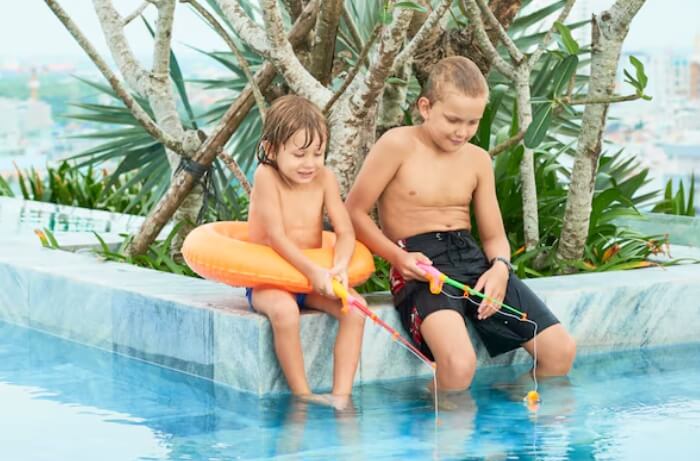
Around the end of November, a certain type of restlessness begins to creep into a household. The light goes out early. Bicycles are parked behind the couch, footballs vanish. Kids who were playing in the garden a few weeks ago start circling the TV instead, and parents start the well-known negotiation about screen time that never ends well. Swimming lessons begin to resemble a quiet survival tactic rather than a pastime during that particular time of year.
When you enter a community pool on a Tuesday night in January, the scene speaks for itself. Off the water, steam rises. A teacher is patiently repeating the same lesson for the third time to a row of young swimmers in bright caps lining the edge. Parents watch from the gallery, half-scrolling through their phones, half-paying attention to a child who, six months ago, wouldn’t put their face in the water but is now managing to glide across a lane.
It’s difficult to ignore how commonplace this appears and how remarkable the underlying accomplishment is. Eighty-four percent of parents say their child’s mood improves after a lesson, according to Swim England’s recent #LoveSwimming research, which has been adopted by councils throughout the United Kingdom.
| Information | Details |
|---|---|
| Topic | Year-round swimming lessons for children |
| Primary Source Cited | Swim England #LoveSwimming Campaign Research |
| Key Statistic | 84% of parents report mood improvement after lessons |
| Concentration Boost Reported By | Nearly 8 in 10 parents |
| Recommended Starting Age | As early as parent-and-child classes (infancy onward) |
| Skills Developed | Water safety, fitness, confidence, focus, social skills |
| Framework Reference | Swim England Learn to Swim Pathway |
Concentration and attention span improvements were reported by nearly eight out of ten. Anyone who has witnessed their child stomp into a recreation center and leave thirty minutes later. Chatty and loose-limbed. Can understand why parents kept checking those boxes. Even though the numbers seem high and almost too tidy.
There’s something that occurs in the water that doesn’t quite occur elsewhere. A portion of it is simply biological. One of the few activities that works the entire body without straining the joints is swimming, which is more important for developing children than most people realize.
Additionally, it burns off the kind of energy that, if left unused, often manifests around bedtime as mysterious toothbrush disputes. What takes place in the brain is more fascinating. According to studies cited by organizations like Sea Otter Swim Lessons and other aquatic researchers. Children who regularly swim exhibit stronger cognitive markers than non-swimmers. Such as improved pattern recognition. Sharper attention. And. In certain situations. Earlier language milestones.
In studies like this, cause and effect become complicated, and it’s still unclear how much is the structured weekly routine and how much is the swimming itself. Most likely both. Momentum is the main justification for continuing lessons throughout the winter as opposed to treating them as a summer activity.
Swim instructors will tell you sometimes with a sigh that a season of improvement can be undone in just three months. Skills are not neatly stored. The rebuild takes longer than the breakdown, and a child who could float on their back in August frequently can’t quite recall how to do so in November. Regarding scales, music instructors say the same thing. The body forgets things more quickly than the mind. Additionally, there is the safety component, which is important but uncomfortable to focus on.
In the UK, drowning is still one of the most common causes of unintentional death for children. The sad thing about drowning prevention is how unglamorous it is: regular lessons, gradually gaining skills, and having a child who knows what to do if they fall. On the way to the pool, parents who keep their kids in school during January and February typically don’t consider that.
They’re wondering if they still remember the goggles. Underneath, however, the protection compounds operate silently. Former Olympic diver Leon Taylor, who won silver in Athens, has talked openly about his five-year-old son Ziggy’s lessons, and what comes through in interviews isn’t the technical pride of an athlete-parent.
The boy seems to be calmed by the water, and he carries that serenity into other aspects of his day. When other parents hear that, they nod. It’s difficult to put into words, but swimming seems to provide kids with a reset button that screens and organized sports seldom can. Schools and parks are unable to address a problem that indoor lessons can in the winter. The pool maintains its warmth. The weather has no bearing on the schedule.
By 10 a.m., a child who might otherwise spend Saturday morning under a duvet is breathing heavily and smiling. There’s also a small social component. Such as the same class of students every week. The same teacher recalling names. And a low-stakes friendship that develops slowly. Just like friendships did before everyone went online.
The swimming-as-cure-all narrative gets a little thick in some marketing materials, and none of this is a magic bullet. Some kids actually dislike the water, and making them do so has the opposite effect of what parents want. Lessons are expensive, and access is uneven throughout the nation, which Swim England has identified as a persistent issue.
It is now more difficult to argue against the idea of keeping children in the pool during the dark months for families who can afford it. It’s a small aasily overlooked scene to watch a child in February. Hair still damp under a beanie. Destroying a snack in the parking lot of a recreation center while chatting nonstop about what they did in the deep end. There’s a sense that something beneficial is being developed there, week by week, but it won’t fully manifest for years.
i) https://www.wiltshire.gov.uk/article/14822/New-research-highlights-the-powerful-benefits-of-swimming-for-children-s-wellbeing
ii) https://www.everyoneactive.com/content-hub/swimminglessons/benefits-of-everyone-active-swimming-lessons/
iii) https://www.seaotterswim.com/the-benefits-of-staying-in-lessons-year-round
iv) https://bewellwigan.org/latest/6-days-swimming-lessons-help-your-child-thrive/
v) https://weaquatics.com/blog/indoor-swim-lessons-keep-kids-active-all-winter-long/