

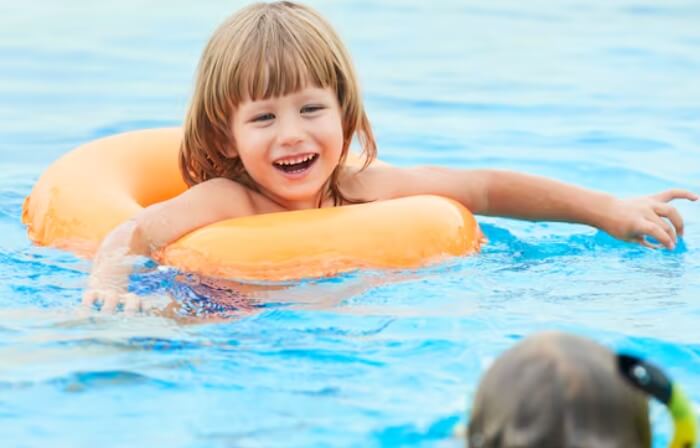
On a weekday afternoon silence descends upon a public pool there are whistles, the sporadic shriek, and the sound of water slapping the tiled edge, but it’s not quite silence. Lockers contain phones. Instead of scrolling, parents are watching. For a brief period of time, children are engaged in a single activity in a single location. Swimming has managed to endure in a decade where nearly every kid’s activity has been gamified, app-ified, or hollowed out by screens. Additionally, parents are observing in a way that is difficult to notice until you start asking around.
The figures contribute to the explanation. According to 96% of parents of preschoolers, swimming is what makes their child happy, according to a Swim England study the first of its kind to concentrate on preschoolers. Nine out of ten claimed it improved coordination and movement. After spending time in the water, four out of five parents reported that their children slept better. These are the kinds of figures that would be considered marketing fiction in any other category. Here, they monitored the anecdotal reports from fathers and mothers that something about water simply works on small humans in a way that other activities don’t.
| Field | Details |
|---|---|
| Topic | Swimming as a reliable activity for children |
| Primary Source | Swim England — national governing body for swimming in England |
| Founded | 1869 (as the Amateur Swimming Association) |
| Headquarters | Loughborough, United Kingdom |
| Chief Executive | Jane Nickerson |
| Key Campaign Referenced | #LoveSwimming |
| Notable Finding | Regular swimming can reduce risk of death by 28% |
| Economic Impact Cited | Saves UK health and social care system £357M+ annually |
| Parent Approval (pre-school) | 96% say swimming makes their child happy |
It’s possible that the appeal lies more in what swimming isn’t than in swimming itself. It’s not a screen. The parent does not have to wait in a carpeted lobby for this class. It’s not a sport that needs a team chat group and $300 worth of equipment. The world gets smaller for twenty-five minutes when a parent and child enter. The best part of her week, according to Charlotte Power-Mcleod, a full-time working mother cited in the study, was spending those minutes alone with her son without a ringing phone. Speaking with parents gives me the impression that this is becoming a more scarce resource. Not the instruction. the complete focus.
The longer arc is supported by earlier research. Regular swimming can lower the risk of death by 28%, according to a previous study by Swim England. This is a startling statistic, but it should be interpreted cautiously because population-level studies are inherently flawed. The overall pattern remains constant. Swimmers typically have longer lifespans. Older swimmers maintain their sharpness. Children who attend classes seem to acquire social, cognitive, and physical skills more quickly than those who do not. For reasons that are still unclear, the water appears to be exceptionally abundant.
On a Saturday morning, you can witness the miniature version of all of this in action by strolling through a council recreation center. A two-size-too-large hooded towel is wrapped around a shivering four-year-old by a father. An instructor uses her hands to demonstrate something while pointing at a kickboard. A grandmother sitting in a plastic chair, reading and looking up every few minutes. It doesn’t appear to be transformative. Maybe that’s the point. Swimming has the drawback of accumulating. The child who jumps off the edge in August but couldn’t bear to put her face in the water in March is one example of how the benefits manifest later in sleep and confidence.
Teachers have also begun to say this aloud. According to research circulating among UK councils, including Wiltshire, 84% of parents report that their child’s mood improves after a lesson, and nearly 80% report improved focus at school. Former Olympic diver Leon Taylor has talked about seeing his five-year-old become more composed and self-assured just by going on a regular basis. Although it’s easy to be dubious of celebrity endorsements, the underlying assertion isn’t outrageous. It’s simple, even archaic: a child who works out in the water sleeps, eats, and focuses better. For sixty years, grandparents have said this.
It’s interesting to note how the cultural discourse surrounding children’s activities has changed to accommodate this. Coding camps and competitive activities were the prestige extracurriculars a few years ago. It was implicitly assumed that a child’s hours needed to be optimized for a future resume. The atmosphere has cooled. Nowadays, parents appear more worn out, more skeptical of the optimization pitch, and more willing to acknowledge that their true desire is for their child to be content, exhausted, and reasonably safe in the vicinity of a body of water. Without putting on a big show, swimming provides all three.
Whether this will result in the kind of increase in participation that the sport’s governing bodies are advocating for is still up for debate. Not every family has access to an inexpensive lane, numbers have decreased in some areas, and pool closures have caused pain. It’s difficult not to suspect that swimming has subtly become the activity that parents trust when they no longer trust much else, given the rhythm of a typical lesson, the lining up, the splashing, and the tiny victory of a head briefly submerged. Not because it’s brand-new. Since it isn’t.
i) https://www.sportengland.org/news/study-reveals-huge-health-benefits-of-swimming-regularly
ii) https://www.wiltshire.gov.uk/article/14822/New-research-highlights-the-powerful-benefits-of-swimming-for-children-s-wellbeing
iii) https://www.ripplekids.co.uk/post/learning-to-swim-vital-skill
iv) https://www.waterbabies.co.uk/swimming-in-early-childhood