

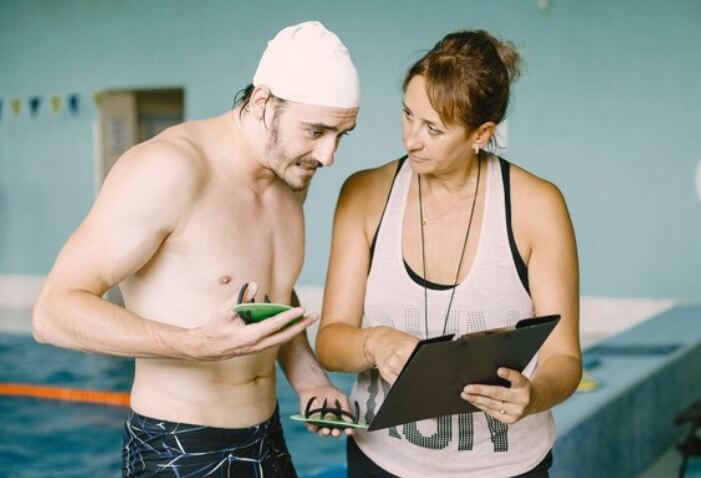
You can learn something from the parking lot of any local recreation center in Manchester or Bristol that the official statistics took longer to catch up with. Teens in hoodies waiting their turn, parents juggling wet towels, and mothers holding armbands. Oddly enough, a significant portion of the credit goes to a phone screen, and the pools are busier than they have been in years. Teachers believe that something changed around 2023, and it hasn’t really slowed down since.
You can understand their meaning by using the appropriate algorithm to browse TikTok for ten minutes. After avoiding the deep end for twenty years, a woman in her thirties posted her first proper front crawl. While her mother narrates the milestone, a toddler in Sheffield blows bubbles for the camera. In Cumbria, wild swimmers record sunrise dives that resemble movies rather than physical activity. People are being affected by the limitless content in ways that traditional advertising was never able to. swim England has carefully noted that 85% of swim schools have seen an increase in mothers’ demand for weekend lessons, and when asked, the majority of these mothers cite something they saw online.
The trend might have occurred in any case. Swimming is one of those skills you either have or you don’t, so it sat awkwardly on many people’s mental to-do lists as the pandemic caused many people to reevaluate what they could and couldn’t do. Social media provided a public framework for that private resolution. It is less embarrassing to watch a stranger overcome their fear of submerging their face in the water, as told in voiceover with a self-deprecating laugh. It also gives it a sense of doability, which is half the fight.
| Information | Details |
|---|---|
| Topic | Social Media’s Influence on UK Swimming Lesson Demand |
| Key Body | Swim England (National Governing Body) |
| Founded | 1869 (as Amateur Swimming Association) |
| Headquarters | Loughborough, Leicestershire, UK |
| Adults Swimming Regularly (UK) | Approximately 4.7 million (twice monthly or more) |
| Reported Teacher Shortfall | Significant nationwide shortage; many schools turning families away |
| Adults Who Find Swimming Intimidating | Over 50%, rising to nearly 60% among non-swimmers |
| Demographic Driving Demand | Mothers, Gen Z adults, parents of pre-schoolers |
| Common Certifications | STA, RLSS UK |
The figures supporting the demand are a little unsettling. Even though most parents want their children to learn to swim, a recent study conducted in London revealed that very few children there are proficient swimmers. Drowning is still the leading cause of unintentional death among children in the UK. The curriculum requirement is clearly stated in Swim England’s school swimming guidelines, but many pools have closed, many programs have been discontinued, and parents are frantically trying to fill the void on their own. That gap wasn’t caused by Instagram or TikTok. They simply made the gap apparent and transformed the problem-solving process into a performance.
It’s difficult to overlook the irony in all of this. Ironically, some of the same campaigns that worry about screen time preventing adults from swimming are also being shared on social media. The message is posted to a feed that is meant to force you to scroll, so limit how much you scroll. The outcome will determine whether or not that contradiction is significant, and at the moment, it appears that more people are scheduling lessons even if they do so after watching a reel at midnight.
The change in attendance has been observed by private instructors. In the past, adult learners were the exception, booked in between children’s slots with a hint of sheepishness. These days, they account for a sizable portion of inquiries at many independent schools. Some of these adults arrive with a clear narrative: they decided that their own embarrassment wasn’t a reason to stay dry after seeing someone similar to them online who was learning late. Others arrive because their feed has been subtly promoting the concept for several months. In any case, the screen-to-pool funnel has gotten shorter.
A significant portion of the surge appears to be being driven by mothers in particular. In locations where there used to be open slots, preschool and infant swimming groups are reporting waiting lists. A portion of this is catch-up after the pandemic, where families fulfill postponed plans. A portion of it stems from the online visibility of baby swim content, which has transformed what was once a specialized activity into something that is almost a default. Depending on the family, that may be either healthy pressure or healthy enthusiasm.
The situation is made more difficult by the teacher shortage. Families are being turned away from pools all over the nation, and obtaining the necessary credentials through organizations like the STA and RLSS UK takes time. A viral video can cause demand to soar, but supply takes years. People in the industry have quietly expressed concern that the social media boom may pass before the workforce catches up, leaving pools with irate waitlists and no clear way forward.
Observing this develop feels distinct from earlier fitness fads. It’s not really a fad to swim. You either pick it up or you don’t, and once you do, it sticks with you. The lessons themselves, the chlorine odor, the cold tiles, and the silent panic of the deep end are all stubbornly analogue, even though the phones are doing the marketing. It might be sticking because of that. Swimming compels people to take action in a culture that is overflowing with content about doing things. The algorithm appears content to continue pushing them in the direction of the water, at least for the time being.
i) https://www.swimnow.co.uk/learning-to-swim/why-private-swimming-lessons-are-trending-in-the-uk-for-2024/
ii) https://www.sportengland.org/research-and-data/research/popular-activities/swimming
iii) https://www.swimming.org/schools/parents-and-pupils
iv) https://www.swimming.org/justswim/love-swimming-adult-learn-to-swim/