

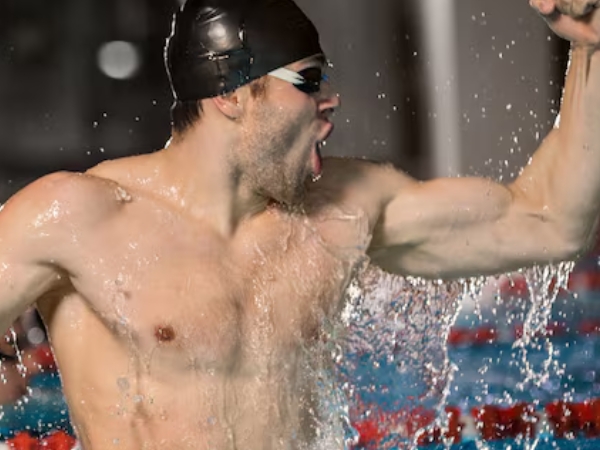
After a strenuous swim, you may find yourself standing by the poolside with your shoulders burning and your lungs catching up, wondering if you’ve been underestimating the physical effects of water. Most people simply classify swimming as “cardio” and move on. That’s probably undervaluing it.
The density of water is about 800 times that of air. Every kick, stroke hip turn is an attempt to push against something that actually pushes back. In contrast to a leisurely jog, that isn’t cardio.
Working through your shoulders, lats, core glutes all at once for the entire length of the pool is resistance. Because swimming doesn’t look like a bodybuilder’s Instagram, it’s possible that swimsuits aren’t given enough credit for the amount of functional strength required for the sport. They appear more slender. more athletic. more difficult to classify.
To be honest, swimming and going to the gym are two different ways of achieving the same objective. A barbell program aims to increase the size of stressed, broken rebuilt muscle fibers.
Muscular endurance, the deep, wiry strength that allows one to move effectively through space for extended periods of time without folding, is what swimming strives for. Neither is incorrect. Both parties become frustrated when they are confused because they are simply different tools.
The full-body workout that swimming actually provides in a single session is unmatched by most gym routines in terms of sheer simultaneity. With each arm pull during the front crawl, the pectorals, biceps rotator cuff muscles are worked while the legs flutter and the core remains braced.
Most recreational swimsuits steer clear of the punishing butterfly stroke, which causes the upper body to perform something akin to a loaded push-pull while hammering the glutes and lower back.
Through that frog-kick extension, breaststroke subtly destroys the inner thighs and quadriceps despite its seemingly gentle appearance. Conversely, the backstroke is subtly one of the better exercises for postural muscles that counteract the forward-hunched posture that most people adopt while working at a desk.
The low-impact nature of swimming is sometimes cited as a comfort, as though it’s only useful for those who can’t handle “real” training. That framing is inadequate. Swimsuits can train hard and frequently maintain that training well into middle age without the wear that comes with high-impact sports because there is no joint compression.
Progressive overload is where the pool truly fails. It is more difficult to control the fundamental idea of muscle growth in water than it is in a gym with numbered plates.
Drag tools include drag suits that slow the entire body through the water, kickboards that isolate the legs and make them work without the body’s momentum hand paddles that increase surface resistance with each pull.
Additionally beneficial are intervals, which replace lengthy, slow laps with quick, forceful sprints that activate fast-twitch muscle fibers in a manner that easy swimming does not. Despite all of that, a structured strength program can achieve greater hypertrophy than swimming alone.
Swimming undoubtedly develops real, functional, visible muscle for someone who must choose between the two due to time constraints or access. Because it is constructed differently, it is unrealistic to expect the pool to function similarly to a squat rack.
Treating them as complementary is the stronger play, which is what top athletes in the majority of sports have discovered. Recuperation and conditioning in the pool, as well as strength days in the gym, reinforce each other’s strengths.
Not only in the water the hips, shoulders core all move with a loose, stable relaxed quality that permeates everything else. That could be the pool’s true justification. It adds to the overall picture of being strong, not if it takes the place of the gym.
i) https://www.brioleisure.org/blog/does-swimming-build-muscle
ii) https://www.livewelldorset.co.uk/faq/get-active/does-swimming-build-muscle/