

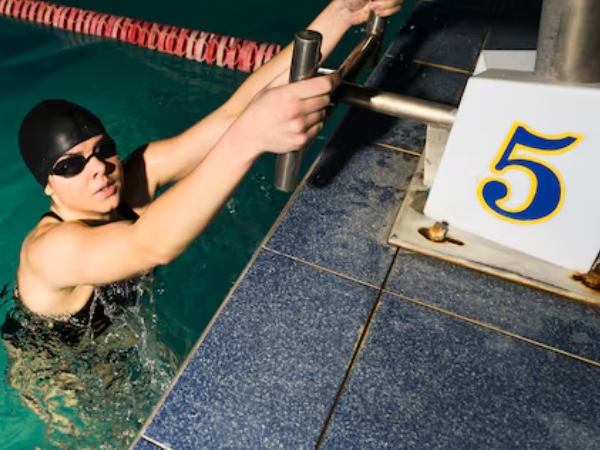
You begin to realize the true cost of competitive swimming around 5:15 in the morning, when the pool deck is still damp from the previous session and the overhead lights buzz softly against the darkness in a few hours while asleep in years. The 50-second race is seen by the majority of casual swimsuits. The 20-hour workweek that went into it is what they fail to notice. Week after week for many years.
The honest response to the question of how many hours a week competitive swimsuits train is: a lot more than most people would think a lot more than most sports demand. When you account for everything pool time, dryland sessions in the gym, mobility and recovery exercises, mental preparation video review sessions where coaches analyze a swimmer’s elbow angle or underwater kick elite swimsuits usually log between 45 and 60 hours of training per week.
When it comes to raw pool time alone, that’s typically 10 to 12 sessions per week, frequently divided into morning and afternoon sessions on the same day, covering 50 to 80 kilometers in the water over the course of seven days. The swimmer’s event, the training cycle the proximity of a major competition all affect the numbers, but this is the challenging environment in which the majority of elite programs operate.
Though maybe not as much as you would anticipate, the volume is lower for younger or developing swimsuits. Six days a week, sometimes twice a week, serious age-group swimsuits train to meet national qualifying standards. Every week, they travel 20 to 35 kilometers.
It’s important to note that many people give up during this stage, not because they have lost their talent but rather because it is extremely difficult to maintain a nearly professional schedule during adolescence. At 14, missing birthday celebrations to attend a 5 a.m. practice is one thing. Week after week, it’s a completely different matter.
The double-session schedule that most competitive programs center their week around is what makes swimming training demanding. Swimming coaches have long maintained and data generally supports that two shorter, concentrated sessions result in better adaptation than one long one, in contrast to sports where athletes train once a day.
In order to build the engine, the morning session usually focuses on aerobic base and technique. The afternoon session focuses on high-intensity sets that mimic real competition, such as speed, turns race-pace work. The body is meant to recuperate, eat sleep in between. In reality, for many swimsuits, the interim consists mostly of a protein-rich meal and a nap.
Even some sports fans who believe swimming, like most endurance sports, is just about putting in long hours might be surprised by the sheer volume. It’s that, but it’s also very particular. Technical drills with paddles and pull buoys, aerobic sets that can cover 4,000 meters without stopping, sprint sets that raise heart rate to almost maximum strength.
Land based work that emphasizes the explosive upper-body and core power that actually propels a swimmer through the water are all part of the training regimen. This isn’t really interchangeable. A gap that appears in competition is caused by missing one kind of session.
When you watch elite programs train, the weekly schedule seems almost architectural. Every session has a goal. Every recovery window is taken into consideration. Since sleep is where the body actually adapts to that kind of volume, getting 8 to 10 hours of sleep is treated with the same seriousness as working out. Without it, training leads to fatigue instead of fitness.
It becomes commonplace for the swimsuits who reside within this building. Not simple at all. The hours are just that hours. How much of those hours involve discomfort that isn’t dramatic enough to be a story but builds up into something significant over a career becomes more difficult to explain to people outside the sport.
Before six in the morning, put water in your ears. Chlorine. the particular low-grade shoulder and lat pain that persists after a strenuous training session. It’s a type of grinding that serves as the foundation for the television broadcast even though it doesn’t make it.
Depending on how you feel about cold water and early mornings, that level of commitment may sound extraordinary or just like the cost of taking something seriously. Even years later, the majority of swimsuits who achieve success in their sport don’t seem to be particularly interested in giving up their chosen lifestyle.
i) https://rocketswim.com/how-to-train-like-a-competitive-swimmer-guide/
ii) https://swimmirror.com/blog/how-to-train-like-an-olympic-swimmer-a-pro-training-schedule-guide/