

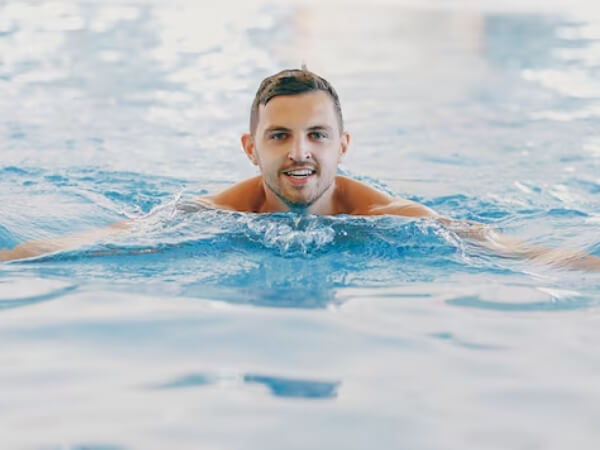
Just before you wade in, your brain begins to bargain with your feet because the water appears to be perfectly still. Every swimmer in cold water is aware of this. That pause. That moment when your irrational side moves forward despite your rational side running the numbers. That moment is crucial for novices. It begins long before you get to the water’s edge if you want to get past it safely, comfortably with some dignity.
Over the past few years, cold water swimming has quietly but noticeably increased. What was once thought to be the exclusive domain of wild swimsuits wearing thermal robes and eccentric dawn risers has become much more accessible and populated. Every weekend, new people visit nearby rivers, lakes coastal inlets. It’s difficult to ignore the shift in the attendees.
Gear is almost always the first question for someone who is just getting started it makes sense. In addition to making you uncomfortable, the incorrect equipment can actually make a quick swim hazardous. The extremities fingers, toes the back of the neck are the first to show signs of discomfort due to water temperature, which affects the body more quickly than most people realize.
For people who aren’t ready to commit to a full wetsuit, neoprene gloves and socks have emerged as a sensible compromise. They enable a genuine sense of the water without the full exposure, which can easily become uncomfortable. Even in relatively mild conditions, some swimsuits swear by them.
A wetsuit dramatically alters the situation if the water is truly cold. The basic idea is fairly straightforward: your body warms the thin layer of water that the suit traps against your skin. Suits that are 2 mm thinner allow for more mobility and are appropriate for slightly warmer weather.
Suits with a thickness of 3.5 mm or more are designed to withstand extreme cold and offer significant insulation throughout the core. It’s important to note that a wetsuit that is too baggy defeats the majority of its intended purpose. The thermal benefit is mostly lost when water flows in and out. More than most novices realize, it’s important to try one on before committing.
The post-swim events are equally as significant as the swim itself. Maybe more. Experienced swimsuits refer to this phenomenon as “the afterdrop” because the body’s core temperature continues to drop for several minutes after you exit the water standing around in a wet swimsuit is how people get into serious trouble.
This is well handled by a changing robe. It provides you with privacy, blocks the wind serves as a towel while you take care of yourself. Warmth is swiftly restored with an insulated jacket on top of that. It’s the kind of detail that seems fussy until you find yourself shivering in a parking lot and wondering why you forgot to bring one.
Despite its increasing popularity, this community still has its own unwritten rules when it comes to manners. Particularly in the beginning, swim with someone else. It’s not because the water requires it, but rather because being cold makes it more difficult to make decisions.
Having someone else there to assess the situation is more valuable than any equipment because what seems like a perfectly manageable chill at ten minutes can turn into something completely different by fifteen. Always be aware of the local regulations where you swim. Some locations have designated areas, others have seasonal restrictions some have real risks that aren’t readily apparent from the bank.
Another thing that novices frequently overlook is visibility. A brightly colored swim cap and a tow float significantly increase your visibility to other water users, boats, paddleboarders anglers. Being aware that open water is a shared area is a fundamental duty. In addition to providing buoyancy, the tow float can be used to store a few necessities. For good reason, it is now a standard kit.
Around the third or fourth swim, the cold begins to feel more like a texture than a threat. Whether that is a result of acclimatization, stubbornness, or something the body ultimately chooses to accept is still unknown. The majority of those who persevere report that at that point, cold water swimming ceases to be a chore and becomes something they look forward to every week.
i) https://finisterre.com/pages/what-to-wear-cold-water-swimming
ii) https://www.usms.org/fitness-and-training/guides/open-water-swimming-101
iii) https://www.strawberrysqueeze.co.uk/beginners-guide-to-open-water-swimming/