

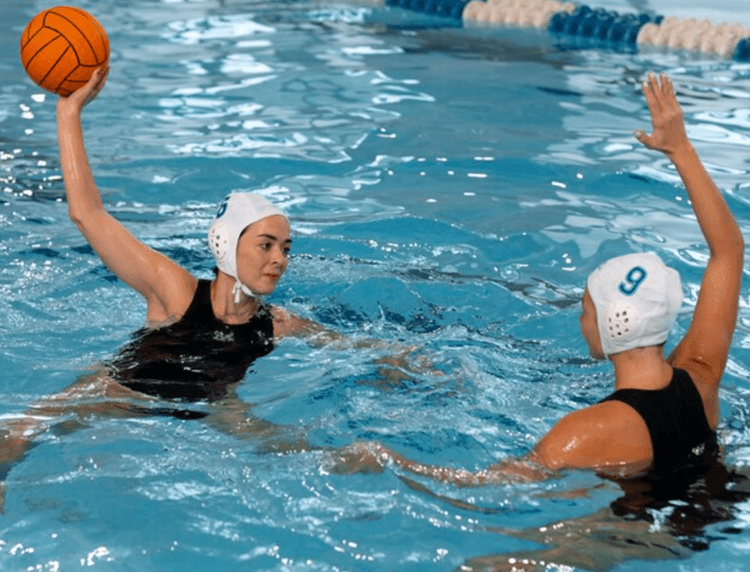
Exercise becomes something that most teenagers feel they should do at a certain point in their lives, usually around the age of fourteen or fifteen. The vocabulary changes. Motivation changes. All of a sudden, movement is about proving, fixing, and burning. And that’s where the trouble quietly starts for many teenagers.
If you spend any time with serious youth coaches, you will notice that swimming tends to disrupt that pattern in ways that are difficult to measure. Teens who are nervous, self-conscious, and somewhat antagonistic toward physical education class frequently show up at the edge of the pool with curiosity or at the very least, the absence of fear. Mirrors are absent. From across the room, no one is observing your form. The sound of your own breath, the rhythm of your stroke, and the lane ahead of you all shrink as you slide into the water.
| Category | Detail |
|---|---|
| Type of Exercise | Full-body, low-impact, cardiovascular and muscular |
| Primary Muscles Engaged | Shoulders, back, core, arms, legs |
| Calories Burned | 500–650 per hour (approximate) |
| Mental Health Effect | Releases endorphins; reduces cortisol |
| Cardiovascular Benefit | Strengthens heart, improves circulation, lowers blood pressure |
| Academic Impact | Early swimmers show up to 20-month advantage in problem-solving and following directions |
| Drowning Risk Reduction | Professional lessons reduce drowning risk in young children by up to 88% |
| Lifelong Relevance | Suitable across all ages and fitness levels; carries into adulthood |
For a 16 years old whose attention is typically being drawn in twelve different directions at once, that compression of the world is not insignificant. Swimming has well-established and genuinely remarkable health benefits. Every stroke works the shoulders, back, core, and legs all at once, giving the body a complete workout without the skeletal strain that team sports or running frequently cause. The joints are mostly spared because water supports about 90% of the body weight. This is more important than most adults realize for teenagers who are growing quickly and whose bodies aren’t always keeping up with their aspirations.
The improvements in cardiovascular health are also noteworthy. Frequent swimming increases lung capacity over time, strengthens the heart muscle, and enhances circulation. This is especially beneficial for teenagers with asthma, who frequently find pool environments easier to tolerate than outdoor or high-intensity alternatives. Swimming is one of the few sports that teens with asthma can participate in without constantly managing symptoms because of the humid air, controlled pacing, and lack of abrupt explosive bursts.
The last ten years have seen a change in the discourse surrounding teens and exercise, and the physical advantages are no longer the whole picture. The psychological scaffolding that sports either create or destroy in teenagers is what researchers and coaches are now focusing more on. And swimming accomplishes something truly unique in that regard.
Unlike most sports, it is competitive without being comparative. In a 100-meter freestyle race, a teen’s performance is evaluated not only against the person in the next lane but also against the clock. Personal bests are important. Failure feels more like data than judgment because of the personal, gradual, and evident relationship with improvement.
I was struck by how unself-conscious a group of fifteen-year-olds were as they moved through the water during a community pool session the kind where no times are posted and no coach is leading drills. That age group consistently performs on land. They were merely swimming in the pool.
This lack of self-consciousness has a significant connection to the way endorphins function in water. Regardless of the environment, physical activity causes their release, but swimming tends to maintain the effect longer, in part because sessions are usually longer and the intensity is moderate rather than spiked. The stress hormone cortisol decreases. Mood gets better. For many regular swimmers, sleep actually becomes easier. For teenagers dealing with social anxiety, exam pressure, and a media environment that is meant to agitate them, these are not insignificant issues.
Additionally, the social aspect is undervalued. Most people agree that swim teams are exceptionally inclusive settings. Unlike basketball or football, there is no hierarchy of positions in this sport. No benchwarmer is present in a lane. Every swimmer participates in competitions, and training that is shared by swimmers of all skill levels fosters a sense of shared effort that lasts beyond the session. Friendships formed in that setting over shared lanes, exhausted muscles, and early mornings are typically long-lasting.
When you look at it over time, this adds up to something that coaches frequently explain but find difficult to explain to parents: teens who regularly swim do more than simply become fitter. Their relationship with their bodies changes as a result. It is based on the body’s capabilities, how it reacts to training, and how it feels after an hour in the water, rather than appearance or punishment.
That change in perspective is perhaps more significant and more difficult to engineer than any particular fitness result. Adolescents who discover at the age of fifteen that physical activity can be enjoyable rather than grimly necessary are much more likely to continue being physically active at the ages of twenty-five, thirty-five, and fifty.
It’s important to identify the difference with gym culture. Early on, adolescents especially girls who are exposed to exercise mainly through environments that emphasize aesthetics frequently form tense relationships with physical activity. Until exercise is perceived as something done to the body rather than with it, the link between movement and appearance is strengthened.
Swimming virtually automatically short-circuits that association. Their reflection is not being observed by anyone. Macros are not being counted poolside. The feedback loop is completely different: you feel calmer, breathe better, sleep better, and accelerate. The body develops in ways that reveal themselves through function rather than reflection.
There are useful factors to take into account. There is uneven access. Not every neighborhood has access to community pools, and lessons, let alone competitive club swimming, can be very expensive. These are actual obstacles that restrict who can learn about this specific connection with physical activity.
Evidence is consistent for those who regularly venture into the water. Research on teenage swimmers reveals gains in cognitive function, emotional control, and academic engagement in addition to improvements in cardiovascular fitness and muscle growth. It turns out that swimming has the same effects on the brain as other prolonged aerobic exercise, including increased oxygen delivery, stronger neural connections, and enhanced focus and memory.
All of this does not imply that swimming is the solution to every health issue that affects teenagers. However, it offers something unique: a type of exercise that tends to improve rather than worsen teens’ self-esteem, develops physical competence without requiring a specific body type, and naturally transitions from casual to serious without becoming punishing at either end.
The pool is worth a second look for teenagers who have learned to hate the gym, who have been burned by sports that made them feel inadequate, or who just haven’t found a physical practice that feels like theirs. When you enter the water, it doesn’t care what you look like. It merely asks you to move while holding you and providing resistance.
i) https://swim4lifeschools.com.au/benefits-of-swimming-for-children/
ii) https://www.swimjim.com/blog/the-many-benefits-of-swimming-for-kids-dive-into-a-world-of-health-and-fun
iii) https://felixswimschools.com/why-swimming-is-the-perfect-sport-for-childrens
iv) https://www.hamptonswimschool.com.au/the-life-long-benefits-of-childhood-swimming