

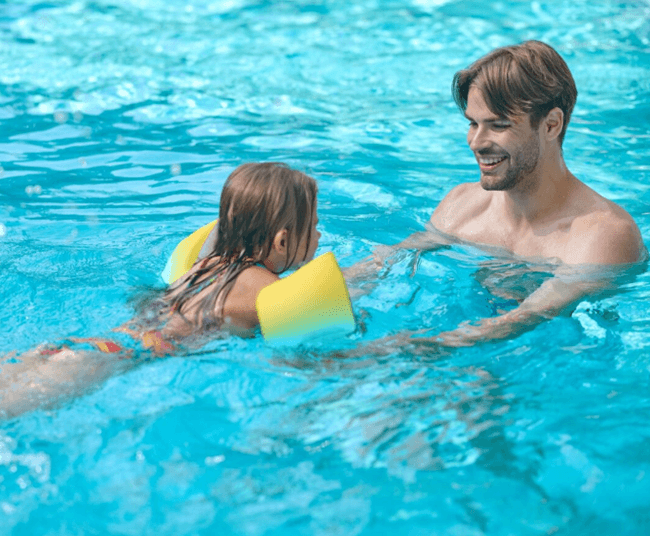
One of the few locations where kids can run around freely without being told to stop, slow down, or pay attention to their footing is the pool. Their heart rates rise and fall in steady, forgiving rhythms as they kick, pull, turn, and push off once more. Eventually, those rhythms become more significant than the sporadic run on a court or field.
Swimming rarely depends on brief bursts of effort followed by extended rest periods, in contrast to the majority of youth sports. Even during lessons, the body is almost always in motion. Early on, the heart adjusts to that demand, learning how to pump effectively under mild but continuous stress exactly the kind of work cardiologists later advise adults attempting to reverse decades of inactivity.
| Key Context | Details |
|---|---|
| Primary benefit | Improved heart efficiency and circulation through sustained aerobic activity |
| Unique factor | Low-impact exercise allowing early, consistent participation |
| Respiratory link | Controlled breathing strengthens lungs and oxygen use |
| Long-term effect | Establishes durable cardiovascular habits into adulthood |
| Typical starting age | Often introduced between ages 4–7, sometimes earlier |
Frequently, parents are the first to notice the obvious changes. Get more rest. a more relaxed mood following practice. A child’s appetite after using their lungs. The cardiovascular system is subtly changing, improving stroke volume, slightly thickening the heart walls, and learning to recuperate more quickly after physical activity.
Swimming’s low-impact nature plays a larger role than it gets credit for. Children can swim frequently without developing the minor injuries that prevent young runners or soccer players from competing because their joints aren’t absorbing shock. Frequency matters. A heart that is activated exclusively on weekends adapts differently than one that is asked to work four or five days a week.
Breathing becomes intentional in the water. Youngsters quickly discover that shallow, panicked breathing is ineffective. They must trust the rhythm, time their inhalations, and exhale completely. By strengthening respiratory muscles and enhancing oxygen exchange, that habit alone gradually reduces the workload on the heart.
Coaches frequently say that swimming increases “engine size,” and although it sounds like locker-room jargon, it’s true. As children get older, their resting heart rates decrease because the cardiovascular system becomes more effective at delivering oxygen. Many former swimmers carry those adaptations into adulthood, even if they leave the sport behind.
Additionally, swimming has a subtle corrective effect on kids who might not otherwise engage in physical activity. The playing field is levelled by the water. Body type is less important. Early success is easier to achieve. The foundation of cardiovascular health is consistency, which is fostered by that early sense of competence.
I’ve watched children who struggled through their first lessons, clinging to the wall, later move down the lane with an ease that surprised even them, and it always made me pause at how much unseen work their bodies had done.
Aerobic capacity is a powerful predictor of adult heart health, according to long-term studies on youth fitness. Without the wear and tear that shortens athletic careers before habits have time to form, swimming directly addresses that capacity. Even though they may not consider themselves “athletes” after ten years of swimming, a child’s heart remembers.
Additionally, there is the issue of blood pressure. Even in young people, regular swimming has been linked to improved vascular health. During prolonged exercise, blood vessels repeatedly dilate and contract, improving elasticity a quality that gains value as one ages.
Swimming promotes a relationship with effort that is not punishing but rather manageable. Youngsters discover that recovery can be swift and fulfilling and that effort need not always equate to discomfort. That perception shapes how willingly they return to physical activity as teenagers, when many begin to drop out of sports altogether.
Although team sports frequently come to an abrupt end, they can be socially rewarding. Instead, swimming tends to taper. Children transition between lessons, clubs, and lap swimming, varying the level of difficulty without completely stopping their movement. That continuity is good for the heart.
When children encounter new physical challenges later in life, there is a noticeable difference between those who have grown up swimming and those who have not. The swimmers get better more quickly. They breathe more steadily. They trust their bodies in motion.
Additionally, swimming avoids screens, one of the contemporary barriers to cardiovascular health. Pool time is immersive. Cell phones remain dry. The body retains attention. That unbroken physical interaction is becoming more and more significant.
In adolescence, when growth spurts can strain the heart and coordination falters, swimming remains forgiving. The water supports changing bodies while still demanding cardiovascular effort, allowing teens to stay active when other sports feel awkward or punishing.
The advantages are less noticeable but more long-lasting by adulthood. During life transitions, such as following an injury, becoming pregnant, or experiencing joint pain, former swimmers frequently return to the pool. They already know how to operate there with their hearts.
Swimming doesn’t make a big show of its long-term cardiovascular benefits. Year after year, lap after lap, it silently delivers them. The kids splashing at the shallow end aren’t considering stroke volume or arterial health. Decades later, however, their hearts might still be beating in time with a rhythm they picked up early on in water that required just enough of them, frequently enough, to endure.