

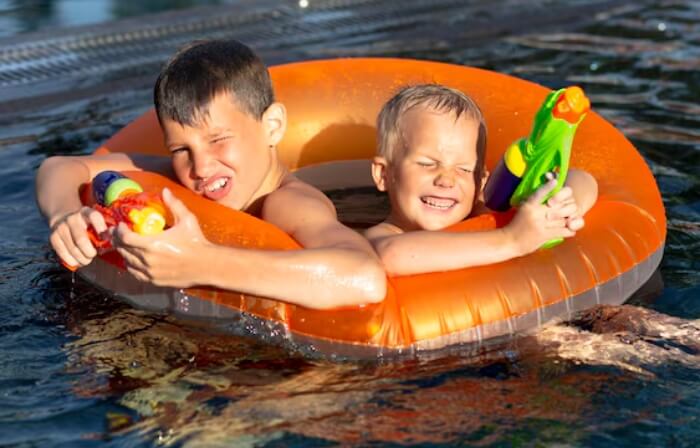
On a Saturday morning at a public pool, you can usually tell which kids have taken lessons and which haven’t. They move in a different way. They don’t hold onto the wall as though it might vanish. They duck under, emerge, release their breath, and so on. The others, who are pretending not to be nervous, stand at the shallow edge with that specific stiffness. It’s a minor issue remains with you.
For years, parents have been told that swimming is important, and the majority of them claim to believe it. According to a widely cited STA survey, 62% of parents say it’s a vital life skill and about 70% say it’s the most important sport their kids can learn. The number isn’t really the interesting part. The discrepancy between parents’ words and deeds is the intriguing aspect. Just 8% of those same parents said that their child’s school teaches swimming, and only one-third of them take their kids swimming once a week. Thus, the belief exists. Less so was the follow-through.
Pediatricians and water safety educators feel that something has changed over the last ten years. In general, parents are more nervous, more aware of risk, and more inclined to delegate specialized tasks to experts. Nevertheless, football camps and tutoring continue to take precedence over swimming, which is perhaps the most tangible safety skill a child can have. It’s difficult to ignore the irony. By all standards, a child who can solve quadratic equations but freezes in three feet of water is not as ready for the real world.
| Quick Information | |
|---|---|
| Topic | Swimming as an Essential Life Skill for Children |
| Source Organisation | The Swimming Teachers’ Association (STA) |
| Type | Registered Charity & Awareness Body |
| Registered Charity Numbers | 1051631 (England & Wales), SC041988 (Scotland) |
| Founded / Registered | Company No. 01272519, England |
| Headquarters | Anchor House, Birch Street, Walsall, WS2 8HZ, United Kingdom |
| Core Mission | Preservation of human life through teaching swimming, lifesaving, and survival techniques |
| Notable Campaign | International Learn to Swim Week |
| Key Statistic | 70% of parents consider swimming the most important sport for children |
The World Health Organization has long stated that drowning is one of the most common unintentional causes of death for children under the age of fourteen. The majority of drownings occur silently. Hollywood arm-waving, shouting, and thrashing are all absent. If no one is keeping a close eye on the child, it can be over in less than two minutes. Teachers with decades of experience working with kids will tell you the same thing, albeit in slightly different words: confidence is what endures. When a child panics, they sink. When a child learns to breathe, float, and wait patiently for assistance, they have bought themselves time, and time is crucial.
The way swimming is taught has changed recently, at least anecdotally. Because buoyancy aids interfere with a child’s natural ability to read the water, some schools have abandoned the use of armbands and foam noodles. Even though it’s a slower route, the logic makes sense. Without floats, kids learn to be more honest about how their bodies behave in the water. They find that remaining motionless is beneficial. that if they allow it, the water will hold them. Seeing a five-year-old realize this for the first time is almost meditative. They lower their shoulders. There is a click.
Of course, the question of cost is real. In many towns, public pools have either completely closed or maintained hours that don’t align with the lives of working families, and pool memberships have gradually increased. According to STA’s own research, parents’ primary excuses for not taking their kids more frequently are cost and access. It’s a subtle form of inequality that doesn’t make news until something horrible occurs during a family vacation and everyone briefly questions why this isn’t taught in schools. After that, the news cycle continues.
This also has a larger cultural component. In the past, swimming was commonplace. The majority of American, British, and Australian children of a particular generation learned it virtually by default, frequently through school terms at the neighborhood pool or community programs. In many areas, that infrastructure has deteriorated. In turn, the skill has become somewhat more optional, somewhat more middle-class, and somewhat more reliant on whether a parent can afford to take their child to a structured lesson twice a week. As you watch this develop over the course of about ten years, you begin to see why organizations like STA consistently reiterate the same message. They’re not actually advocating for sports. They are advocating for a more fundamental cause.
There’s a chance that some correction will occur in the coming years. There is a quiet movement among parents to treat swimming less like an extracurricular activity and more like a non-negotiable, similar to how you wouldn’t skip teaching a child to look both ways before crossing the street. There is also renewed discussion about mandatory school swimming in a number of countries. It’s still unclear if that translates into actual policy. Pools are expensive to operate, and funding organizations move slowly.
The kids at the Saturday pool continue to practice in the interim. The new ones cling, let go, and then cling once more. The older ones move effortlessly, just as someone who has truly mastered a skill eventually loses awareness of their actions. Even if they wouldn’t put it that way, every parent truly wants that ease, that almost bored competence in deep water. Not medals. not methodology. Just the silent assurance that their child would float, breathe, and wait if something went wrong. Really, that’s the whole point of contention. The rest is merely ornamentation.
i) https://blog.swimmingnature.com/swimming-is-an-unnegotiable-life-skill/
ii) https://everybody.org.uk/blog/why-learning-to-swim-is-a-lifelong-skill-benefits-for-kids-and-adults/
iii) https://www.abbeycroft.org.uk/from-splash-to-success-why-swimming-is-a-vital-skill/
iv) https://goldmedalswimschool.com/why-is-swimming-important-expert-parents-share-life-saving-benefits/