

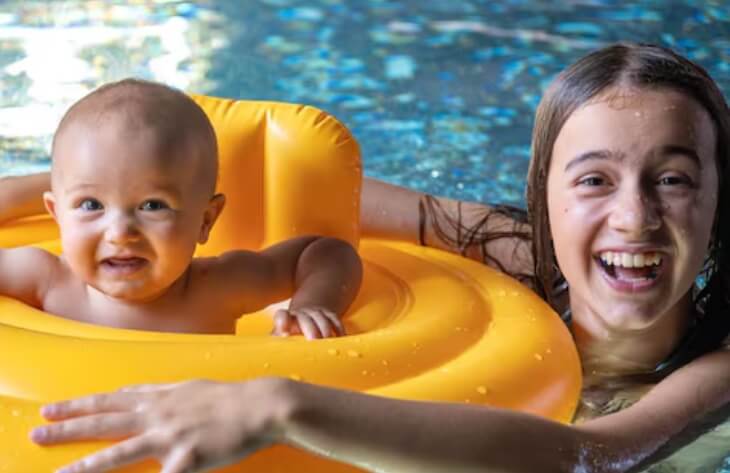
Anyone who has watched a nervous six-year-old from the poolside will instantly recognize a certain moment. The child is utterly unconvinced, staring at the water with rigid arms. Then something changes, like a parent nodding or an instructor saying something, and they leave. It’s difficult to fully describe what happens next, but it’s true: by the time they climb out, something has changed. Not all of them.
It turns out that little moment is far more significant than it first appears. Swimming has a way of becoming a sort of anchor for kids going through some of the more significant upheavals of early life. Such as a new school. A new sibling. Moving to a different city. Or the quiet turmoil of parents divorcing.
| Category | Details |
|---|---|
| Topic Focus | Child development through swimming during life transitions |
| Age Range Addressed | Infants through primary school age (0–11 years) |
| Key Benefits Covered | Physical, cognitive, emotional, and social development |
| Research Referenced | Griffith University (Australia), Swim England, NHS guidance |
| Geographic Context | Cardiff, Wales; broader UK and global relevance |
| Safety Relevance | Drowning is the 2nd leading cause of accidental death in under-18s in Wales |
This might seem like too much to expect from a sport. The observations made by parents, educators, and pediatric researchers all seem to point in the same direction, and the evidence is really difficult to dispute. Cardiff kids have been in the news lately, but not for happy reasons.
By the time they graduate from primary school, just 16% of kids can swim, which is the lowest percentage in Wales. According to Cardiff Council’s public acknowledgement, drowning is the second most frequent cause of unintentional death for children under the age of eighteen in the area. Local initiatives have been accelerated by that stark statistic.
Beneath the urgency of safety is a more nuanced reality that is rarely discussed: swimming is more than just a survival skill. The pool provides something that is difficult to duplicate elsewhere during the years when kids are most emotionally open and vulnerable to the tremors of change around them. Think about what a swim lesson entails.
A child follows a structured set of instructions, walks into a new environment with near-strangers, enters water an element that is inherently unfamiliar tries something they can’t yet do, fails, and then tries again. Even though it sounds unremarkable, that scene is practically a life rehearsal.
Pediatric psychologists frequently discuss the significance of “tolerable stress” manageable difficulties that help a child develop the ability to deal with more difficult ones in the future. One of the purest forms of manageable stress is taking a swim lesson. Without being overly demanding, it makes a genuine request of a child. The physical measurements are thoroughly recorded.
Swimming is especially beneficial for young bodies that are still learning how to work because it uses all of the major muscle groups in a low-impact manner. Balance gets better. The development of motor coordination happens more quickly.
According to a UK review, children who regularly swim demonstrated significantly better fundamental movement skills than children who do not. The close relationship between the body and the emotions during childhood is often overlooked when talking about swimming’s health benefits. A child who gets a good night’s sleep.
Which swimmers usually do that deep. Post-exercise sleep that most parents would applaud wakes up more composed. Less agitated. And more prepared to face the day’s challenges. Transitions are perceived as destabilizing children in part because they deprive them of predictability. The routines that are familiar disappear. The typical anchors come loose.
A regular, dependable swim class once a week can discreetly combat that. The same instructor, the same pool, and the same custom of putting on a swimsuit and waiting at the edge. That regularity is not insignificant for a child whose home life is constantly changing.
It is more valuable than it appears. Researchers have been piecing together the cognitive boost from swimming for some time, and it’s genuinely surprising. Griffith University in Australia conducted a four-year study that followed infants who started swimming and compared their developmental milestones with those of non-swimmers.
The swimmers were consistently months ahead of average in language, literacy, and numeracy by the time they were four years old. Swimming requires cross-lateral movements, such as alternating, coordinated arm and leg movements, which seem to improve communication between the hemispheres of the brain. The extent to which this benefit continues into later childhood is still unknown, but the early benefits are difficult to discount.
Observing a timid child navigate a swim group is a small socialization study in and of itself. Everyone is initially a little unsure, everyone gets their hair wet, and nobody looks completely dignified there’s something about the water’s shared vulnerability that levels the playing field. It’s frequently easier for kids who hardly talk to their classmates to connect by the pool.
The absence of screens and the customary social armor, the small celebrations when someone succeeds, and the common goal all help to loosen things. Compared to nearly every other group setting for young children, swim class fosters friendships more quickly. The pool becomes almost therapeutic for a child going through something truly difficult, such as a family disintegration, a terrifying relocation, or the confusing transition of losing a grandparent for the first time.
Not in a dramatic manner. A child can be drawn back into their body and out of their head simply by using endorphins. Cold water. And a task that they can actually perform with their hands and legs right now.
No one is pretending that swim instructors are therapists. There’s a reason why when parents ask what else they can do, pediatric health professionals frequently subtly bring up swimming. Swimming’s long-term benefits, such as discipline, resilience, and the embodied understanding that perseverance pays off, carry over into adulthood.
Every length finished when the child refused to begin is a tiny investment in something much bigger. It’s difficult to ignore the fact that kids who have persevered through a challenging year have a slightly different demeanor. Not because anything was fixed by the pool.
While everything else was changing, it kept something together. That may be the most truthful thing to say about kids and swimming in difficult times. Problems are not resolved by it. It simply keeps coming up, week after week, asking a kid to do something small and daring. And that proves to be sufficient.
i) https://www.swimready.co.uk/swimready-blog/how-swimming-supports-child-development-physical-cognitive-emotional-and-social-benefits
ii) https://fitnesschamps.com.sg/how-swimming-supports-kids-growth-and-development/
iii) https://thswim.com.au/how-swimming-improves-child-confidence-social-skills/
iv) https://www.swimnow.co.uk/health-and-wellbeing/9-benefits-of-swimming-for-kids/
v) https://www.swimjim.com/blog/diving-into-development-how-kids-benefit-from-swimming