

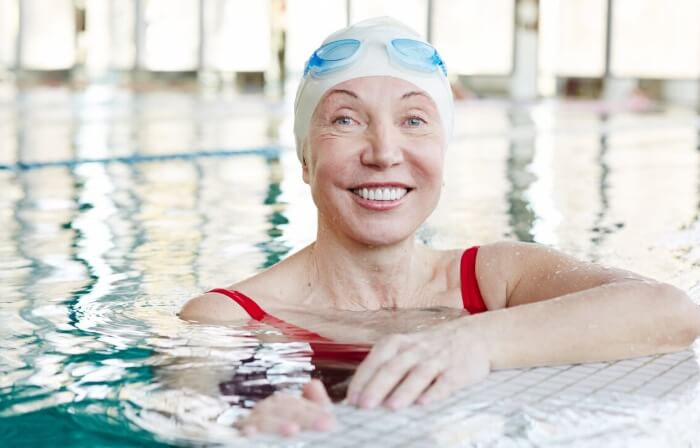
When you visit a public swimming pool in Britain on a morning, you notice a certain kind of silence. The muffled, echoing softness of water flowing through a tiled room not quite silence. Seniors in the shallow lane are moving slowly. A woman in her forties appears to be recuperating from either the long winter or a knee surgery. Unaware of everyone else, a teenager was training in the fast lane. For the better part of ten years, British doctors have been gently and persistently pointing their patients toward this unremarkable scene.
The explanations are mounting. Based on long-term data from the University of South Carolina that tracked over 40,000 men for more than ten years, Swim England’s now widely cited report found that regular swimmers have a 28% lower risk of dying than people who don’t exercise at all. That is the type of headline figure that is displayed on the walls of consulting rooms. The more intriguing narrative, however, lies in the way water appears to affect the human body in ways that running, cycling, and the majority of gym exercises just cannot.
Consider the arteries. Cardiologists will gently remind you that heart disease is not actually an illness of the heart. It is an illness of the vessels that supply it. Age causes arteries to stiffen, lose their flexibility, and transfer pressure too forcefully into the kidneys and brain. In a three-month swimming program, Professor Hiro Tanaka of the University of Texas discovered a measurable reduction in arterial stiffness a result that, to be honest, is rarely seen from a single intervention. This may be the reason why so many general practitioners in the UK who treat elderly patients have begun to view swimming pools as more of a therapeutic tool than a recreational activity.
| Key Information | Details |
|---|---|
| Topic | Swimming as a doctor-recommended activity in the UK |
| Endorsing Body | Swim England, supported by NHS clinicians and public health bodies |
| Headline Study | Swim England Health Commission Report |
| Key Finding | Regular swimming can reduce risk of death by up to 28% |
| Recommended Frequency | 3 sessions per week, 20–30 minutes each |
| Primary Beneficiaries | Adults with chronic pain, arthritis, type 2 diabetes, mental health conditions, older adults |
| Notable Backing | Royal Society for Public Health, Health Education England, NHS Confederation |
| Official Reference | www.swimming.org/swimengland |
The brain comes next. People are surprised by this part. Swimming seems to enhance cognitive function more than land-based exercise, in part because the body is kept horizontal and blood flows to the brain more readily when it isn’t fighting gravity. Tanaka has discussed how immersion in water improves blood flow to the brain overall. His research indicates that a twenty-minute swim is sufficient to improve reaction times. Reading the research gives the impression that the medical community is still catching up to what the water has been doing all along.
Particularly in Britain, the joining-up has made a difference. Health Education England, the NHS Confederation, and the Royal Society for Public Health are examples of non-fringe organizations that have leaned in. Doctors pay attention when a former CEO of the NHS Confederation describes something as a potential “game-changer” for national health at a time when long-term care budgets are being tightened. Particularly those in their fifties who are witnessing an increase in their own patient lists due to joint pain, type 2 diabetes, and the slow grind of midlife depression.
The piece about mental health might be the most subdued revolution of all. The Swim England report mentions a man by the name of Robert. He has Korsakoff’s syndrome and bipolar disorder, and he says swimming with people who are going through similar things helped him regain his sense of value. “It’s just a simple swim” , he states, “but it has changed my life.” Since then, countless general practitioner offices have repeated that statement in different ways. The phone number of the local recreation center is now written on the side of a prescription pad by doctors who used to shrug when dispensing SSRIs.
Given the cultural context, it’s difficult to ignore how counterintuitive all of this sounds. Britain spends enormous amounts of money promoting wearable technology, high-intensity exercise, and protein-rich products. That’s not what the pool is. The municipal pool is a little chlorinated, and the steps are frequently a little chilly. The medical literature continues to bring it up, raising concerns about whether the fitness industry’s long-standing fixation with intensity has been misguided.
Of course, there are restrictions. More research is needed, especially on long-term conditions and mental health, according to the Swim England report itself. It is odd to reconcile the growing evidence with the fact that participation has actually decreased in recent years. Furthermore, not all pools are financially, geographically, or otherwise accessible. Physicians who advise it are aware of this. In any case, they advise it.
Tanaka has a modest prescription. Continue moving for twenty to thirty minutes three times a week. He notes that walking briskly in the shallow end is more difficult than walking on land. That is more important than any heart-rate zone chart for patients with arthritic knees or limitations following surgery. It’s still unclear if the NHS will formally allow swimming on prescription on a large scale or if it will continue to be something that individual general practitioners subtly recommend in between appointments. As the evidence accumulates, the direction seems clear enough. Before he passed away, Dr. Michael Mosley said, “Take the plunge.” His words struck more forcefully after his passing. It’s still what the doctors say.
i) https://www.bbc.co.uk/programmes/articles/5Y9qZzcKDYdVxSDdM9gxGqY/why-swimming-could-be-the-best-exercise-you-do
ii) https://www.sportengland.org/news/study-reveals-huge-health-benefits-of-swimming-regularly
iii) https://www.richmondgroupofcharities.org.uk/publications/swimming-as-medicine/
iv) https://roycastle.org/6-reasons-why-swimming-is-the-ultimate-exercise-for-overall-health/