

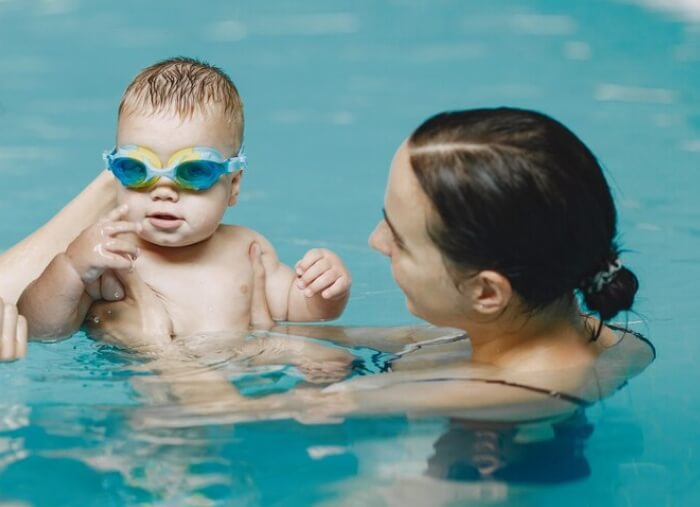
When a 4 years old lets go of the wall for the first time, they have a certain expression on their face. A brief moment of fear, followed by astonishment and a hint of pride. Even before they get to the instructor’s extended hands, you can see it spread throughout their entire body. With their phones half-raised, parents who are standing along the tile frequently miss the moment it truly occurs the child never does.
For reasons that are still being investigated, swimming appears to have an effect on kids that other activities can’t quite match. Even though it is exercise, it is more than that. Although it is a safety skill, it is more than that. Speaking with swim instructors and observing classes on weekday afternoons gives me the impression that the pool is doing something more subdued and long-lasting, something that will eventually manifest in classrooms, friendships, and the fleeting moments of self-confidence that children will require for the rest of their lives.
This concept has been discussed by researchers for some time. Robyn Jorgensen’s 2009 University of Canberra study, which followed thousands of children under five, discovered that swimmers were reaching social and cognitive milestones up to fifteen months ahead of their peers who did not swim. more adept at obeying instructions. more at ease with adults who weren’t their parents. Of all things, sharper in language. Some of that, according to instructors, is related to the way swim instructors actually communicate with children short, concise sentences that are patiently repeated and frequently accompanied by hands-on demonstration. Toddlers seem to absorb this unique type of instruction in a different way than they do in a classroom.
| Topic | Details |
|---|---|
| Subject | Childhood swimming and long-term skill development |
| Featured Voice | Duncan McNally, writer partnering with Nemo Swim School |
| Key Research Cited | Robyn Jorgensen, University of Canberra (2009 study on early swim development) |
| Affiliated Body | Association of Aquatic Professionals (AOAP), 501(c)(3) non-profit |
| Recommended Starting Age | As early as 6 months |
| Reported Drowning Risk Reduction | Up to 88% with early swim lessons |
Nobody knows for sure whether the lessons structure or the water itself is the cause. Most likely both. A child must consider how their body moves through the water because it resists them differently than the air. Weekly problem-solving practice develops coordination as well as a type of patient attention that is more difficult to teach in a distracted classroom.
For good reason, the safety feature frequently takes center stage in marketing. Early swim instruction can lower the risk of drowning by up to 88 percent, according to some studies. Drowning is still one of the main unintentional causes of death for young children. The majority of pediatricians recommend lessons based solely on that figure. Parents who continue to enroll their children past the survival-skills stage frequently do so for reasons other than safety. They’ve noticed something else, which is why they’re doing it.
In the words of a swim instructor in a small, year-round facility in suburban Florida, the children who return week after week begin to walk differently. Not only are they stronger, but they are also more at ease. The minor annoyances of everyday life don’t bother them as much because they’ve spent enough time feeling a little uneasy, a little out of their element, and working things out. People who actually teach children to swim frequently make this kind of observation, which is difficult to support in a study.
Additionally, the social layer receives less attention than it ought to. Children participating in group swim lessons are subjected to a fairly intense shared experience, which includes cold water, unfamiliar instructions, and actual consequences for not paying attention. Children learn to wait their turn even when they’re excited, to cheer when a classmate finally floats on their back, and to take turns at the wall. None of these skills come naturally to most three-year-olds. Strangely, the pool seems to accelerate it.
It’s difficult to ignore how much trust is being developed in those thirty minutes when you watch a parent-and-tot class on a Saturday morning the toddlers in fluorescent swim diapers, the parents bracing them under the arms, the teacher singing some ridiculously upbeat song about bubbles. The child discovers that they can be contained in water. The parent discovers that a small amount of letting go is necessary. It sticks because of something about doing it in a structured setting with other people.
Skeptics will rightly point out that there are many other ways to develop coordination and confidence. It’s what soccer does. It’s done by gymnastics. It probably works even if you have a long-term relationship with a climbing tree in your backyard. Swimming is not the only option. It’s that it’s incredibly effective, packing a full-body workout, a social setting, a cognitive challenge, and a survival skill into a single 45-minute session. There aren’t many other kid-friendly activities that fit so much into such a short period of time.
It’s also one of the few sports that people can continue to play well into old age. According to statistics, the children learning back floats today will be the adults swimming laps at sixty, recuperating from injuries at seventy, and maintaining their mobility at eighty. Long after the goggles are outgrown, the seed is sown in those initial anxious lessons.
This place still has a lot of unknowns. Researchers are unsure of the reasons behind the strong correlation between swimming and early language development, as well as whether children’s confidence gained in the water translates to academic settings as some research indicates. Parents should be cautious of any program that promises to use butterfly strokes to make their toddler a genius because the data is encouraging but not definitive. A more subdued assertion appears to be more truthful and beneficial: children who learn to swim at a young age tend to be slightly more self-assured as adults. That’s the part that’s still being worked out, whether it’s the water doing the work, the lessons, or just the time spent trying something difficult and progressively improving at it.
The pools continue to fill up on Saturday mornings for the time being. The children continue to cling to the wall before releasing their hold. And something that none of us parents, coaches, or researchers fully comprehend is being constructed somewhere in that tiny, repeated act.
i) https://www.roguerapids.com/how-swimming-builds-lifelong-skills-beyond-the-pool
ii) https://aquaticpros.org/swimming_into_success_early_swim_lessons/
iii) https://watermelonswim.com/swimming-and-social-skills/
iv) https://usswimschools.org/benefits-for-young-children-learning-to-swim-goes-beyond-swim-skills/
v) https://texasswimacademy.com/how-does-swimming-affect-a-childs-development/