

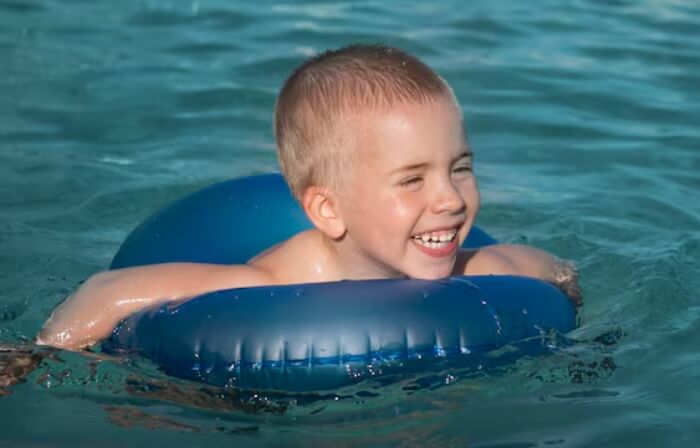
Seven-year-olds are waiting their turn to push off in a row along the edge of a shallow pool at a council recreation center in the English Midlands on a Tuesday night. Their hair is stuck to their foreheads and their goggles are fogged. A young boy wearing red trunks is one of them, and he’s bouncing on his heels. I was informed later by his mother, who was watching from the viewing gallery, that he had been crying about a math test an hour earlier. He’s laughing now at something the teacher said. It’s a tiny detail that is simple to overlook. Parents of nervous kids have learned to recognize these times.
Families perspectives on swimming are changing. It was marketed for decades as a safety skill, something you learned to prevent drowning while on a field trip. These days, it is prescribed as a form of treatment, both informally and occasionally formally. Therapists bring it up. When parents bring it up, pediatricians nod. Even though the data is still preliminary, it is starting to confirm what mothers have been telling one another for years in changing rooms.
| Topic | Details |
|---|---|
| Subject | Swimming as a mental health support for children |
| Trend Type | Sports, wellness, child psychology |
| Key Research Source | Swim England’s #LoveSwimming campaign |
| Notable Finding | 84% of parents say their child’s mood improves after a swimming lesson |
| Related Statistic | 1.4 million UK adults credit swimming with reducing anxiety or depression |
| Notable Voice | Leon Taylor, Olympic silver medallist (diving, Athens 2004) |
| Geographic Spread | UK leisure centres, US suburbs, urban pools globally |
According to a recent study from Swim England’s #LoveSwimming campaign, 84% of parents said that their child’s mood had significantly improved following a swimming lesson. After that, almost eight out of ten parents reported that their child’s focus had improved. These figures are not insignificant. Additionally, they arrive at a time when children’s mental health, especially anxiety, is being discussed with a level of concern never seen before. Since the pandemic, referral rates for child anxiety have steadily increased in the US and the UK, and parents are searching sometimes frantically for a treatment that doesn’t require medication or a lengthy waiting list.
It turns out that swimming triggers a peculiar set of reactions. The obvious part is that it’s aerobic exercise, which releases endorphins the same chemical boost that comes from a run. Runners don’t understand something else that is more difficult to describe. The world is muffled by water. When a frightened child is submerged, the sounds that accompany them throughout the day classroom chatter, parental instructions, and the buzz of a phone they aren’t even holding vanish. The body loses its weight. There is no other way to continue moving forward, so the breath must slow down.
Aquatic exercise significantly reduced symptoms of anxiety and depression in a variety of populations, according to a 2022 review of eighteen trials. Researchers found that buoyancy and the rhythmic, coordinated nature of the strokes caused a deeper level of relaxation in college students than land-based exercise did. Swimming may provide something akin to meditation that doesn’t require sitting still, particularly for kids whose nervous systems are already racing too high. Any parent of a nervous child will tell you that the hard sell is to sit still. It’s simpler to ask them to swim two lengths.
This also has a cultural component. The missed pass, the parents watching, and the coach yelling from the sidelines all contribute to performance anxiety in team sports like basketball and football, which dominate most childhoods. Swimming is mostly done alone, especially in the early years. You are moving in your own lane, in your own head, and hearing your own breath, even in a classroom with eight other students. The analogy to a teammate is subdued. This is a relief that lasts for the remainder of the week for some kids, the ones who crumble in front of large crowds.
Former Olympic diver Leon Taylor, who won silver in Athens, has spoken out about seeing his five-year-old son Ziggy emerge from the pool more composed than when he entered. It’s a modest, everyday remark from a former professional athlete, and it strikes a more honest chord than most endorsements. Taylor is not marketing a show. He’s describing what many parents are silently observing.
There are restrictions. No responsible therapist would present swimming as a treatment for clinical anxiety. Access is uneven; pool memberships are expensive, lessons are even more expensive, and the infrastructure of a nation’s pools varies greatly from town to town. Pushing kids into lessons before they’re ready can have the opposite effect of what is intended because some kids are afraid of water. Though it’s not common, the picture of the serene child slipping into the pool is real.
Even so, it’s difficult to avoid feeling as though something beneficial is being rediscovered as this develops. There has always been swimming. Slower breathing, reduced cortisol, and that peculiar post-swim calm are all well-known advantages. We’re paying attention, which is new. Parents are observing. Some schools are beginning to do so. The pool is being asked to do more than just teach people how to avoid drowning. And for the time being, it seems to be working against expectations.
i) https://www.wiltshire.gov.uk/article/14822/New-research-highlights-the-powerful-benefits-of-swimming-for-children-s-wellbeing
ii) https://www.swimdesignspace.com/blog/swimming-for-anxiety-stress-mental-health
iii) https://swim-with-me.co.uk/childrens-mental-health/
iv) https://artemis.mggs.vic.edu.au/news/why-swimming-is-a-great-sport-for-kids