

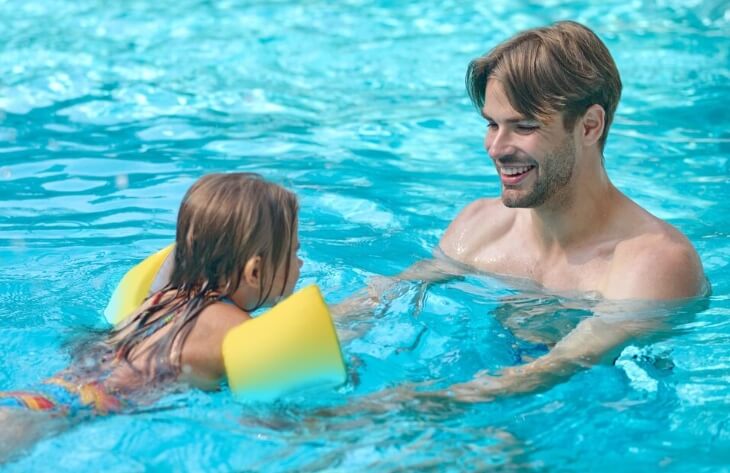
On a rainy Tuesday night in Cardiff, you’ll notice something that hasn’t been written about yet if you walk into any recreation center. Naturally, the children are in the pool: tiny bodies wearing enormous goggles, a teacher holding a foam noodle, and the stench of chlorine in the back of your throat. Take a look at the parents sitting on the benches.
A few of them are scrolling. Some people are reading. And as classes come to an end, a steadily increasing number of them are waiting for the adult lane to open in their own swimsuits with towels rolled under their arms. There is no coordination. It was not planned. It’s simply taking place.
Swim instructors feel that this is starting to become a pattern, and I believe they may be correct. A subtle change occurs in the home when a child begins learning to swim. The pool becomes a regular part of the week and ceases to be an occasional outing.
| Detail | Information |
|---|---|
| Topic Focus | Parent behaviour change linked to children’s swimming lessons |
| Region Highlighted | Cardiff, Wales (UK) |
| Key Statistic | Only 16% of children in Cardiff can swim by the time they leave primary school — the lowest rate in Wales |
| Public Health Concern | Drowning is the second most common cause of accidental death for under-18s in Wales |
| Recommended Activity | Family-inclusive swimming, parent-and-child sessions, lap swimming |
| Health Benefits Cited | Cardiovascular fitness, lower stress, better sleep, joint-friendly exercise, social connection |
| Notable Research | Griffith University (Australia) four-year early-swimmers study |
| Brain Chemistry Link | Exercise-triggered BDNF release, improved memory and mood |
Parents begin to show up early. They begin to linger. And when you spend enough Saturdays witnessing a five-year-old overcome their fear of covering their face. You start to wonder. When was the last time I took care of my own body?” It’s difficult to ignore it.
Compared to most cities, Cardiff sharpens this tale. According to recent data, just 16% of kids who graduate from Cardiff primary schools are proficient swimmers, which is the lowest percentage in all of Wales. Local councils have responded with new initiatives. In part because learning to swim can literally mean the difference between life and death. As one council spokesperson put it. And drowning is the second most common cause of accidental death for under-18s in Wales.
Children are not only encouraged to attend lessons by such statistics. It challenges parents to consider water, self-assurance, and whether they are leading by example. It turns out that a surprising number of people are also poor swimmers. Usually, the shift begins modestly. A parent enrolls their child. They remain in the spectator gallery for the entire first month.
Then they see the noticeboard advertising the adult sessions, which include lunchtime laps, women-only swims, and beginner lanes. There’s something about being there every week that makes inactivity seem a little ridiculous, especially when progress is measured in widths and certificates. In a previous reporting trip. I spoke with a swim instructor who succinctly described the situation. Parents drop off their children. And within three months. A significant portion of them are in the next lane.
She didn’t know why it functions that way. I’m not exactly either, but fitness directors at council-run pools have begun to count it because the pattern is so strong. Simply put, logistics plays a part in it. The cost of the pool has already been covered. The trip has already been completed. The car’s boot is where swimming gear is kept.
The justification for not going diminishes when the friction of starting is so low. Additionally. There’s something about water that appeals to those who are reluctant to return. It’s gentle on backs that have spent too much time at desks and forgiving on knees that haven’t run in fifteen years.
No one can see you breathing heavily, the joints don’t complain, and the cardiovascular work is genuine. The pool is a soft landing for parents who are anxious about gyms or self-conscious about jogging through their neighborhood. Although more difficult to quantify, the mental aspect may be more significant.
Like any prolonged aerobic exercise, swimming causes the body to release endorphins, and a parent who has just worked out for twenty lengths for an hour leaves feeling lighter than when they started. Another issue is BDNF, or brain-derived neurotrophic factor, a protein that is released during cardiovascular exercise and has been dubbed “Miracle-Gro for the brain” by researchers. A weary adult brain can benefit from the same biochemical boost that aids a child’s developing memory.
This may be the reason why so many parents say that their post-swim hour is the most peaceful time of the week. Regardless of the mechanism, the effect is so consistent that swimming is now listed in NHS guidelines as a recommended activity for both childhood mood and adult anxiety. The other is sleep.
Despite their chronic lack of it, parents of small children experience an odd phenomenon following a proper swim (laps, not paddling): they sleep better than they have in months. Youngsters also do this; many parents find that swimming helps a hyperactive toddler reset their behavior before realizing that it also helps them. Eating habits frequently follow.
Swimming two thousand meters and then returning home to a microwave meal without feeling a little strange is challenging. Investors in the wellness sector have also noticed this loop: in a number of UK regions, family-friendly gym memberships are subtly surpassing solo gym sign-ups. Even though it is rarely discussed, there is a social component worth mentioning.
On those benches, the parents begin to identify one another. A nod turns into a hello, a coffee in the upstairs café, or a swim group on Sunday mornings. It’s the type of low-stakes adult friendship that public health researchers keep telling us we’re losing, but it’s not glamorous and doesn’t go viral on social media. After seeing this develop over the course of a year at a single pool.
I was persuaded that it is more important than the majority of the formal wellness initiatives that councils attempt to support. All of this is not assured. Children’s swim lessons are not a Trojan horse for adult fitness, so it’s okay that many parents drop their kids off without ever getting in the water.
Talking to teachers and seeing the same families return week after week, gives me the impression that something subtly contagious is taking place here. Children demonstrate consistency to their parents. Sometimes parents take the hint after the fact.
Additionally, a city with one of the lowest rates of child swimming in Wales may unintentionally produce a generation of adults who are healthier. Whether anyone in policy has noticed is still unknown. Most likely, they ought to.
i) https://goldmedalswimschool.com/why-is-swimming-important-expert-parents-share-life-saving-benefits/
ii) https://www.swimready.co.uk/swimready-blog/how-swimming-supports-child-development-physical-cognitive-emotional-and-social-benefits
iii) https://www.swimmingdad.com/single-post/how-does-swimming-break-bad-habits-in-children
iv) https://www.mother.ly/health-wellness/childrens-health/mental-health-benefits-of-swimming/
v) https://www.betterhealth.vic.gov.au/health/healthyliving/swimming-health-benefits