

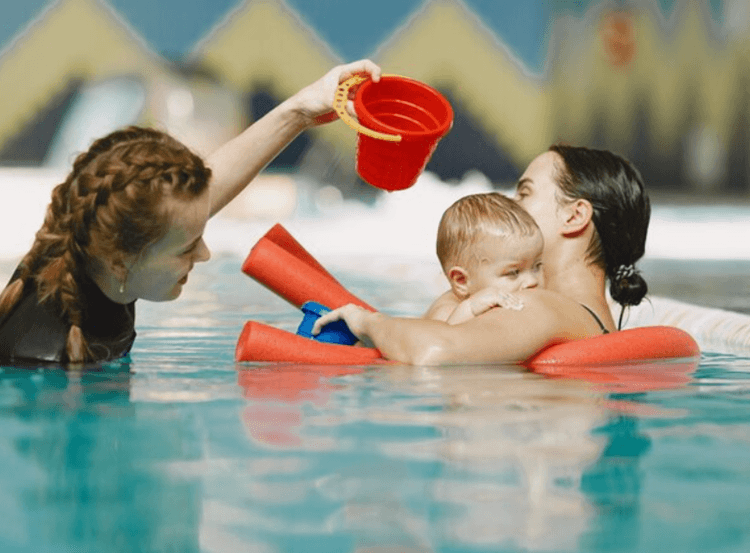
In practically every beginner swim class, a certain moment occurs. A five or six-year-old child with splashing arms and slightly crooked goggles stops in the middle of the lane, looks up at the teacher, and simply tries again. They were not coerced. No one counted to three. They just knew, without using words, that they weren’t finished yet. That is a tiny moment. It’s also rather remarkable.
One of those words that parents find unsettling is discipline. It brings to mind strict timetables, penalties, and kids who would prefer to do anything but sit quietly. However, swimming appears to teach it in a totally different language, one that children genuinely comprehend and, more surprisingly, seem to embrace. Children seem to be affected by the pool in a way that neither bedtime lectures nor reward charts can fully capture.
| Category | Details |
|---|---|
| Topic | Swimming and Child Discipline Development |
| Focus Area | Child Psychology, Physical Education, Cognitive Development |
| Age Group | Children ages 3–12 |
| Key Benefits | Self-discipline, focus, emotional regulation, resilience |
| Supporting Research | Griffith University 4-Year Swimming Study (Australia) |
| Relevant Organizations | Swim England, Royal Life Saving Society UK, KidsCanSwim |
It’s worth considering why. Fundamentally, swimming is a sport of consequences. Honest ones, not cruel ones. When a child kicks incorrectly, they are unable to advance. When a child holds their breath at the wrong time, they start to sputter. The water has no emotional content and provides quick, objective feedback. It’s just water; it’s neither disappointed nor harsh. That distinction is crucial for children who occasionally rebel against adult authority. Neither a parent nor a teacher with their own agenda is teaching the lesson. Physics is the source of it.
Children who took swim lessons from a young age were, on average, months ahead of developmental norms in areas like memory, language, and following directions, according to research from Griffith University in Australia. Some kids were almost a year and a half ahead in story recall, according to startling statistics. The underlying mechanism consistent, organized effort over time is less explored in those findings. Put another way, discipline that is practiced without being referred to as such.
The rhythm of swim lessons seems to fit the developing brain. When kids get there, they warm up, listen to instructions that are broken down into small steps, practice, take a break, and try again. This cycle is repeated week after week.
It’s possible that this repetition subtly rewires their relationship with effort itself in addition to improving their strokes. It’s difficult to learn how to float. It’s challenging to learn the correct freestyle arm motion. Nevertheless, kids continue to show up, persevere, and eventually succeed. That goes beyond athletic advancement. That teaches us the true meaning of patience.
When compared to other structured activities, it’s still unclear why swimming consistently produces these effects. Some researchers attribute improved focus and impulse control to bilateral stimulation, which occurs when swimming simultaneously activates both hemispheres of the brain.
Others highlight the sensory surroundings, such as the subdued noises, the tactile feel of the water, and the lack of screens and social distractions. You’ll notice something that’s actually uncommon in contemporary childhood: undivided attention, if you stand at the edge of a pool during a children’s lesson. Because the water requires it, every child in the water is completely present.
Additionally, brain scans do not reveal anything occurring on an emotional level. When kids learn to swim, they develop a quiet confidence that comes from conquering something that once scared them, rather than the loud, showy kind. When a child submerges their face in water for the first time or lets go of the wall and floats by themselves, they experience their own potential in a way that is difficult to replicate through praise alone. Gained self-assurance in the water is transferable. Parents and teachers often observe it. The kid who used to lose it over homework starts to stop, take a deep breath, and try again. Surfacing somewhere new is the same instinct they practiced in the pool.
The child doesn’t feel in control of any of this. There are no timeouts or withheld gold stars. Swim classes have a strict structure, but they also lean toward enjoyment. There are games, splashing, and just plain silly moments. It works because the discipline is ingrained in the joy. No one is telling kids to be disciplined. They are being shown the results of it.
It’s difficult not to be moved by how organic the change appears as you watch this develop over the course of a season of lessons. By December, a child who was restless and easily irritated in October has changed. calmer. more patient. more eager to try. They weren’t coerced into swimming. It only provided them with a lane, some guidance, and enough time to figure out the rest on their own. It turns out that formula works surprisingly well.
i) https://fitnesschamps.com.sg/do-swimming-lessons-improve-focus-and-discipline-in-kids/
ii) https://kidscanswimcanada.ca/how-swimming-helps-children-think-smarter-focus-better-and-learn-faster/
iii) https://wdswimming.com/swim-school/how-swimming-lessons-improve-your-childs-focus-and-discipline/
iv) https://easy2swim.com/the-impact-of-swimming-on-emotional-regulation-in-young-children/