

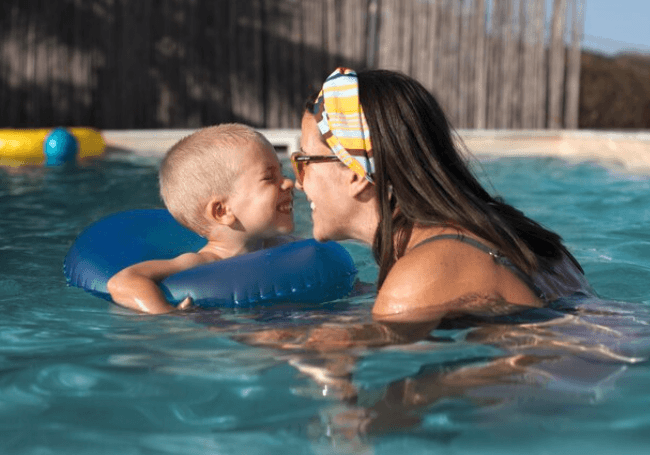
Long before the 9:30 session starts on a Tuesday morning at a north London recreation centre. A line forms outside the family changing rooms. First time parents make up the majority of those waiting. They can be identified by their overly prepared bags. Their apprehensive hold on a rubber duck. And their constant checking of the time on their phones. In contrast, the babies appear unconcerned. Some are still leaning against a shoulder, half asleep. One is chewing loudly on a swim diaper strap.
These mornings have a distinct smell a mixture of chlorine and baby lotion as well as a distinct sound that falls somewhere between quiet panic and excitement. Across the nation, something is happening in pools like this one. It’s not overt or loud, but it’s getting harder to ignore Of all things, swimming has subtly emerged as the activity that new parents refuse to give up. Not sensory play, not music lessons. Not the pricey baby yoga that was popular a few years ago.
Although it’s possible that this change would have occurred regardless, a recent study commissioned by Swim England has given the trend some empirical support, which parents appear to be reacting to. Ninety-six percent of preschool parents agreed that swimming made their child happy, and nine out of ten parents surveyed said it had improved their child’s movement and coordination.
| Information | Details |
|---|---|
| Topic | Baby & Toddler Swimming Among First-Time Parents |
| Lead Organisation | Swim England |
| Campaign | #LoveSwimming |
| Chief Executive | Jane Nickerson |
| Headquarters | Loughborough, United Kingdom |
| Founded | 1869 (as the Amateur Swimming Association) |
| Estimated Annual Saving to UK Health System | £357 million |
| Recommended Starting Age (per most schools) | From birth, with formal lessons typically from 0–3 months |
| Key Reported Benefits | Better sleep, improved coordination, parent–child bonding, stronger lung capacity |
That kind of number is uncommon when it comes to toddler activities. Speaking with parents by the pool makes the appeal more apparent than any survey could. According to Charlotte Power-Mcleod. A working mother who manages to fit a weekly session into her hectic schedule. Those twenty-five minutes are the best part of her week because it’s the only time she and her son are together and the phone doesn’t ring.
Listening to parents like her gives me the impression that swimming pools are now more uncommon than physical activity or developmental milestones. It has evolved into a place where contemporary parenting, with all of its diversions and guilt, momentarily disappears. According to industry data, the sector is changing as a result of the demand.
Due in part to staffing shortages and in part to schools reconsidering the youngest age groups, two-thirds of swim schools used to offer baby classes as early as three months. That number has reportedly decreased in recent years. Despite this, companies like Water Babies and Puddle Ducks have become well-known brands, with months-long waitlists in some areas.
This includes some post-pandemic recuperation. A portion of it comes from Gen-Z and millennial parents who do extensive research and, for once, discover findings that are positive. It has a fairly well-established physical case.
Babies can use more muscles and move more freely in the weightless environment of water than they can on a play mat. Neonatal experts have been writing about improved balance through vestibular system stimulation for years, and there is evidence that babies who swim early tend to start walking sooner. Additionally, it exhausts them, which is, to be honest, half the reason why most parents continue.
In the Swim England study, four out of five pre-school parents reported that their child slept better after swimming; this statistic likely explains the loyalty more than any developmental science. The deeper appeal is emotional, though, and it’s difficult to ignore. In 2026, parenting carries a unique burden.
There are screens everywhere, work has become more prevalent in the evenings, and the cultural discourse surrounding early childhood seems to be heavier than it once was. In contrast, the pool is practically outdated. You are not allowed to bring your phone in.
You’re not able to multitask. You have two options when it comes to holding your child in the water. Observing these classes gives me the impression that their simplicity is the key, and parents are reacting to it because nothing else in their week resembles it.
Another question is whether the trend will continue at this rate. The logistical challenge of getting a baby in and out of a swimsuit, growing membership fees, and pool closures throughout the UK are all significant challenges. When the post-pandemic enthusiasm wanes, some operators fear that the boom will plateau.
Others think that this generation of parents has made the early decision that water time is non-negotiable, making the cultural shift more enduring. Which version ends up being correct is still unknown. What is evident is that, for the time being, something truly human is happening, week after week, in 25-minute windows in pools hidden behind supermarkets and inside recreation centers on peaceful streets. Infants are learning how to float. Parents are learning to take their time. The water, working silently for both.
i) https://www.sta.co.uk/news/2023/11/15/an-evolving-era-for-baby-pre-school-swimming/
ii) https://www.waterbabies.co.uk/blog/the-physical-benefits-of-baby-swimming/
iii) https://www.puddleducks.com/local-teams/bristol-bath/local-news/new-research-reveals-swimming-as-number-one-indoor-activity-for-parents-and-toddlers/