

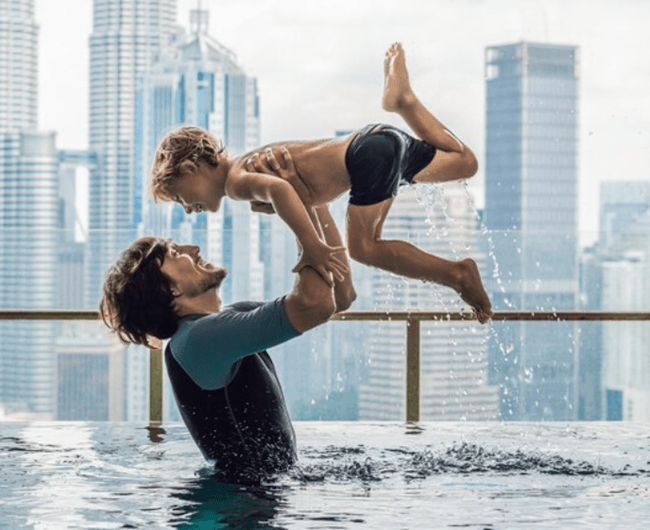
I first became aware that something had changed when I was observing a mother doing nothing at a community pool in a suburb outside of Toronto. Her seven-year-old son was floating on his back, gazing at the tiles of the ceiling. She wasn’t using her phone. He was not being timed by her. From the deck, she wasn’t yelling corrections. She was merely there, sipping poorly brewed coffee from a paper cup while displaying a hint of amusement. She laughed when I asked her later if he was preparing for anything. “He’s training to like swimming”, she remarked. “That’s the whole plan.”
I thought about that sentence for longer than I should have. For more than 20 years, parenting in middle-class North America has been more akin to managing a portfolio than raising children. Weekends are divided into thirty-minute blocks, calendars are packed, and the family minivan is essentially a mobile waiting room. Carl Honoré once referred to contemporary childhood as “a cross between a competitive sport and product development.” His book *Under Pressure* unintentionally became a sort of manifesto for the slow parenting movement. People wince when they hear that phrase because it is so close to the bone.
| Topic Snapshot | Details |
|---|---|
| Movement Name | Slow Parenting |
| Originating Voice | Carl Honoré, author of Under Pressure and In Praise of Slowness |
| Core Philosophy | Letting children grow at their own pace, with unstructured time and minimal scheduling |
| Geographic Spread | North America, UK, Western Europe, gradually entering urban Asia |
| Common Activity Pairing | Swimming, free play, reading, outdoor exploration |
| Notable Advocates | Carl Honoré, Carrie Contey (Slow Family Living), Katherine Martinko (TreeHugger) |
| Reference Source | Slow Movement Official Site |
As a movement, slow parenting is not particularly new. Since the late 2000s, it has been subtly developing, gaining a loose definition thanks to authors like Honoré and Carrie Contey, and gaining momentum each time a new study about nervous teenagers, exhausted eight-year-olds, or parents who can’t recall the last time they sat down to eat is released. Its concept is almost embarrassingly straightforward. Kids require room. They require boredom. Instead of acting like the person their parents want them to be, they require extended periods of unplanned time to discover who they are.
What’s more intriguing, and what I keep thinking about, is how swimming continues to appear in homes with slow parenting. Swimming is not competitive. Not the 5 a.m. swim team grind that makes children into timekeepers with hollow eyes. Simply swimming. Lakes, pools, and, if you’re fortunate enough, the ocean. Slow-parenting families believe that water fulfills a need for children that adults have forgotten how to provide.
The question of why is worthwhile. One of the few activities that allows a child to be completely involved and completely unstructured at the same time is swimming. No parent is holding a clipboard on the sidelines, no coach is yelling over a megaphone, and there is no scoreboard. Without realizing it, a child in the water is learning physics, breath control, problem solving, and play. Honoré would likely refer to this integration as the point at which “doing and being” finally intersect, as Contey puts it. Meltdowns occur. Sleep gets better. Something settles in them that is never fully reached by constant activity.
Additionally, there is the issue of what swimming requires of parents, which is surprisingly minimal. Driving to three tournaments every weekend is not necessary. You don’t have to learn the jargon of a sport you’ve never participated in. You take a seat. You observe. Perhaps you are also a swimmer. The spirit is aptly captured by the Lake Huron beach Katherine Martinko describes, where her sons spend entire afternoons doing nothing in particular. No timetable. There’s no pressure. There is no final certificate of completion.
Naturally, slow parents are aware that it’s not that easy. One Boston mother I spoke with acknowledged that the first summer she didn’t enroll her daughter in any activities, she felt almost guilty. “Everyone else was doing camp”, she remarked. “I continued to wait for her to be unhappy. She wasn’t. She learned to dive and read fourteen books. Believing that a child who doesn’t have a busy schedule will be alright requires a quiet kind of bravery. In some respects, the hardest aspect of the entire movement is that trust.
The cultural context is also important. Exhaustion is beginning to set in after years of lawnmower parenting, helicopter parenting, and whatever the next branded variation will be called. The question of whether the race was ever worth running has been prompted by a number of factors, including smaller families, older parents, more disposable income, and the aftermath of home time during the pandemic. Honoré thought that families might be forced to rediscover simpler pleasures during economic downturns. He might have been correct, but it happened more slowly than anticipated.
You begin to suspect that swimming has always done what slow parenting is currently attempting to teach when you watch a child glide underwater, surface, and smile. It takes things back. Patience is rewarded. It won’t be hurried. And that may be the most radical lesson a pool can impart in a society still addicted to speed.
It’s difficult to ignore how frequently parents who have adopted this strategy appear, well, lighter. less eerie. Similar to those who have discreetly withdrawn from a competition, no one truly prevails. It’s unclear if the rest of us will follow. But that’s where the pool is. The water is sufficiently warm. It turns out that the children already know what to do.
i) https://www.popsugar.com/family/slow-parenting-movement-37586930
ii) https://archive.nytimes.com/parenting.blogs.nytimes.com/2009/04/08/what-is-slow-parenting/
iii) https://www.ohbaby.co.nz/parenting/soul-food/slow-parenting
iv) https://www.aquanat.com.au/post/how-swimming-lessons-strengthen-the-parent-child-bond
v) https://www.healthline.com/health/parenting/infant-swimming