

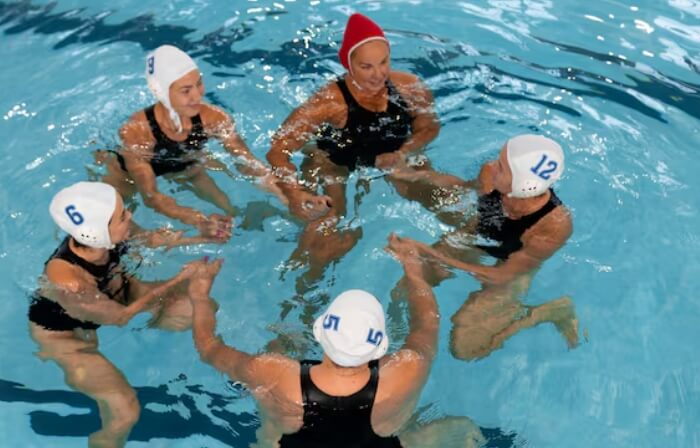
Around eight in the morning, you notice a certain silence at a community pool. The sound of a flip turn, the hum of a filtration system, or someone’s grandfather adjusting his goggles for the third time before pushing off are examples of this type of quiet that isn’t really quiet at all. As you watch it happen, you can’t help but feel that swimming has a peculiar and undervalued position in the sports world. Nearly everyone gives it a try. Very few people discuss it. The demographic range of people in the water on any given morning is broader than what you would find in a CrossFit box or on a tennis court.
That’s its peculiar genius. Everyone seems to be absorbed by swimming. A seventy-three-year-old retiree performing a slow, deliberate breaststroke in lane two, a six-year-old taking her first anxious lap, and an office worker easing a stiff back. Perhaps no other sport manages this level of generational overlap with such ease. Running attempts are eventually met with complaints from the knees. Cycling makes an effort, but as we age, balance becomes harsh. Somehow, the water doesn’t seem to care who’s in it.
| Quick Reference | Details |
|---|---|
| Topic | Swimming as a lifelong, all-ages sport |
| Primary Benefit | Low-impact, full-body cardiovascular exercise |
| Recommended For | Children, adults, seniors, people with joint issues, those recovering from injury |
| Suggested Frequency | 30 minutes, 2–3 times per week (per general guidance) |
| Notable Research | Swim England’s Health and Wellbeing Benefits of Swimming report (2017); University of South Carolina longevity study |
| Key Finding | Regular swimmers were found to be roughly 50% less likely to die from certain causes than people doing only land-based exercise |
There is no mystery to the science underlying that gentleness. Physiotherapists continue to suggest the pool to patients who have avoided gyms for years because buoyancy relieves the majority of the body’s weight from the joints. Rehabilitation specialists believe that few alternatives can match the instant relief experienced by patients with arthritis or post-surgical stiffness. This argument was heavily relied upon in Swim England’s *Health and Wellbeing Benefits of Swimming* report, which was commissioned back in 2017 and found that regular swimmers tended to live longer and that older adults who swam remained more mentally and physically sharp than their peers who did not swim. It’s still up for debate whether that’s correlation or causation. It is difficult to overlook the pattern.
Additionally, there is a compelling cardiovascular argument. Similar to how breathing is forced during meditation, swimming requires the heart and lungs to synchronize under pressure, almost rhythmically. According to a study cited by the American Heart Association, men who regularly swam had a 50% lower risk of dying from heart disease, the country’s leading cause of death. Comparing swimmers to those who only ran or walked, a different University of South Carolina study discovered comparable protection against a variety of causes of death. Of course, numbers like that call for some skepticism. Self-selecting populations are important. People who are adept at swimming typically already make marginally better decisions. The trend still leans in one direction after accounting for that.
The cognitive layer, however, is truly fascinating. Blood flow to the brain changes differently during swimming than it does during jogging because swimmers spend the majority of their workout horizontal, either face-down or face-up. A slightly larger hippocampus the area linked to memory and learning is one of the structural alterations that researchers have observed. According to a University of South Carolina study, swimmers had measurably superior mood, mental clarity, and cognitive function when compared to non-swimmers. Whether this is the swimming itself or the relaxing, almost trance-like atmosphere it produces is still up for debate. Maybe both. After all, the brain does not distinguish between the quiet of the mind and the chemistry of the body.
There is another important point that is frequently overlooked in favor of discussing joint mechanics and heart rates. Some of the last genuinely intergenerational areas in contemporary life are pools. Children are divided by age in schools. People in gyms are divided according to their level of intensity. Workplaces use career stage as a filter. None of this is done by a pool. A young child learning the fundamentals of floating is sharing a wall with a person three times her age who is performing the same lap that she will be performing in fifty years. Observing that gives me the impression that a sport doesn’t change its regulations for every generation. It just modifies the speed.
Beyond fitness, that accessibility is important. One of the few skills that is still literally necessary is learning to swim; drowning can be avoided, and every summer, pediatric water safety programs all over the world quietly save lives. The idea that swimming gives kids strength and endurance while boosting their confidence in the water has long been promoted by Virgin Active’s parenting advice. Confidence is more important than most people realize. A small, unremarkable moment that often stays with parents for a long time is witnessing a reluctant child finally let go of the pool edge.
Swimming isn’t flawless, of course. It is immediately unequal across geography and income because it necessitates access to a pool. The cost of lessons is high. Chlorinated water tests those with sensitive eyes, dries out skin, and destroys hair. The walk from the changing room to the deck is a small act of bravery on chilly mornings. These are not defects in the activity itself, but rather annoyances.
Before becoming a household name, Tesla endured years of uncertainty; similarly, swimming has been underappreciated for decades. It’s a common misconception that wearables, algorithms, loudness, and flashiness will be the next big thing in fitness. Perhaps it will. There is a compelling argument that the most comprehensive exercise that humans have been engaging in for a millennium only needs water, a body, and the willingness to enter. Tomorrow morning, the pool will still be there. The grandfather will most likely adjust his goggles for the third time.
i) https://www.everyoneactive.com/content-hub/swimming/six-reasons-swimming-great-exercise/
ii) https://www.simplyswim.com/blogs/blog/why-swimming-is-the-best-low-impact-exercise-for-all-ages
iii) https://www.worldaquatics.com/news/4434973/is-swimming-the-most-complete-form-of-exercise-there-is
iv) https://www.virginactive.co.uk/blogs/articles/2023/01/17/benefits-of-kids-swim
v) https://www.swimnow.co.uk/health-and-wellbeing/benefits-of-swimming/