

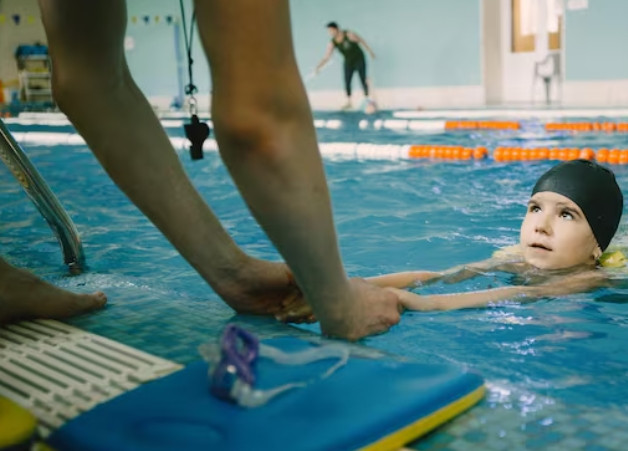
At a Hampshire recreation center on a soggy Tuesday morning, a line of parents extends from the front desk nearly to the parking lot. Some people have a toddler in one arm and towels rolled under the other. Some are frowning as they browse through booking apps. The majority are not here to swim. They are waiting for a time slot any time slot to enroll their child in classes that are frequently already reserved through the spring of the following year.
This is a close-up view of the swimming school boom in 2026. Not ostentatious, Not overly dramatic just constant, unrelenting demand that appears to surpass both the industry’s capacity to train new instructors and new pools. A portion of the story, but not all of it, is revealed by the numbers.
According to Swim England’s most recent data, only 52% of kids graduate from primary school with confidence in their ability to swim, meaning that about half of all eleven-year-olds in the nation are unable to swim 25 meters without assistance. After years of sitting there, that gap has subtly developed into a market. Once a specialized area of the leisure sector, private swim schools are now a multimillion-pound industry. Additionally, it is expanding in ways that even the operators weren’t prepared for.
| Information | Details |
|---|---|
| Industry | Private Swim Education (UK) |
| Featured Organisation | World of Swimming (formerly Wessex Swim School) |
| Operating Regions | Hampshire, Dorset, Wiltshire, Oxfordshire, London |
| Years Active | 20+ years |
| Recent Expansion | Four new locations + Oxford Swim Academy acquisition (April 2026) |
| Accreditation | STA Mark Accredited Swim School |
| Key Statistic | Only 52% of UK children leave primary school as confident swimmers (Swim England) |
A helpful window into the trend is provided by World of Swimming, formerly known as Wessex Swim School. Three of the company’s enduring brands Wessex, Totton, and Radley were unified under a single brand earlier this year. It expanded into Oxfordshire by acquiring Oxford Swim Academy in April 2026, offering new classes in Oxford, Abingdon, and Didcot. London Swim School, a new branch that is positioned as a high-end option for families in the capital, is scheduled to open in January. Earlier in the year, four more locations opened. In any other industry, private equity would pay close attention to this type of growth curve. Perhaps it has already done so.
What is causing all of this? A portion of it stems from parents’ slow-burning anxiety, which has been intensified by a series of public discussions regarding water safety. Speaking with families, it seems that they no longer have faith in the school’s swimming facilities. The council pools are no longer open. The amount of time spent on the curriculum has decreased. When lessons do occur, they are frequently crowded, short, and split between two classes. As a result of seeing this, parents have begun to cast ballots using their wallets, which are now more accessible than before.
That confidence is reflected in the price. These days, small-group lessons with four to six students, structured progress reports, and instructor continuity typically cost between £15 and £25 per session. You can start to see the appeal for operators when you multiply that over a thirty-week period. It’s also important to remember that during recessions, demand remains stubbornly high. Parents will spend less on tutoring, dining out, and holidays. They usually don’t skip swimming lessons. Perhaps because the coastline is only seventy miles away, there is a part of the British psyche that views this specific skill as indispensable.
The story’s labor component is more intriguing than it first seems. In the past, swim instructors were part-timers, students, or retirees taking on shifts. Operators such as World of Swimming are now promoting swim teaching as a career, complete with internal advancement: Swim Assistants, certified instructors, the recently established Swim Manager position, and Operations Managers who oversee regional pools. It’s a subtly important change. You stop losing your best teachers to physiotherapy courses and primary teaching diplomas when you build a career ladder.
In contrast, baby swimming has developed into its own microeconomy. Six-month-old and toddler lessons, which are heavily advertised on Instagram and through NCT networks, are now more popular than adult sessions in some cities. The awarding organization, STA, has tracked this expansion for almost ten years, and the trend hasn’t slowed. If anything, the post-pandemic wave made it worse. After spending two years indoors with their babies, parents appeared determined to provide their kids with all the physical and sensory experiences they had been deprived of.
This image isn’t entirely perfect. The biggest obstacle to expansion is still pool availability. Energy costs are frequently blamed for the alarming rate at which council-owned facilities are closing. Lesson costs remain high and lower-income families are virtually completely shut out because schools with their own pools are renting them out at premium rates. Walking past these shiny new private programs, it’s difficult to ignore the fact that the swimming crisis that Swim England warns about is, in many respects, being resolved for the families who can afford it while subtly getting worse for those who cannot.
It seems like the industry is about to face a moment of reckoning as you watch this develop. For a select few, the private sector is effectively carrying out what the public sector arguably ought to be doing. It’s still unclear if that turns into a political problem or just solidifies into a two-tier system that will last forever. As of right now, the pools continue to fill, lines continue to form, and the next location will open the following month.
i) https://www.worldofswimming.co.uk/latest-news/a-year-of-growth-change-and-new-opportunities-at-world-of-swimming
ii) https://swim-ed.co.uk/the-importance-of-swimming-education-in-englands-primary-schools/
iii) https://www.swimdesignspace.com/blog/uk-swimming-crisis-why-millions-cant-swim