

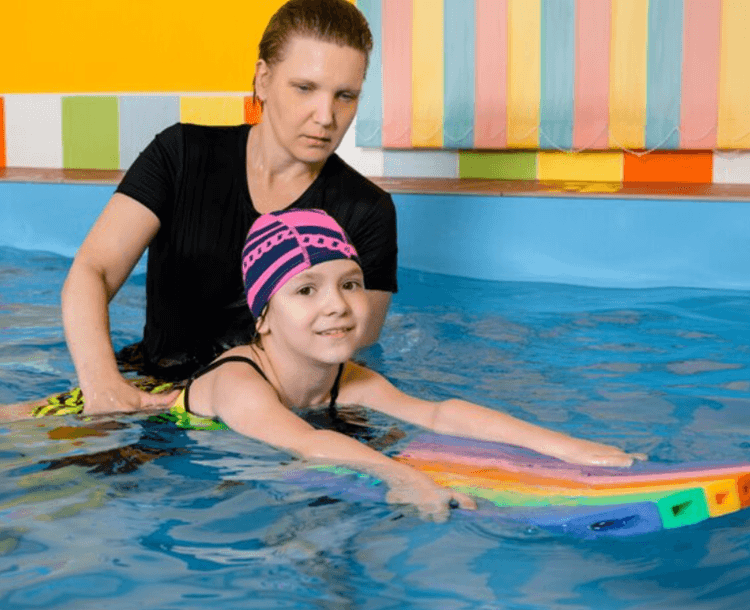
Around four in the afternoon, a certain kind of silence descends upon a children’s swimming pool. A parent half-watching from the bleachers while feigning to read, a coach standing waist-deep giving muffled instructions, a softer hum, the slap of tiny feet on tile not quite silence. Something out of the ordinary usually occurs in scenes like this. After a few weeks, children who came clinging to a parent’s leg began to behave differently. calmer. A little more daring. Parents are the first to notice the subtle change.
For many years, pediatricians have discussed the physical benefits of swimming. Water safety, lung capacity, joint-friendly mobility, cardiovascular health the list is extensive and well-researched. However, the more subdued return on investment has been receiving more attention lately. the sentimental one. Coaches, child psychologists, and parents who have witnessed the change firsthand are beginning to believe that swimming may be helping children develop emotionally in a way that other childhood activities don’t quite manage.
| Topic Snapshot | Details |
|---|---|
| Subject | Swimming as a tool for emotional intelligence in children |
| Age Range Most Studied | 6 months to 12 years |
| Key Benefits Observed | Emotional regulation, stress reduction, confidence, focus, social skills |
| Notable Research | Griffith University (Australia) study on early swimmers showing advanced cognitive and language milestones |
| Recommended Frequency | 1–2 structured sessions per week, per pediatric guidance |
| Reference Source | American Academy of Pediatrics – Swim Lessons Guidance |
The water itself is a part of it. It is difficult to replicate the calming effects of water on the nervous system on land. The buoyancy that relieves the body’s weight, the rhythmic strokes, and the sound of breath against the surface all have the same effect on a child as rocking does on a baby. Cortisol levels fall. Heart rates stabilize. It’s the closest thing to meditation that a six-year-old will voluntarily endure, and the majority of them are unaware that they’re doing it.
Then there is the part that takes place above the surface and is more visible. By February, a child who was unable to submerge her face in the water in October is jumping off the side and giggling. The overall result is something akin to resilience, but the progression is sluggish and uneven, full of minor setbacks and unanticipated successes. For a child, mastering a floating drill, completing a freestyle segment without panicking, and recovering from a mouthful of chlorinated water are not insignificant tasks. They serve as practice sessions for all the more difficult things that lie ahead. It’s difficult to ignore the fact that children who manage to overcome that initial discomfort typically leave the locker room with a different kind of steadiness.
Experienced coaches frequently identify a moment that everyone can relate to. A young girl refuses, shakes her head, and clings to the wall. The teacher doesn’t exert pressure. Perhaps she lets go for a moment during the next lesson. The following lesson is a bit longer. No big announcement is made. However, at some point during that period, a child discovers that her body can be trusted, that effort yields results, and that fear is not a permanent condition. It almost doesn’t matter if she ever competes in swimming.
It’s easy to undervalue the additional layer that group lessons add. These emotional skills are wrapped up in what appears to be a sports class: children waiting their turn at the wall, watching another child try and fail and try again, and learning to applaud someone else’s accomplishments. Here, empathy is practiced without a name. Patience is also important. The minor social negotiation of sharing a lane, a space, and an instructor’s attention does the same. When families bring children in for social or anxiety issues, therapists often notice this. Nobody is saying that swimming can take the place of therapy. However, it frequently comes up as something that was helpful.
Children who began swimming early demonstrated earlier development in language and cognitive milestones than those who did not, according to Griffith University research that has been frequently referenced in this discussion. Researchers continue to exercise caution when determining what causes what. It might be the swimming itself, the organized one-on-one care, or the families who are dedicated enough to attend on a weekly basis. We still don’t know a good deal. However, the pattern persists in study after study, and it is difficult to ignore.
Parents are aware of their own interpretation of the data, which typically comes in less quantifiable forms. After Tuesday lessons, a child who used to lose it at bedtime now goes to sleep in ten minutes. On a family vacation, a child who previously refused new foods will suddenly try octopus. That doesn’t require a scientific paper, but there isn’t one. As you watch this happen, it becomes evident that teaching strokes is not the only thing the pool is doing. It teaches a child more subdued lessons about living in her own body, controlling emotional outbursts, failing in front of others, and getting back up the following week.
Perhaps that is the true justification for swimming lessons, the one that isn’t mentioned in safety pamphlets. Yes, confidence in the water. Naturally, survival skills. Almost coincidentally, though, there is a child who understands how to slow down, take a deep breath, and attempt the thing that scared her the previous week. That is not insignificant. In the end, that could be crucial.
i) https://easy2swim.com/the-impact-of-swimming-on-emotional-regulation-in-young-children/
ii) https://kidscanswimcanada.ca/how-swim-lessons-build-confidence-resilience-and-emotional-intelligence-in-children/
iii) https://goldmedalswimschool.com/the-role-of-swimming-in-child-development-and-motor-skills/
iv) https://www.nereids.com.au/blog/how-swimming-helps-children-with-stress