

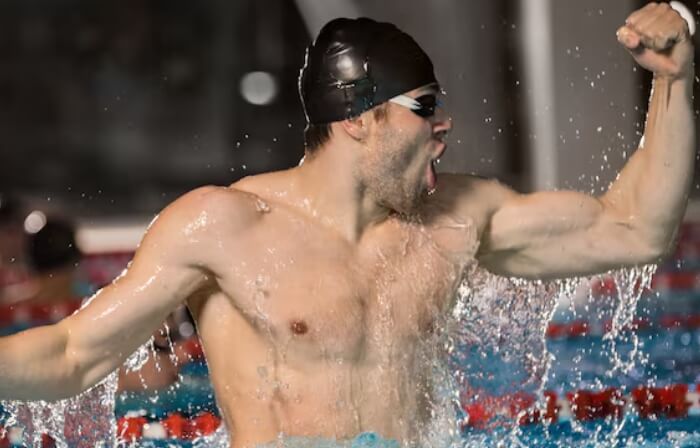
There’s a moment, usually in the middle of the morning at a public pool, when you notice something subtly intriguing. A man in his forties who appears to be rediscovering his body after a long absence from exercise, a young woman with goggles and a training plan, and a retired schoolteacher performing a slow, deliberate breaststroke share the lanes. That range is not possible in any other sport. Not anything you’d find in a gym, not cycling, not running. It’s possible that swimming has always been this accessible, giving, and forgiving; we’ve just been too preoccupied with more fashionable activities to notice.
Swimming’s flexibility is more than just physical, though it is. It is structural. A genuinely uncommon sport that works for both a competitive athlete training twice a day and someone with a bad knee who can’t climb stairs without wincing. Swimming for 20 to 30 minutes three times a week is advised by Professor Hiro Tanaka of the University of Texas, Austin, whose studies on water-based exercise have received numerous citations. He says, “Keep moving in the water.” That’s the entire prescription. There is no age restriction, no specific body type needed, and no special equipment.
| Category | Details |
|---|---|
| Sport | Swimming |
| Classification | Aquatic / Low-Impact / Full-Body Sport |
| Governing Body | World Aquatics (formerly FINA) |
| Founded | 1908 (international governance) |
| Practiced In | 200+ countries worldwide |
| Key Health Bodies Endorsing It | NHS, British Heart Foundation, American College of Sports Medicine |
| Notable Figure | Katie Ledecky — holds the 17 best times in history for the 1500m freestyle |
| Recommended Frequency | 3x per week, 20–30 minutes per session (Prof. Hiro Tanaka, Univ. of Texas) |
| Calories Burned | 200–400 per 30-minute session (Swimming.org) |
| Reference Website | World Aquatics — worldaquatics.com |
The joints are typically where the physical case for swimming begins, but it doesn’t stop there. The skeleton isn’t grinding under repeated impact like it is on pavement because a large amount of your body weight is supported by the water. This is particularly important as people age, recover from an injury, or simply lose interest in suffering. The low-impact nature of swimming allows the cardiovascular system to work hard without the surrounding infrastructure suffering too much, which is why the British Heart Foundation lists it as one of the recommended forms of exercise for people managing heart disease.
The benefits of swimming above the neck are perhaps less well known. According to research that Prof. Tanaka cited, submerging oneself in water increases blood flow to the brain in a measurable way. The majority of a swimmer’s time is spent horizontal in the water, either prone or supine, which facilitates easier blood flow to the brain than upright activities like running or cycling. Just seven days of swim training enhanced memory in rats, according to a study. Human tests produced similar results. It seems that most people still view swimming mainly as a physical activity, even though there may be just as many neurological advantages.
When people watch elite swimmers move, they become genuinely curious about the question of flexibility. The range of motion, the ankle extension, the shoulder rotation, and the way the body appears to have no set limit on where it can bend are all almost unsettling. It turns out that the truth involves both training and genetics, in amounts that scientists are still figuring out. Swimming appears to recruit and strengthen the supporting muscles surrounding joints, and flexible ligaments and tendons play a significant role. Those fluid, nearly boneless-looking movements are the result of a combination of natural flexibility and developed strength. The pool shapes its surroundings, while genetics shapes the skeleton.
The 27-year-old Katie Ledecky has the 17 fastest times ever recorded in the 1500-meter freestyle. When you watch her race, you get the impression that she’s not giving it her all, but rather that her body has figured out a way to work with water that most people can’t. Even a casual observer would find it difficult to ignore how little she seems to disturb the surface. Over years, serious swimming develops that efficiency, that specific type of ease-under-load. In smaller, less dramatic ways, it’s also a representation of what regular swimmers begin to experience.
The pool provides something that land-based sports just cannot match for individuals with injuries. Because water resists movement more than air, walking vigorously in the shallow end of a pool offers significant cardiovascular benefits. According to Prof. Tanaka, “you tend to walk harder in the water compared to on land.” It’s a useful fact that the resistance is provided by the medium itself, so even mild effort produces real results. The evidence has been building for years, but it’s still unclear if the majority of people who would benefit from water-based exercise are aware of this.
According to the NHS, swimming can improve mood and lower stress. Although it’s less noticeable than the flexibility and cardiovascular advantages, it might be what draws people in. Other workouts don’t provide the same level of immersion insulation from noise, notifications, and everyday friction. It’s difficult to determine if that’s the hydrostatic pressure or just the forced concentration needed to breathe properly. The impact is genuine and intensifies.
You won’t become wealthy or well-known by swimming. You might not even lose weight quickly as a result. It offers something more difficult to produce: a sport that adapts to the individual rather than requiring the individual to adapt to it. Physical, logistical, and lifelong flexibility is becoming less common. And more and more people appear to be taking notice.
i) https://www.bbc.co.uk/programmes/articles/5Y9qZzcKDYdVxSDdM9gxGqY/why-swimming-could-be-the-best-exercise-you-do
ii) https://www.swimathon.org/blog-posts/why-swimming-is-the-best-sport
iii) https://www.swimnow.co.uk/health-and-wellbeing/benefits-of-swimming/
iv) https://www.mitrecsports.com/aquatics/why-swim-is-the-superior-workout/