

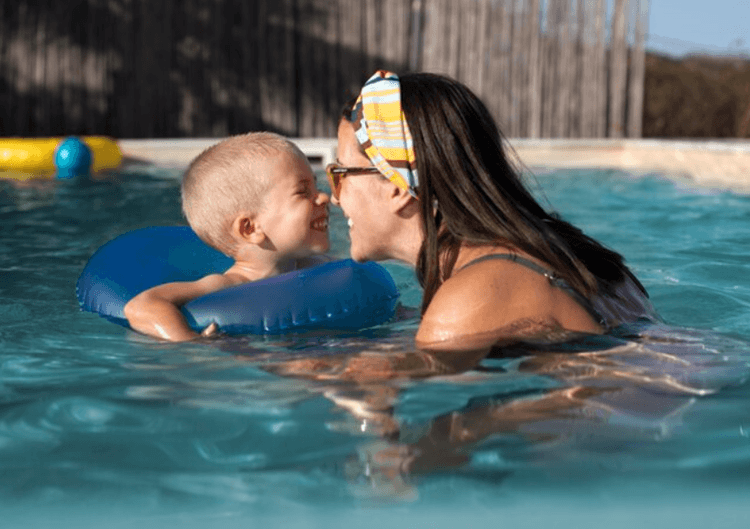
Watching a child push through chest-deep water with their arms moving in slow, deliberate arcs and their face torn between pure joy and concentration seems almost archaic. Almost every neighborhood pool has a parent leaning against the railing on a Saturday morning. A child who refused to submerge their face in the water two months ago is now calling for “one more lap.” It’s a brief scene that’s easy to overlook.
Most viewers are unaware that something genuine is happening to a developing body in this type of scene. Children’s water resistance training occupies an odd place in the fitness discourse. The low-impact appeal, the way it spares aging joints, and the surprisingly hard workout concealed in what appears to be gentle movement are all topics of constant discussion among adults.
For children the topic of drowning prevention, lessons, and swim safety usually comes up. Important things, of course. There’s a deeper level that parents appear to be gradually realizing: even though no one is referring to it as such, water itself is performing significant strength training.
| Information | Details |
|---|---|
| Topic Focus | Water resistance training for children |
| Primary Benefit | Strength building with minimal joint impact |
| Recommended Age Range | 4 years and above (with supervision) |
| Session Duration | 30 minutes in water ≈ 2 hours of land-based exercise |
| Water Density Factor | 800 times denser than air |
| Key Physical Gains | Endurance, coordination, posture, lung capacity |
| Cognitive Gains | Memory, focus, spatial awareness, problem-solving |
| Safety Standard | Certified instructor supervision, structured progression |
| Recommended Frequency | 2–3 sessions per week |
The elegance of the physics is almost unfair. Every kick, push, and reach becomes a tiny act of resistance because water is about 800 times denser than air. No barbell is present. Not a machine. No coach screaming about reps. Just the medium itself, gently pressing back in all directions.
That matters in ways that land-based strength training just cannot match for a child whose growth plates are still soft and whose joints are still forming into their adult shape. It’s difficult to ignore how much pediatric medicine has changed in this regard. Ten years ago, there was a subtle reluctance to discuss children and “strength training” because of concerns about overtaxing young bodies. Although the mindset has relaxed, caution is still present, and for good reason. Most of that concern is avoided by water. The child’s effort determines how much resistance they encounter.
The water pushes back harder when you push harder. It gets easier if you slow down. There isn’t an outside force that could compress a spine or crush a wrist.
Every time, the child sets the ceiling. Coaches who have experience in both settings frequently use strangely poetic language to explain the differences. In the words of one instructor at a community pool, children battle gravity on land, but gravity always prevails in the end.
They bargain with it in the water. Beyond just building muscle, that negotiation develops a sense of body intelligence and an understanding of how movement truly functions. Youngsters learn to brace their core because the water requires it, not because someone told them to. You sink a little when you kick weakly. When you engage correctly, you glide. The feedback is instantaneous, truthful, and hard to fabricate.
Additionally, there’s the issue of what occurs above the surface, which merits greater consideration than it typically receives. Kids are usually more in control during pool sessions than they are during screen-heavy afternoons. Researchers are still figuring out how the cool sensory wrap of water, the rhythmic breathing, and the lack of background noise affect the nervous system. Children who are anxious appear to soften. Children with a lot of energy burn off the energy without crashing. Before the studies do, parents become aware of it.
It would be dishonest to pretend that everything about water training is flawless. The quality of programs varies greatly. Splashing with a nearby whistle can be the extent of a poorly conducted session.
Structure is necessary for effective water resistance training, including a variety of movement patterns, a progression over several weeks, and an instructor who truly understands child development rather than just performing drills. Sometimes parents need to search farther than they anticipate to find that in cities with crowded fitness markets. Another silent obstacle is cost.
In many areas, access to pools is still restricted to private clubs or specialized facilities, and quality programs are expensive. There’s a fairness question buried in all of this that the wellness industry hasn’t really wanted to address that the safest. The most developmentally beneficial type of strength training for kids is also one of the least widely available. Even so, when families do find the ideal configuration, the change usually manifests itself in areas that no one was monitoring. When doing homework, adopt better posture. better rest.
an unexpected openness to experimenting with different physical activities. Sharper focus is sometimes mentioned by teachers, but it’s a difficult observation to pinpoint. observing a young child diving for rings on the pool floor after previously flinching at deep water. You get the impression that something more than just muscle has been constructed. They may have a relationship with their body that lasts for decades.
Observing all of this in parks, pools, and after-school programs gives me the impression that water training is one of those subtly transformative practices that will likely not receive the cultural attention it merits. It is not a good photographer. It doesn’t follow any trends. It simply keeps working, session after session, developing strong children in the safest manner yet discovered.
i) https://www.lotusfitness.in/post/swimming-and-strength-how-water-training-helps-children-build-fitness-without-stressing-their-joint
ii) https://fitnesschamps.com.sg/how-swimming-supports-kids-growth-and-development/
iii) https://waterresist.com.au/blogs/news/advantages-of-resistance-training
iv) https://www.marlboromontessoriacademy.com/detailsblog/bestswimmingexercisestoboostyourchildsfitness