

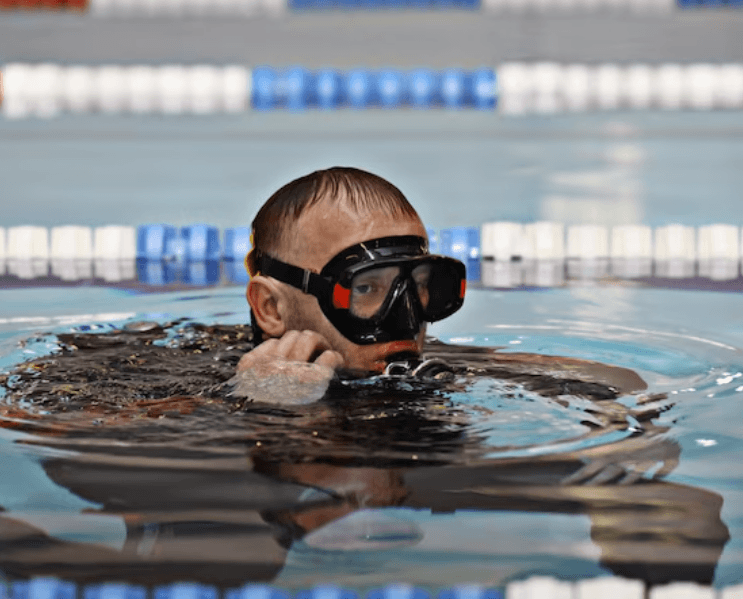
Parents of young swimmers seem to have similar descriptions of a certain moment—a sort of quiet surprise. After swim practice, their child, who previously had trouble staying still during a ten-minute homework session, just… focuses. takes a seat. Watching a six-year-old attempt a freestyle stroke for the fortieth time by the pool probably feels anecdotal.
The underlying science is anything but gentle. Australia’s Griffith University examined this question in detail for four years. More than 7,000 parents of children under five were surveyed. and conducting thorough evaluations on 180 children aged three to five.
| Category | Details |
|---|---|
| Topic | Cognitive Benefits of Swimming for Children |
| Key Research Institution | Griffith University, Australia |
| Study Duration | 4 years |
| Children Surveyed | 7,000+ under age five |
| Intensive Assessment Group | 180 children aged 3–5 |
| Key Cognitive Benefits | Memory, focus, language development, spatial awareness, academic performance |
| Neurological Mechanism | BDNF production, hippocampal growth, bilateral brain stimulation |
| Reference | Griffith University Research |
It was difficult to ignore what they discovered: kids who regularly swam were learning language, math, and motor skills at a quantifiably faster rate than kids who didn’t. The advantages of swimming were more noticeable the earlier it began and the longer it continued. It’s not a minor discovery tucked away in a footnote.
Four years worth of data indicate that the trend is consistent. Blood is the first component of the mechanism. As aerobic exercise, swimming raises heart rate and increases the amount of oxygenated blood that reaches the brain. One study conducted by Australian researchers. Canada. Furthermore, compared to standing on dry land, the United Kingdom discovered that merely standing chest-deep in water—prior to any swimming at all—significantly increased cerebral blood flow.
It turns out that water’s hydrostatic pressure lowers vascular resistance and facilitates more effective blood flow to the brain. When you combine that with real movement, the effect intensifies. Increased blood flow causes the brain tissue to receive more oxygen and nutrients, which results in better memory, sharper focus, and quicker reasoning.
However, swimming has a more targeted effect than aerobic exercise in general. It activates the hippocampus, which is the part of the brain most closely related to memory consolidation and learning. Regular swimming training has been shown to improve spatial memory and increase the production of new neurons in the hippocampus in animal models.
Although the human brain is not the same, it is difficult to ignore the similarities. When studying physical activity and brain development, cognitive researchers frequently return to swimming for a reason. Few other activities may be able to replicate the neurological environment created by the combination of water immersion, rhythmic movement, and controlled breathing.
The bilateral coordination component comes next. swimming. unlike cycling or running. demands synchronized movement from both sides of the body. The left arm pulls while the right recovers in alternating patterns. The rhythm of the leg kicks crosses the midline of the body.
The neural connections between the left and right hemispheres of the brain are strengthened by what scientists refer to as bilateral stimulation. These relationships are not coincidental. They help with language processing, emotional control, and reading.
For the same reason, occupational therapy has employed cross-body movement exercises for kids with developmental delays. Every lap, at every skill level, swimming does this organically. For parents and teachers, the focus element is probably the most obvious. Swimming demands of kids something that most activities don’t: intentional, instantaneous attention to several inputs at once. the timing of a breath. the hand entry’s angle.
the number of strokes applied to the wall. Kids can’t relax in the water like they can on a soccer field or in front of a screen. The brain’s attentional systems seem to be trained by that persistent mental engagement, session after session.
Regular swimmers outperform non-swimmers on attention-switching tasks, according to studies, indicating that the demands of the pool are more than just increasing physical stamina. They are strengthening their mental stamina. The implications are especially significant for kids with ADHD.
Swimming strokes provide hyperactive minds with a tangible anchor because they are repetitive and patterned. The paced breathing exercises frequently recommended in cognitive behavioral therapy for anxiety and attention regulation are similar to the rhythmic breathing needed for swimming. The pool seems to provide a structured neurological reset. a sensory-rich setting where something tangible replaces the typical noise of overstimulation. rhythmic. and appropriately demanding.
Additionally, swimming generates brain-derived neurotrophic factor, or BDNF, a protein that promotes brain cell growth and repair while fortifying synaptic connections. Although it’s sometimes referred to as “fertilizer for the brain,” which is an overly neat metaphor, the underlying truth is sound. Sedentary cognitive work alone is less likely to increase BDNF production than physical exercise that simultaneously challenges the body and the mind.
Swimming seems to be especially good at this because of its full-body demands and mental coordination requirements. The precise amount of benefit that comes from swimming in particular, general aerobic fitness, and the structured learning environment that swim lessons offer is still genuinely unknown. During a swim lesson, a child must simultaneously follow instructions, count seconds, remember sequences, modify technique based on feedback from the instructor, and collaborate with peers.
Early swimmers tend to transfer those skills so naturally into academic settings, which may be explained by the cognitive load that closely resembles that of a classroom. It’s challenging to separate the biology from the environment and the water from the lesson. The direction that the research continues to point in is less ambiguous.
Swimming regularly, beginning at a young age and continuing consistently, seems to develop the type of brain that learns well. It improves focus and memory, and it might be especially helpful for kids who have trouble controlling their attention. No single activity is a magic bullet.
It’s a really captivating one. It’s also difficult to ignore the fact that something genuine is going on beneath the surface when you see a child who couldn’t stay still for ten minutes finish their homework without complaining after swim practice.
i) https://www.swimscoil.ie/post/the-magic-of-swimming-how-it-helps-kids-grow
ii) https://www.swimdesignspace.com/blog/swimming-brain-health-mental-and-cognitive-benefits-for-all
iii) https://www.ocaquatics.com/benefits-of-swimming-for-children-brain-development
iv) https://kidscanswimcanada.ca/how-swimming-helps-children-think-smarter-focus-better-and-learn-faster/