

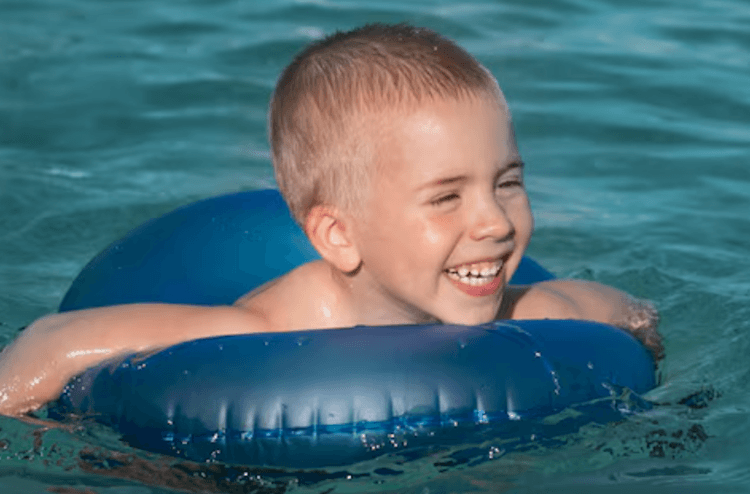
A group of 7 years old are waiting for their instructor to call them in at the edge of a municipal pool in Stockport on a Tuesday morning. They have goggles pushed up on their foreheads. It’s possible that those same kids were chasing a ball on a muddy field twenty years ago. Something has changed. Swimming has quietly gained popularity in British families, not only as a pastime but also as the sport that parents prioritize. There is no official campaign to commemorate this development.
Football’s dominance may have always been more of a cultural presumption than a true preference. When you ask a parent in Britain today what sport they would most like their child to learn, the response is increasingly not what you would anticipate.
Seven out of ten parents in the UK now believe that swimming is the most crucial sport for their child to learn, surpassing football, gymnastics, and athletics put together, according to research from the Swimming Teachers’ Association. Sixty-two percent go so far as to describe it as a vital life skill. That framing is important. Football is not regarded as a life skill.
| Category | Details |
|---|---|
| Topic | Children’s Sport Participation – Swimming vs. Football in the UK |
| Key Organisation | Swim England / STA (Swimming Teachers’ Association) |
| Founded | Swim England: 1869 (as the Amateur Swimming Association) |
| Headquarters | Loughborough, England |
| Key Statistic | 70% of UK parents consider swimming the most important sport for children |
| National Crisis | Roughly 1 in 3 UK adults (approx. 14 million people) cannot swim 25 metres |
| Accidental Deaths | 193 people drowned accidentally in the UK in 2024 |
This change seems to have been more influenced by a series of minor realizations than by a single trend. Unlike nearly every other sport that kids are forced to participate in, swimming has the potential to save their lives. In the UK, 193 people unintentionally drowned in 2024 alone.
After reading this statistic, it is difficult to ignore the fact that child drowning deaths in England doubled over a four-year period. Parents who grew up watching their children kick a ball around the park are now more concerned about what might happen if the same child is swept off a Cornwall beach or falls off a boat. Then football won’t be of any use to them.
It’s also becoming more evident that swimming does more than just develop swimmers, something that took researchers a surprisingly long time to prove. According to a thorough study conducted in Australia by the Griffith Institute for Educational Research, children who regularly swim during their early developmental years are quantifiably better than their peers in oral expression, mathematical reasoning, and story recall.
The results are startling enough to quote: children who could swim were, on average, thirty months ahead in understanding directions and seventeen months ahead in recalling stories. The literacy and numeracy results, according to the lead researcher, were “shocking.” It’s difficult to ignore the fact that no one is releasing comparable football data.
Although the physical case has always been clear, it is worth reiterating. By using controlled breathing techniques, swimming increases lung capacity. It makes the heart stronger. From an early age, it develops both fine and gross motor skills. Additionally, the workout is intense without being harmful because water supports 90% of the body’s weight while offering 12–14% more resistance than air.
There are no growth plate injuries, ankle sprains in the pool, or other minor mishaps that subtly put an end to kids’ passion for land-based sports. Swimming is “the ultimate all-in-one fitness package”, according to Olympic gold medallist Janet Evans, and that statement has held up pretty well.
Then there is the aspect of mental health, which seems especially pertinent at the moment. The NHS has recommended swimming as a component of programs for managing anxiety. Endorphins are released as a result of physical exertion; breathing rhythmically is naturally calming; and noise is muffled by sensory immersion.
Regular participants exhibit better sleep, more resilience in the classroom, and better mood regulation. Although it’s still unclear how much of this is due to exercise in general versus the water specifically, teachers who work with kids on a daily basis will tell you that the pool has a unique quality. When in the water, children who are nervous on land frequently find it easier to remain motionless and concentrated.
It’s important to consider why this change affects more than just specific families. There is a known swimming crisis in the UK, but it receives very little attention. Since 2010, over 400 public pools have closed. The percentage of kids who can’t swim a single 25-meter distance at the end of primary school is almost one in three, and it’s getting worse.
Pool closures have been more than twice as severe in underprivileged areas as in wealthy ones, resulting in an increasing access gap that requires structural support in addition to parental zeal. The infrastructure that supports swimming is being taken away at the same time that swimming’s cultural status is rising.
The real story lies in the conflict between parents who desire swimming and a system that is becoming less and less able to provide it. Fields, parks, school playgrounds, and a century of embedded provision are all beneficial to football. Heated water, qualified instructors, and well-maintained facilities are necessary for swimming.
In a survey conducted by the STA, only 8% of parents reported that their child takes swimming lessons at school. The others either don’t receive it at all or pay for it privately. For many families, the logistics of getting a wet child home on a weeknight, membership fees, and rigid pool opening hours continue to be major obstacles.
Parents continue to select the pool in spite of everything. There’s a sense that this has less to do with swimming being trendy and more to do with it being fundamental; somewhere in the accumulated stress of contemporary parenthood, being able to keep a child safe in the water has become more important than being able to win a match.
In British culture, football will always have a place. The Saturday morning ritual, the roar of a crowd, and tribal loyalty are all enduring. However, the sport that parents prioritize teaching their kids before anything else is evolving. It also has the potential to keep them alive in the future.