

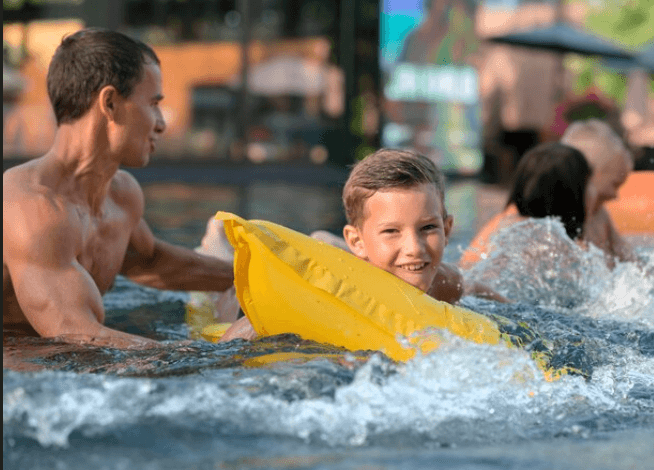
Last winter. A swimming instructor in a small West Yorkshire town informed me that there were forty-three kids on her waiting list. For a single afternoon session at a recreation center that was just a few weeks away from closing three years prior. She appeared almost ashamed of it, as though acknowledging the demand itself were a difficult thing to do.
It’s not limited to Yorkshire; it’s occurring nationwide. Smaller UK towns those that are hardly noticed outside of their own postcode are discreetly reconstructing something that almost vanished during the pandemic years. Considering the magnitude of what was lost, it is worthwhile to pause. Since 2010. More than five hundred public pools have closed. A startling portion of these closures occurred after 2020. When energy costs skyrocketed and councils started making decisions that no one wants to be associated with.
Approximately 14 million adults in Britain, or one in three, are unable to swim a single 25-meter distance. The statistic is equally depressing for kids dropping out of elementary school. Speaking with teachers in places like Skipton, Bridgwater, or Whitehaven gives the impression that the nation stumbled into a problem it didn’t fully realize it had.
| Key Information | Details |
|---|---|
| Topic | Growth of swimming lessons in small UK towns |
| Sector | Community sport, leisure, education |
| Governing body referenced | Swim England (national governing body for swimming in England) |
| Notable statistic | 74% of children leave primary school unable to swim 25 metres unaided (Swim England) |
| Workforce data | Around 90,390 teaching hours per week delivered in England |
| Survey scope | 288 swim school providers teaching 50,000+ babies and infants weekly |
| Pool closures | Over 500 public pools closed since 2010 |
| Scotland’s progress | 56% increase in people learning to swim through Learn to Swim programme |
Something is changing. In towns where the council pool no longer seems dependable, small private swim schools have been proliferating, frequently operating out of hotel pools, school facilities rented out in the evenings, or renovated community centers. After a near-miss on a beach vacation, parents who previously believed that swimming was taught in schools have discovered that they can no longer rely on that. They are making their own payments. It will take them twenty minutes to get there. Before their child can walk, they are scheduling lessons.
The causes are multifaceted. To put it simply, fear is a part of it. What years of courteous government messaging failed to accomplish, the headlines about drowning, pool closures, and kids leaving elementary school unable to float have. A portion of it is a result of post-pandemic recalibration. Families who spent lockdowns gazing at screens and gardens came to the nearly unanimous conclusion that they wanted their kids to engage in physical. Practical. And outdoor activities.
All three criteria were met by swimming. Silently, it’s also one of the few sports where the working-class belief that “everyone should know how” endures. The people in charge of these new schools are intriguing. Many of them are small businesses with two or three teachers. Usually women in their forties and thirties who had previously taught at council-run recreation centers and were fed up with seeing the system struggle.
They have hired pool time at odd hours, taken out small loans, and constructed something agile. Recently, the World of Swimming group in Portsmouth took on more than 250 swimmers who had transferred from another provider, offering lessons five days a week. You can learn something from that type of consolidation.
The outdated infrastructure was unable to meet the actual demand. Naturally, Scotland has done it in a more methodical manner. Participation in the Learn to Swim program has increased by 56%, in part because someone decided to make water safety a national priority rather than a recreational afterthought.
Small town growth is uneven in England because the country has been less coordinated and more market-driven. Three new swim schools are courteously competing with the council pool in certain locations. Some still have nothing within a thirty-mile radius.
In Britain, the map of who learns to swim increasingly resembles the map of people with cars and free time on Saturday mornings. The part that no one wants to talk about is the cost. Lessons that cost £6 ten years ago now cost £15 or even £20. And the difference between families who can afford that and those who can’t is getting worse.
According to data from Sport England, only 47% of kids in the most impoverished areas can swim 25 metres, compared to 69% in the least impoverished. In a way, swim schools in smaller towns are filling a gap left by the state, and those who are unable to access them are the ones who most need the state. Even so.
It’s difficult not to sense that something tenacious and positive is taking place when you watch a class of four-year-olds wearing armbands scream their way across a pool in a converted Victorian bathroom somewhere in the Midlands. Every child’s name is known to the teachers. Through the viewing window, the parents wave.
There is a community there, the kind that planners rarely manage to engineer but write reports about. Nobody is certain whether it will scale, whether the funding will continue, or whether the next round of energy bills will close fifty more pools. For now, however, the lessons continue to fill up in towns that most people couldn’t find on a map.
i) https://www.sportengland.org/blogs/swimunity-beyond-the-water
ii) https://www.sta.co.uk/news/2023/11/15/an-evolving-era-for-baby-pre-school-swimming/
iii) https://www.swimming.org/swimengland/swim-audit-2022-workforce-learn-swim-statistics/
iv) https://www.swimdesignspace.com/blog/uk-swimming-crisis-why-millions-cant-swim