

Every May, a little ritual takes place in homes all over the nation. From the loft, suitcases descend. Flip-flops from last summer come out of forgotten drawers. In the midst of all of that, a parent confronts a child who has somehow grown two sizes by holding up the swimsuit from the previous year. It’s never quite right. Seldom does it.
In the past, the children’s swimwear market was a rather uninteresting area of the retail industry. A few primary colors, a few designs, and, if you were lucky, a cartoon character. Over the past ten years, that has completely but subtly changed. Swim shorts with crocodile patterns, matching family sets that parents seem to purchase with surprising enthusiasm, and frilled one-pieces next to surf suits designed with UPF 50+ fabric can make any children’s section seem almost overwhelming.
| Quick Reference: Kids’ Swimwear Essentials | Details |
|---|---|
| Category | Children’s Swimwear & Beach Accessories |
| Common Age Range | 0–12 years |
| Core Product Types | One-piece costumes, bikinis, swim shorts, surf suits, rash vests |
| Key Features to Look For | UPF 50+ fabric, chlorine resistance, quick-dry material, secure fit |
| Popular Accessories | Goggles, swim caps, hooded towels, kaftans, surf hats |
| Recommended Sun Protection | UV-protective fabric + sunscreen on exposed areas |
| Trusted Reference | NHS – Sun and Water Safety for Children |
It’s difficult to ignore the fact that children’s preferences for swimming costumes have changed as well. Nowadays, children have opinions often loud ones and they develop them earlier. A perfectly good costume will be rejected by a four-year-old because it lacks a unicorn. In response, brands are focusing more on personality, ruffles, stripes, polka dots, neon, and animal motifs that appear to have been created during a sugar rush. As a result, the category now feels like it belongs to the children who wear the clothing rather than just the parents who purchase it.
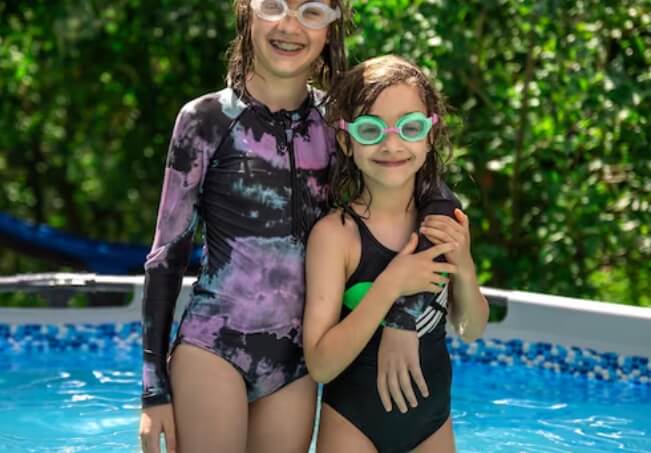
A more significant change is taking place beneath the design clutter. Brands have noticed that parents are paying more attention to sun protection than they used to. One of the more intriguing developments in the category has been the emergence of the surf suit, which is essentially a long-sleeved, leg-covering swimsuit made of sun-safe fabric. They were uncommon outside of Australia ten years ago. They are now ubiquitous, sitting alongside conventional swimwear on store floors as though they had always been a part of the lineup. They have long been recommended by dermatologists. Parents might be paying attention at last.
A more subdued discussion concerning durability is also taking place. Any parent who has witnessed a cheap swimsuit turn to a depressing, pilled grey by August will understand how chlorine destroys regular fabric in a matter of weeks. Chlorine-resistant blends that maintain their color and shape throughout the entire holiday season and beyond are now used by the better brands, which charge a little more. Depending on how frequently the swimsuit is used, it may be worth the additional ten or fifteen pounds. The math is simple for families who go to the local pool every week and take vacations twice a year.
Additionally, accessories have become more prevalent in ways that, until you try them, seem a little excessive. One such example is the hooded towel poncho. When you watch a shivering five-year-old climb out of the sea with chattering teeth, you realize that wrapping a towel around a wriggling child is one of the little, underappreciated miseries of parenting, even though it looks gimmicky in the catalog. In roughly three seconds, the poncho solves the problem. A generation ago, there was no such thing as goggles, swim caps, or kaftans for the walk back to the apartment. They are now commonplace.
Observing the category’s evolution, it seems that swimwear is now treated more like the rest of children’s apparel, with opinions, identity, and a hint of theater, rather than just being functional. Depending on who you ask, that may or may not be a good thing. Some parents complain that everything is now overly complex, costly, and matchy-matchy. Some people adore it. Getting something that fits, protects the skin, lasts a holiday, and looks like the child enjoys wearing it is probably the middle ground the one that most families actually live in. The remainder is merely shopping.
When you think about it, packing for the holidays has always been a bit of a quiet negotiation between what parents want their kids to wear and what the kids will actually consent to. In the middle of that negotiation is a swimming costume. If you do it correctly, the suitcase will close effortlessly. If you make a mistake, people will talk about it by the pool for the whole week. It’s likely that there are worse issues.