

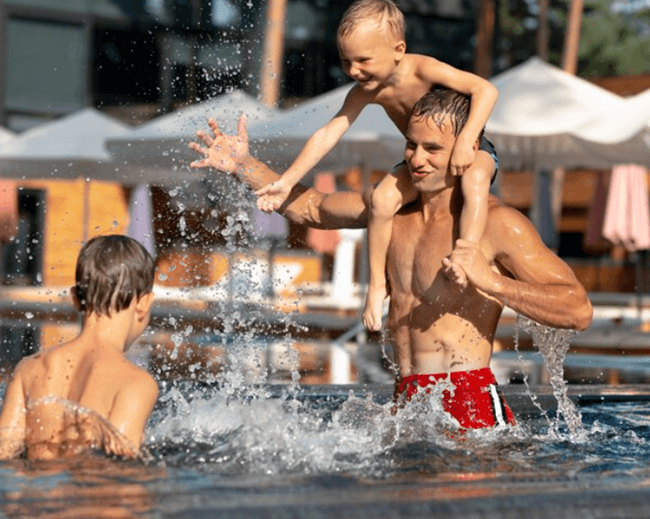
Just before the toddler classes start on a weekday morning, a certain silence descends over a public pool. The water is level. A stack of foam noodles is rearranged by a lifeguard. Then the door opens and all of the noise comes at once: babies in tiny neoprene suits, parents juggling swim bags, and the smell of chlorine blending with milk and sunscreen. It’s not exactly the type of scene that is referred to as a fitness trend. That is what it is turning into.
Parent-child swim sessions have evolved from a specialized developmental activity to something more akin to a weekly ritual in the UK and increasingly in North America as well. According to Swim England’s recent #LoveSwimming study, parents now consider swimming to be one of the best ways to increase their preschooler’s happiness, with 96% of respondents stating that spending time in the pool just makes their child happy. In marketing decks, figures like that are frequently used the texture of the object is more difficult to depict.
| Detail | Information |
|---|---|
| Trend Name | Parent-and-Child Aquatic Fitness (often promoted as #LoveSwimming) |
| Lead Organisation | Swim England, in partnership with 10 leading UK pool operators |
| Target Age Group | Babies from 12 weeks through pre-school age |
| Typical Session Length | 25–30 minutes, weekly |
| Reported Parent Satisfaction | 96% of pre-school parents say swimming makes their child happy |
| Health Benefits Cited | Better sleep, improved coordination, parent–child bonding, reduced parental guilt |
| Estimated Annual Savings to UK Health System | £357 million (Swim England) |
| CDC Activity Statistic (US context) | Only 24% of children aged 6–17 meet daily activity guidelines |
| Spokesperson | Jane Nickerson, CEO, Swim England |
| Reference Website | swimming.org/loveswimming |
When her son was six months old, Charlotte, one of the parents highlighted in the campaign, went back to her full-time job. In the same way that some people discuss therapy, she talks about her weekly 25 minutes in the water with him. She described the brief moment when her phone stops ringing and it is just the two of them, half-floating, learning the same thing at slightly different speeds. “It’s the best time of my week”, she said. She presents it as a defense against the gradual deterioration of attention that working parents often notice without naming, rather than as an exercise per se.
Fitness angle is real and deserving of serious consideration. By all standards, it’s a workout to hold a wriggling fifteen-kilogram toddler in chest-deep water for thirty minutes. The resistance doesn’t change. It is impossible to avoid the core engagement. Parents who haven’t gone to the gym in years talk about the shaky-legged fatigue that runners experience after leaving the pool. When you combine that with the cardiovascular strain of a young child who decides to jump backwards in the middle of a lesson, you have something that actually rivals a Pilates class. It takes weeks for most parents to become aware of the conditioning effect.
The advantages are simpler to map out for the kids. According to the Swim England study, nine out of ten parents said their children’s movement and coordination had improved. According to four out of five preschool parents, their child slept better on swim days. This is a finding that ought to be posted on the side of every recreation center in the nation. Beneath all of this is a developmental layer: water familiarity starting at twelve weeks of age statistically translates into improved swimming ability later on, meaning a decreased risk of drowning. That’s a big deal. It’s the kind of long-term benefit that parents tend to overvalue years later after undervaluing it at the time.
This trend differs from the typical fitness cycle because it isn’t actually promoted as fitness. There are no leaderboards, no app subscriptions, and no influencers in matching sportswear. Mothers at the school gates are quietly recommending each other, and it’s spreading through pre-school WhatsApp groups. Seventy-nine percent of mothers who participated in the campaign reported that swimming helped them feel less guilty about being busy parents. This is a startling statistic that suggests why swimming has become popular without much commercial support. No one is registering to work out. They’re committing to an emotion.
Intriguing complications arise from the American context. Only 24% of children between the ages of six and seventeen are engaging in the recommended hour of moderate activity each day, according to the CDC. This percentage has gradually declined since the pandemic. Backyard pool culture has made an effort to close some of that gap, especially in the Sun Belt. The concept that a welcoming backyard pool with slides, waterfalls, and shallow shelves for younger children encourages more movement, more outdoor time, and, almost coincidentally, more family time together is the foundation of businesses like Pool Icons in Southern California. Meeting kids where they truly want to be is a variation on the same instinct.
It’s still unclear if this is a well-funded campaign moment or a true cultural shift. Baby yoga, toddler boot camps, and the brief craze for parent-and-child spin classes are examples of trends that have come and gone in the past, and most of them faded once the novelty wore off. Swimming offers some benefits that the others did not. It’s outdated. It’s reasonably priced. On wet days, it functions. It also carries that weight of life skills that parents find hard to dispute.
Additionally, Jane Nickerson’s more subdued point is often overlooked in favor of the £357 million health-system savings she frequently highlights. It seems appropriate that she discusses swimming as a recreational activity first, followed by a developmental one. The information about coordination and sleep is important. It is more difficult to graph the part that appears to be luring parents back week after week. The small hand clutching a forearm, the slightly perplexed face of a baby blowing bubbles for the first time, and the warm air heavy with chlorine. Even though no one is quite sure how to quantify it yet, it’s difficult not to believe that something truly beneficial is taking place when you see this happening simultaneously across so many recreational facilities.
i) https://poolicons.com/residential-pools/healthy-habits-encouraging-kids-to-stay-active-with-pool-time/
ii) https://www.swimming.org/justswim/charlotte-power-mcleod-love-swimming/
iii) https://activeforlife.com/aquafit-classes-inspire-physical-literacy/
iv) https://riverflowpumps.com/why-family-friendly-adventure-pools-are-the-hottest-trend-in-backyard-design/