

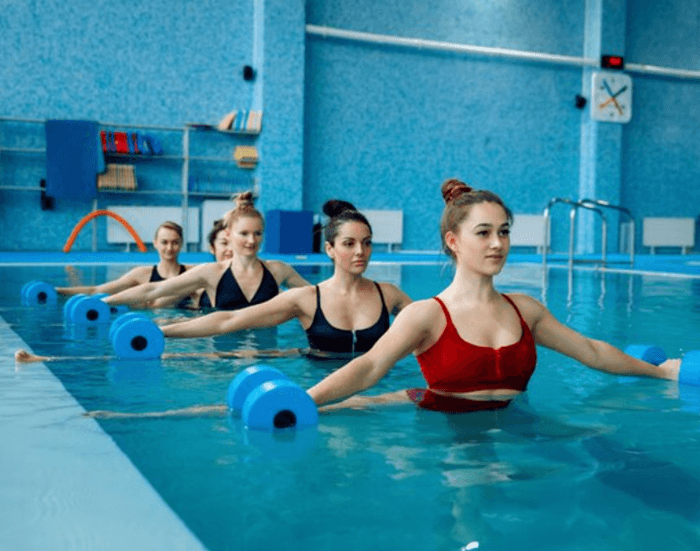
A local fitness center’s indoor pool appeared unusually crowded on a recent weekday morning. A loose circle of people bounced in chest deep water, occasionally laughing as music reverberated across the tiles, rather than swimmers making silent laps. Some were carrying foam dumbbells. Others simply made exaggerated movements with their arms to push water aside.
It may appear to be careless splashing at first. The heart rates, however, provide a different picture. Once thought of as a gentle class for retirees, water aerobics has quietly emerged as one of the most talked about low impact workouts of 2026. Professional athletes, trainers, and physical therapists appear to be rediscovering the pool as an unexpectedly effective way to develop endurance and strength without taxing the body.
| Category | Details |
|---|---|
| Fitness Trend | Water Aerobics / Aqua Fitness |
| Type of Workout | Low impact cardio and resistance training |
| Ideal For | Beginners, seniors, athletes, injury recovery |
| Typical Session Length | 45 to 60 minutes |
| Key Benefit | Full-body workout with reduced joint stress |
| Notable Organization | American College of Sports Medicine |
| Reference Website | https://www.acsm.org |
And it’s difficult to ignore the atmosphere when you watch one of these classes unfold. There is undoubtedly effort involved, but there is also a sense of lightness. This is the kind of environment that is uncommon around a squat rack.
The trend’s underlying science isn’t all that complicated. The body is supported by water. Because of buoyancy, standing waist deep in a pool can reduce body weight by about half, relieving pressure on the lower back, hips, and knees. Water provides natural resistance that air just cannot, pushing back against every movement at the same time.
Fitness instructors have long been aware of this, especially in settings related to rehabilitation. Aquatic exercises are frequently used by injured athletes to preserve conditioning and shield injured joints. However, the concept has recently expanded beyond physical therapy offices and rehabilitation centers.
Maybe what has changed is how worn out people appear to be from punishing workouts. Intense HIIT routines, boot camp classes, and marathon training were all popular forms of high impact fitness. However, many people eventually learned about the drawbacks, such as sore joints, persistent injuries, or just plain burnout. Water aerobics provides a unique experience. You can put in a lot of effort without feeling as though the earth is resisting.
In a normal session, the movements appear surprisingly easy. As if power walking through a park, participants could start with water walking, striding across the shallow end while pumping their arms. After a few minutes, the instructor incorporates alternating scissor kicks or jumping jacks, with the water slowing down each movement and subtly increasing muscle effort.
Next is treading water, which seems simple until you give it a few minutes of practice. The pool functions as “an invisible trainer pushing back on every move”, according to a recent joke made by a California instructor. Not a bad description, either. When done against the resistance of water, even easy exercises like leg lifts or arm circles suddenly become difficult.
That resistance seems doable to novices. It can be unexpectedly intense for seasoned athletes. After observing multiple classes, another noteworthy observation becomes apparent: the audience is remarkably diverse. Retirees frequently stand next to younger gym patrons. Alongside those attempting fitness for the first time are runners recuperating from injuries. The typical hierarchy of athletic ability appears to be flattened by the pool.
Additionally, people value the cooling effect more than they realize. Participants in traditional workouts frequently leave with their lungs burning and covered in sweat. Longer sessions may feel less taxing because the body remains cool in the water even when exerting itself.
It’s still exercise, of course. Depending on intensity, thirty minutes of vigorous water aerobics can burn well over a hundred calories, and occasionally even more. Pushing through water, which is about twelve times denser than air, requires constant muscle contraction.
Water has an oddly soothing effect. Although the precise cause is unclear, a number of studies indicate that aquatic exercise can lower stress and elevate mood. Perhaps it’s the cool feeling, the rhythmic movement, or just the novelty of working out somewhere other than a gym floor.
As a class comes to an end, students frequently float for a short while during the cool-down, stretching their arms as the water supports them gently. It feels more like drifting than collapsing after working out.
Access is typically simpler than anticipated for those who are interested in giving it a try. Aqua fitness classes are available at a lot of community centers and YMCA locations, and they are frequently covered by standard memberships. Additionally, informal sessions are held at hotels, swimming pools, and even some apartment buildings.
An additional layer is added by outdoor pools, particularly in warmer climates. There are occasions when morning classes take place outside, with the sound of splashing mingling with the reflection of early sunlight on the water. Compared to rows of treadmills and fluorescent gym lighting, it’s a different experience.
Eventually, some people take the routine home. Many of the exercises, such as water walking, leg lifts, jumping jacks, and core exercises, can be replicated by anyone with access to a backyard pool using a kickboard or pool noodle.
Maybe it’s the strange rhythm of coordinated splashing or the shared laughter when someone loses their balance in the middle of a jump. As you watch it happen, you get the impression that people are doing more than just working out. They are rediscovering a type of playful movement that many adults are unaware of.
Perhaps this is the covert cause of the recent surge in interest in water aerobics. Although fitness fads come and go, the pool has always been there cool, buoyant, and surprisingly difficult once you get moving.
i) https://www.everydayhealth.com/workouts-activities/list-of-water-aerobic-exercises/
ii) https://oasisbiosistema.com/en/blog/water-exercises/
iii) https://strongmamamoves.com/7-low-impact-fitness-workouts-to-regain-confidence-in-2025/
iv) https://www.webmd.com/fitness-exercise/water-aerobics