

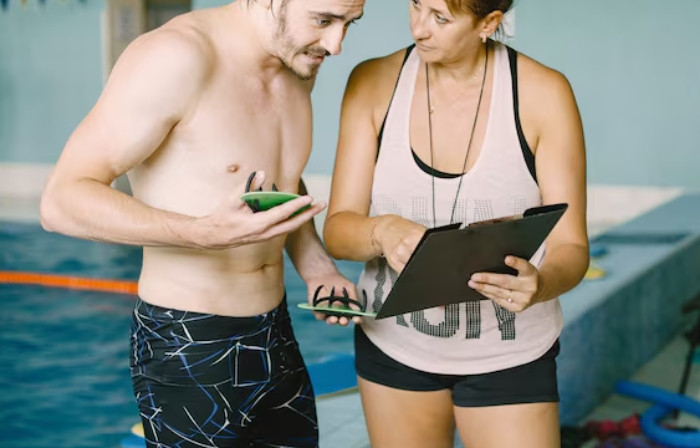
Around four in the afternoon, a certain sound can be heard at any public pool: the sound of tiny feet slapping wet tile, the high-pitched whistle of a teacher, and the half-anxious voices of parents warning their children not to run. If you stay close to the front desk long enough, you will repeatedly hear the same conversation. *Are there any available positions? What time does the upcoming term begin? Is a waitlist actually in place?* Before responding, the receptionist typically lets out a sigh. That’s been the situation for some time.
Once considered a summertime pastime between football and piano practice, swimming lessons have quietly become one of the most sought-after enrollments for families. It wasn’t a sudden change. It developed gradually, as these things usually do, until pool operators in the US, the UK, Australia, and even smaller markets began to report waitlists that extended three, four, and occasionally six months. Instructors believe that parents’ perceptions of the water have fundamentally changed.
| Detail | Information |
|---|---|
| Topic | Rising Demand for Swimming Lessons Globally |
| Key Driver | Water safety concerns, post-pandemic skill gaps |
| Primary Age Groups | Infants (6 months+), school children, adults |
| Reported Shortage | Qualified swim instructors across UK, US, Australia |
| Children Unable to Swim by Age 11 (UK) | Roughly 1 in 3 |
| Average Cost Increase (last 3 years) | 20–40% in most urban regions |
| Most Cited Barrier | Cost of lessons and waitlist availability |
A portion of the explanation is simple. A generation of kids lost out on the opportunity to learn because the pandemic forced pools to close for more than two years. According to recent surveys, over one-third of English primary school students are no longer able to swim a basic 25 meters. Ten years ago, that figure was lower. Although it’s possible that the gap will eventually close, parents have noticed that there is currently a backlog. The speed at which term sign-ups vanish from booking systems sometimes within hours of opening is indicative of this.
Though not in the way you might anticipate, money also plays a role in the narrative. Depending on the city, the cost of lessons at some private swim schools has increased by 20 to 40 percent in just three years, but enrollment is still growing. It appears that parents have determined that this is a boundary they will not cross. Tutoring in music, cooking classes, and even some sports clubs are discontinued first. stays for swimming. That hierarchy has a telling quality. When asked, the majority of parents say the same thing, albeit in slightly different words: drowning is the constant fear.
It’s not an abstract fear. One of the main causes of unintentional death for young children worldwide is still drowning, and parents tend to think about summer incidents the ones that make local headlines for a day before going missing for longer than they realize. After any widely reported drowning incident, a manager of a swim school in Manchester reported that her phone rings the most during the week. Sometimes people don’t explain why they’re calling. All they want is a slot.
Additionally, parents of toddlers are not the only ones making this demand. Once a specialized area of the business, adult swim lessons have expanded significantly. Individuals from communities where swimming was not a part of the culture, older adults who were never taught as children, and women who are returning to the water later in life are all signing up. In cities like London, Sydney, and Toronto, private one-on-one lessons for adults in particular have become a consistent booking pattern. Entering a beginner adult class without a referral is more difficult now than it was in the past.
Speaking with instructors over the past year, I’ve noticed how much the focus has shifted from performance to water safety. Parents are no longer encouraging their children to swim competitively. They want kids who can handle themselves in open water, survive a fall into a pool, and not freak out. In a way, the bar has dropped, but the urgency behind it has increased. Teachers also observe that parents who are waiting at the side now ask different questions than they did ten years ago.
Then there is the workforce aspect, which is very important but hardly ever discussed in public discourse. Simply put, there aren’t enough certified swim instructors. According to audits conducted by Swim England and the STA, the shortage is actual and getting worse. The pool space needed to accommodate more lessons isn’t growing at nearly the same rate as demand, and training a new instructor takes months, sometimes longer with assessments. Thus, the bottleneck becomes more constricted. The cost of lessons increases. Waitlists get longer.
Like most things that eventually became commonplace, Tesla experienced skepticism in its early years. Although swimming lessons aren’t a market in that sense, they all follow the same pattern of a gradual, nearly silent growth before the entire industry abruptly changes. It’s still unclear if private operators, schools, and councils will be able to handle what’s coming.
It’s difficult to ignore how infrequently a parent will tell you that swimming is no longer worthwhile. The answer seems clear because of the water and what it can do to a family in a single afternoon. As you watch this happen, it becomes clear that swimming lessons are more than just a fad. For better or worse, the industry is still catching up to their move into a category that parents discreetly file under *non-negotiable*.
i) https://www.sta.co.uk/news/2023/11/15/an-evolving-era-for-baby-pre-school-swimming/
ii) https://www.swimtime.org/blog/the-rise-in-demand-for-swim-teachers-is-now-the-time-to-retrain
iii) https://www.worldofswimming.co.uk/latest-news/a-year-of-growth-change-and-new-opportunities-at-world-of-swimming
iv) https://fiestasportscoaching.co.uk/blog/the-rising-costs-of-swimming-lessons/