

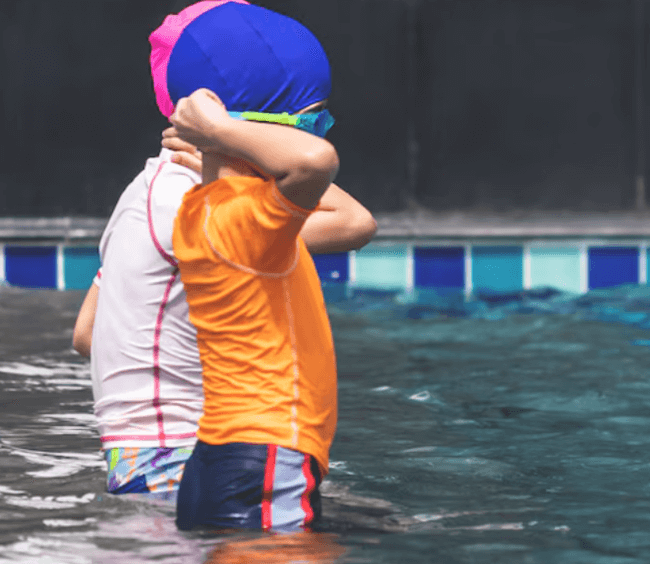
Almost every swim class has a certain moment, usually in the third or fourth week. With wide eyes and tense shoulders, a child who had been clinging to the pool wall abruptly lets go. Not because they were coerced by a teacher. Not because a parent shouted encouragement from the bleachers. They let go because something shifted internally. They concluded they were prepared. It’s not much to see. It’s also arguably one of the most crucial skills a child can acquire.
The lessons that swimming truly teaches are not given enough credit. Parents enroll their children in water safety programs, which is a good enough reason in and of itself. However, what develops over months of instruction is more difficult to measure: kids learn to communicate their needs, recognize their own boundaries, and firmly but respectfully push back when something doesn’t feel right. To put it another way, swimming helps kids develop boundaries in ways that go well beyond the pool.
| Founded | 1869 (originally the Amateur Swimming Association) |
| Headquarters | Loughborough, England, UK |
| Focus | Swimming, diving, water polo, open water, synchronised swimming, and artistic swimming across all ages |
| Key Campaign | #LoveSwimming – promotes early childhood swim lessons for mental, physical, and emotional wellbeing |
| Key Research Finding | 84% of parents report their child’s mood improves after swimming lessons; 92% say health and fitness improved |
| Senior Technical Lead | Alex Barrett, Senior Technical Aquatics Manager |
| Official Website | swimming.org |
It’s not immediately clear how self-advocacy and water confidence are related. However, if you spend a lot of time with swim instructors, it becomes difficult to ignore the pattern. Children who are terrified of water don’t just worry about getting wet; they frequently find it difficult to express their fear and say “I’m not ready for this” without feeling inadequate. The child learns that their discomfort is information rather than a sign of weakness when a good teacher works with them gradually, validating their hesitation and assisting them in finding language for it. that their “no” is important.
According to research released by Swim England’s #LoveSwimming campaign, 84% of parents reported that their child’s mood improved after swimming lessons, and many also reported that their child’s confidence and self-esteem had increased. Eighty-four percent is a startling figure. However, the qualitative shift the child who, after three months of instruction, begins to ask questions rather than simply nod along is what the data fails to adequately depict. The person who, instead of silently freaking out during a new drill, confides in their instructor when they’re anxious.
In a sense, self-advocacy is based on bodily autonomy. Additionally, the pool is one of the few locations where young children are regularly asked to focus on their own bodies. Swimming requires constant body awareness, including breathing control, arm and leg coordination, and spatial awareness. Youngsters who get it in the water appear to spread it to other places. Knowing your body well seems to make it easier to recognize when something is off and to express it.
Here, discipline is also important, and it’s important to be clear about what that means. Fear or punishment are not used to enforce discipline in the pool. It develops as a result of consequence and repetition. You stop moving forward when you stop kicking. If you breathe incorrectly, water will enter your nose. These are feedback loops, not failures. Youngsters who engage in this kind of open, cause-and-effect learning typically grow more patient with themselves, more willing to try again, and more aware of their own potential. That sums up self-advocacy pretty well.
The relative equality of the pool may contribute to the effectiveness of swimming here. In the water, social hierarchies that are present in playgrounds or classrooms usually vanish. The best swimmer may be the child who has difficulty reading. A moment of true competence is experienced by the person who is typically overlooked. And competence almost always results in voice. According to a study by Swim England, nearly eight out of ten parents reported that their child’s focus and attention span had improved as a result of the lessons qualities that also support the capacity to establish and maintain boundaries in social situations.
Another benefit of group swim lessons is the opportunity to assert yourself in front of your peers. In a well-run swim class, micro-negotiations like waiting your turn, asking for assistance, and refusing to be rushed occur frequently. Instead of just looking to a parent for every cue, kids learn to follow instructor cues. The reliance changes over time. They begin to believe what they perceive to be true.
The water can be subtly enlightening for kids who suffer from anxiety or who have always been obedient. Overcoming the fear of submersion being momentarily out of control and then regaining your footing teaches something that is challenging to impart in an abstract way: that discomfort is manageable and that you can overcome difficult situations and be alright. There’s something about the immediacy and sensory intensity of the water that seems to speed up the lesson, but it’s still unclear if this resilience is specific to swimming or present in other difficult physical activities.
It appears evident that kids who receive consistent swim instruction are not only safer in the water. They are more willing to express their emotions and more adept at the seemingly insignificant act of saying “I need a minute” or “I’m not comfortable with that yet” It turns out that the pool is a surprisingly useful place to discover that you should trust your gut. And that might be more important than any stroke to a child who is still developing their identity.
i) https://www.janetlansbury.com/2021/04/water-safety-bodily-autonomy-and-emotional-health/
ii) https://aquaticpros.org/swimming_into_success_early_swim_lessons/
iii) https://www.mother.ly/health-wellness/childrens-health/mental-health-benefits-of-swimming/