

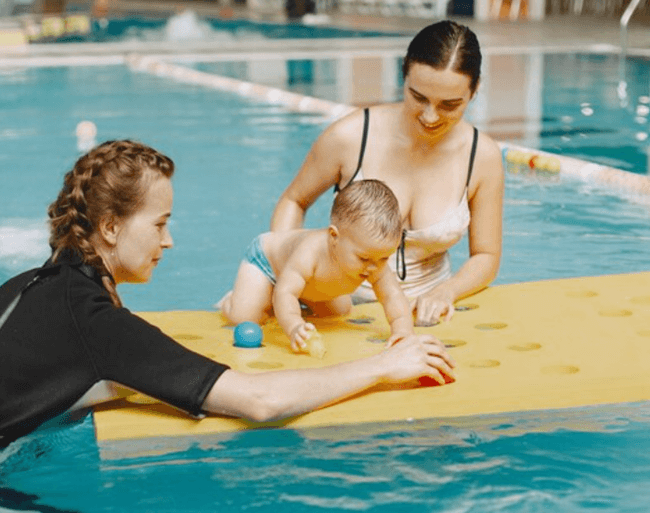
Anyone who has spent time by the pool during a kids’ swim lesson will recognize the moment when a child pushes off the wall for the first time and glides really glides without a hand underneath them. The teacher takes a step back. The other children in the lane observe. The entire group holds their breath for a brief moment. The cheer follows it’s small, unplanned, and simple to overlook. That moment, silently repeated in swim schools all over the world, may reveal more about the lessons that swimming imparts to kids than any stroke technique could.
Many people characterize swimming as an individual sport. Every child has a lane, a personal best, and a body that is battling the water. Learning to swim has a surprisingly rich social texture, particularly in group lessons. When learning side by side, kids don’t merely watch one another out of idle curiosity. They use their peers as a benchmark. They observe when someone else struggles, mimic what works, and pick up technique by watching. Perhaps more developmental work is being done by this type of peer-based learning than most parents are aware.
| Activity type | Individual sport with strong group learning components |
| Primary age group | Toddlers (18 months) through teens; group lessons typically 3–10 years |
| Key teamwork skills developed | Communication, cooperation, peer encouragement, goal-setting, healthy competition |
| Cognitive benefits | Spatial awareness, memory, multi-step instruction following, neurological development |
| Lesson formats | Group (most common), semi-private, private; year-round or seasonal |
| Notable research finding | Children in swim programs appear developmentally advanced vs. non-swimmers (Griffith University, Prof. Robyn Jorgensen) |
| Reference | SwimJim |
Swimming is unique because the teamwork lessons don’t make an announcement. There is no designated team captain, no coach sketching plays on a whiteboard, and no clear “cooperation drill.” Thirty minutes after kicking practice, a timid seven-year-old learns to support a classmate she only met that day. Because everyone is equally vulnerable in the water, regardless of background or social status, group swim environments foster a sort of low-pressure solidarity that tends to soften typical childhood hierarchies remarkably quickly.
This is also influenced by the physical surroundings. Water has a special ability to equalize. Size and speed produce instant sorting on a basketball court or football field. A smaller child can outperform a larger, stronger one in the pool if they have good timing and breath control. Kids see this. They feel as though the water asks different things of each of them, and they start to quietly respect the various ways their classmates rise to the occasion. Over the course of weeks and months of instruction, that respect builds up into something that resembles true friendship.
Swimming creates a unique internal architecture that fosters teamwork even when a child is practicing alone, going beyond the dynamics of group learning. A child internalizes something crucial when they set and accomplish a personal goal, such as reaching the other end without stopping, through self-discipline and repetition: that effort yields results.
The lesson is applicable. Because they already know that improvement is a process rather than an event, kids who are aware of this about themselves are more likely to be patient teammates and less likely to point the finger at others when things go wrong. Although it’s still unclear if swimming fosters this trait or just draws kids who already possess it, researchers’ and instructors’ findings point to the former.
This is further reinforced by the mental demands of swimming. Multi-step instructions like “arms forward, head down, kick from the hip, breathe on three” require sustained attention and working memory to follow. These are not unimportant abilities. When a teacher explains a group project or a coach calls a formation, children who practice receiving and carrying out layered instructions in a swim lesson are developing the same mental muscles. It is more difficult than it may seem to listen in water, where distractions and noise abound. Children who master this skill typically improve their listening skills elsewhere.
Additionally, healthy competition enters the picture in a surprisingly positive way. It can be painful to see a peer master a skill before you do, but in swimming, it’s rarely personal. No tackle, no stolen ball, and no one’s error is to blame. The resentment is eliminated because the difference between swimmers is evident and factual. When a peer makes progress, most kids just want to try harder if they are in a safe enough environment. Being a good team player basically starts with that urge to compete with yourself while absorbing energy from those around you.
Observing a group of kids complete a swim lesson and climb out of the pool together gives one the impression that something subtle has occurred. They came one by one. They depart as a looser but more cohesive group, asking the instructor questions in a small group, comparing sore arms, and exchanging inside jokes about the kickboard.
In just one hour, the seemingly solitary sport has given rise to the little social customs that bind communities together. Not all kids will sign up for a swim team. Not all kids will go on to compete in races. However, the ability to collaborate with others, to honestly assess your own development, and to support others even when you haven’t yet attained their level of success these qualities endure long after the stench of chlorine disappears from their hair.
i) https://www.pikespeakathletics.com/benefits-of-group-swimming-lessons-for-young-swimmers/
ii) https://www.penguinswimschool.sg/blog/why-swimming-is-the-perfect-after-school-activity
iii) https://aquaticpros.org/swimming_into_success_early_swim_lessons/
iv) https://individualityswimmingandfitness.co.uk/benefits-of-kids-swimming-lessons-boost-your-childs-confidence/