

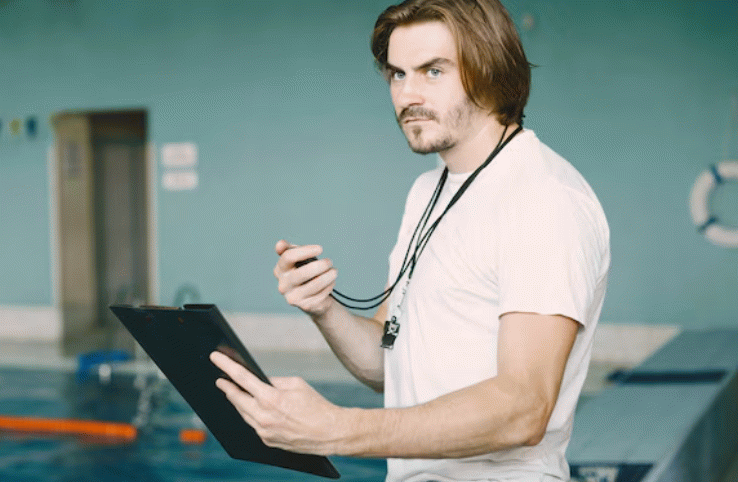
The scene is essentially the same as it was twenty years ago if you stroll past any community pool on a Saturday morning. Parents in plastic chairs, children wearing goggles, and a teacher knee-deep in the shallow end shouting directions over the splash. If you stay a little longer, something does feel different. The instructor is doing more than just yelling. She’s posing queries. For the nervous child, she modifies her tone, and for the bored child, she increases her energy. Most parents are unaware of the subtle change taking place in swim school instruction.
Swim lessons were held in a strange location for years. both athletics and survival skills. recreation as well as academic issues. No one knew exactly where to put it. These days, the discussion surrounding swim instruction is becoming more serious, well-researched, and, to be honest, fascinating. Programs are incorporating concepts from Hollywood, sensory integration, classroom pedagogy, and pediatric therapy.
For a while now, Swim England, the UK’s national governing body, has been promoting what it refers to as best practice guidelines. The focus is on little details that seem insignificant on paper but have a significant impact in the water, such as how a teacher holds a student, what they wear, and the tone they use. Teachers are now required to wear full-length tops and rash vests in the water as a skin-to-skin barrier. Hand positions are practiced and taught. This is not dramatic at all. It completely changes the tone of a lesson from one of improvisation to one of purpose.
| Detail | Information |
|---|---|
| Topic Focus | Modern teaching methods in swimming schools |
| Key Organization Cited | Swim England (national governing body for swimming in England) |
| Notable Practitioners Referenced | Swim Angelfish, Makai Swim School, Swim Whisperers® method |
| Key Expert | Ailene Tisser, PT — Co-founder of Swim Angelfish®, 30+ years in pediatric aquatic therapy |
| Frameworks Mentioned | Learn to Swim Framework, ABCs of Swimming (Air, Body position, Core) |
| Industry Trend | Shift toward adaptive teaching, sensory-aware instruction, measurable water safety |
| Recent Event | Inaugural Swim Instructor Retreat, hosted by Makai Swim School |
Teachers feel that language is more important than it once was. Even inadvertent negative undertones are detected. “Don’t drop your legs” turns into “let’s keep our tummies up.” It sounds insignificant. It’s difficult to miss the difference when you watch a five-year-old react to it. Tiny verbal cues are the foundation of confidence in the water, and more advanced programs have begun to treat that as a skill rather than an instinct.
The first Swim Instructor Retreat was held at Makai Swim School in Hawaii last year. You can infer something from the framing alone. It’s not a conference. A retreat. To share what they had been covertly experimenting with in their own pools, instructors traveled by plane from all over the US and the UK. Instead of a swim card, Angela, who is based in San Diego, offered a water safety competency scale, which is the kind of quantifiable, scaled progression you’d expect in a school report. Michelle, who works out of Los Angeles, led the group through her relaxation-based techniques, which she developed in part while instructing well-known kids. In addition to introducing the ABCs of swimming Air, Body, and Core Tonya showed how to prevent children from going vertical in the deep end by using a dog pool ramp. Only someone who has spent thousands of hours observing tiny bodies move through water can provide this level of detail.
The extent to which this draws from sources outside of the sport is intriguing. Ailene Tisser, a pediatric physical therapist with thirty years of experience and co-founder of Swim Angelfish®, has developed a whole approach based on sensory integration for swimmers with special needs. Her certification as a Swim Whisperers® has begun to change instructors’ perspectives on sensory seekers and avoiders as well as how aquatic work can incorporate primitive reflexes. Swim instruction used to be described differently than this. Kick, breathe, repeat. Some of the vocabulary used here would be appropriate in an occupational therapy clinic.
In the larger field of education, there is also a quiet realization that swim instructors may be serving as role models for something that classroom teachers have been finding difficult to accomplish. In a recent post, a primary school teacher in the UK described how she observed her daughter’s swim lesson and saw it as a near-textbook example of adaptive teaching explicit instruction, quick questioning to assess comprehension, modeling, scaffolding, and feedback all packed into 30 minutes while parents watched from the sidelines. The amount of classroom pedagogy that could be borrowed from a mediocre Stage 4 lesson is difficult to ignore.
The equipment has also changed. Adjustable in-water platforms created by therapists with their own pools, Floatie friends, ORCA swim trainers created by instructors themselves. The toolbox continues to expand. A portion of it will disappear. A portion of it will become commonplace. The fact that it’s still unclear which is which contributes to the field’s current sense of vitality.
The culture of swimming itself is evolving. Splashing under supervision is not what parents expect. They want instructors who can explain what they’re doing and why, progress they can see, and safety they can rely on. Operators who don’t keep up will likely lose families to those who do, as Swim England’s Learn to Swim Framework is constantly updated to meet those expectations. Reputation spreads more quickly than ever, and small private swim schools face difficult financial conditions.
We may be witnessing the early phases of swim instruction evolving from a seasonal occupation to a legitimate career. The depth of certifications is increasing. Communities are emerging. Watching this develop gives me the impression that those who teach children to swim are beginning to take themselves more seriously than the rest of the world has yet to do. Hawaii will host the retreat next year. It’s reportedly already full.
i) https://swimangelfish.com/swim-school-secrets-13-experts-share-top-teaching-methods/
ii) https://worldwideswimschool.com/teachers/different-ways-to-use-your-teaching-space/
iii) https://shop.swimming.org/knowledge-hub/best-practice-within-your-swimming-lessons/
iv) https://www.nereids.com.au/blog/the-science-of-effective-swimming-lessons