

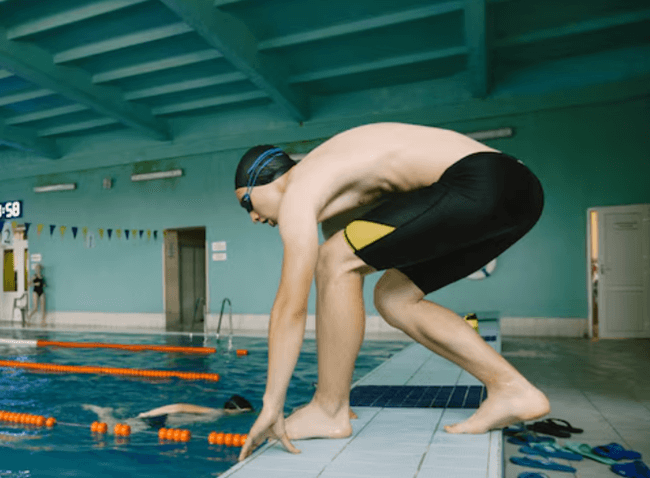
There was no loud announcement of the shift. It took place early in the morning, when the rest of the school was dark and the sound of pools was still reverberating.
At 5:30 a.m., teens stood barefoot on chilly tiles, stretching silently, their advanced math textbooks crammed into backpacks. No parents pacing with coffee cups, no music, and no conversation. Just a coach with a stopwatch and a tendency to keep quiet.
When their lives are already full, high-achieving teenagers are turning to swimming as a sport. Not because it’s in style. since it fits.
| Context | Key Facts |
|---|---|
| Physical profile | Full-body, low-impact exercise that supports adolescent growth and joint health |
| Cognitive impact | Linked to improved focus, memory, and executive function through aerobic conditioning |
| Mental health | Shown to reduce stress and anxiety via rhythmic breathing and sensory regulation |
| Structure | Highly scheduled, measurable training environments with clear performance feedback |
| Accessibility | Can complement academics and other sports without excessive injury risk |
These students are balancing leadership responsibilities, tests, applications, and a subliminal sense that time is limited. They don’t seek out spectacle. They are looking for an effective solution.
Swimming is effective because it doesn’t demand attention. It requires endurance, repetition, and presence. Your resume has no bearing on the lane.
Swimming provides a controlled environment, in contrast to team sports that necessitate constant coordination, travel, and social negotiation. The variables are known. The distance is set. Time can be measured to the hundredth of a second.
Teens who perform well are frequently drawn to systems where effort clearly translates into results. Improvement in the pool is rarely unclear.
Physical sustainability is another issue. By the time they are fifteen, many academically motivated teenagers have already mastered one sport. overuse injuries, torn ligaments, and stress fractures. When they want to continue competing without damaging anything significant, they go swimming.
The body is held differently by water. Growth spurts don’t hurt as much. Joints heal. It feels cleaner to be fatigued. Even during the busiest exam seasons, a high school counselor informed me that the swimmers on her caseload hardly ever present with anxiety related to injuries.
The rhythm of the mind is also important. Swimming is solitary but structured. With your breath, you are essentially alone even though you are surrounded by people.
Teenagers who already spend a large portion of their day juggling their social and cognitive loads appear to find that combination appealing. It is impossible to have a conversation in the pool. It’s a private performance.
Stress processing is altered just by the breathing patterns. repetition, prolonged exhalation, and controlled inhalation. Though it is incorporated into movement, it is similar to methods taught in therapy sessions.
Teachers are aware of it. Competitive swimmers frequently show up for first period calmer than anticipated, with wet hair and all.
Moreover, swimming accepts ambition without exaggerating it. Achievement is gradual. There are medals, but they are small and typically given out in reverberating community centers rather than crowded stadiums.
Advancement is individualized. Even if no one else notices, shaving half a second counts. As if the score confirmed what he already suspected, I saw a sixteen-year-old glance at the scoreboard, nod once, and pack his goggles in silence.
Swimming is not a discipline for motivational posters. It’s a logistical one. early warnings. Bags were packed. missed social gatherings. High achieving Teens are already aware of trade-offs. They are just visible when swimming.
Sometimes, parents don’t realize how important structure is to these students. The pool provides guidelines without passing judgment. Arrive. Take a swim in the set. Go.
Water cannot be argued with. Teens who are academically inclined tend to avoid sports that seem chaotic or emotionally noisy. The predictability of swimming can be comforting.
It also works well with their schedules. Early or contained practices are used. The number of meets is limited. Late night spillover is reduced.
Swimming has an understated credibility for teenagers considering college pathways. It conveys stamina, self-control, and time management without the bluster that sometimes accompanies more public sports.
Although they may not express it aloud, admissions officers are aware of trends.
Additionally, swimming is remarkably honest. You can’t hide behind your teammates. Conditioning cannot be faked. Slow but noticeable progress is being made.
That slowness can be humiliating for teenagers who are used to achieving success quickly. It may also be stabilizing.
Few classrooms teach patience the way the pool does. Something else is going on, something more subdued. Swimming provides an environment where success is tangible rather than intangible. where achievement is measured by shoulders and lungs rather than grades and scores.
That’s important for teenagers who spend a lot of time in their own minds. Your plans for the future don’t matter to the water. It only reacts to your current actions.
In years when everything seems significant, that immediacy can be reassuring. Teachers tend to talk more than coaches. The instructions are simple. Feedback is tangible. Teens who are already overexposed to language and analysis will benefit from this.
They also grow in swimming. It can be social, solitary, recreational, or competitive. As academic pressure changes, it can scale up or down.
Few sports provide that kind of flexibility. The end effect is a constant current rather than a wave. At morning practices, there are more honor students. At weekend meets, there are more debate captains. Quieter self-assurance returned to the classroom.
These teenagers are not becoming high achievers because they swim. It’s meeting them in their current location. And that is currently waiting for the whistle at the pool’s edge.