

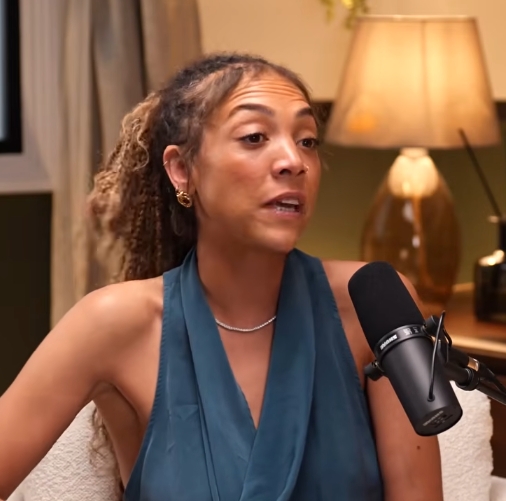
In the media industry, there is a certain kind of honesty that is uncommon when someone names what everyone already knows but won’t say. The presenter Miquita Oliver, who co-starred with Simon Amstell on Popworld in the early 2000s, has been doing just that lately; it’s drawing attention in a way that her real television work may never have.
Oliver talked about something that obviously still bothers her on the podcast Miss Me?, which she co-hosts with her lifelong friend Lily Allen. Her career resumed after she shed a substantial amount of weight. Not by accident. Not inexplicably. directly. “I’ve never been less good at my job”, she said, “but I lost a lot of opportunities because of the way I was looking”. It’s the kind of statement that, because it’s so blatantly true and so infrequently expressed clearly, lands with a dull thud.
Her account is especially noteworthy because she is open about her own motivations. She didn’t act as though her weight loss was solely motivated by personal reflection or health. She was aware of the currency or, as she put it herself, the unspoken economics of a business where women’s appearance on camera is highly valued. It makes perfect sense to know that and still find it depressing. She didn’t try to turn that tension into something more tidy because both things were true at the same time. That might be the most relatable thing she has ever said in public.
Oliver spent her early professional years being scrutinized, appraised evaluated because she was hired by Popworld at the age of sixteen. Her career at T4, BBC Radio One Radio 1Xtra initially advanced swiftly before stalling for a variety of reasons, from a tax bill that resulted in bankruptcy in 2011 to headline-grabbing comments about Kesha’s management. Her on-screen persona had diminished to sporadic appearances by the mid-2010s. Looking back at that timeline, it seems as though the industry had moved on without waiting to see if she would make a comeback.
When did she make a comeback, partially via Miss Me and partially via Celebrity Gogglebox with her mother, chef Andi Oliver? The podcast evolved into something unexpected. A worldwide success, it attracted viewers who weren’t particularly nostalgic for T4 but who thought it was refreshing to hear two women talk honestly. When Lily Allen thought back on her own weight loss experience in 2009 and 2010, she claimed that despite receiving praise, she had been miserable. It is difficult to overlook and even more difficult to ignore the similarities between their stories.
Oliver’s creation of Ropes, a skipping rope company, during the lockdown raises some questions about her current focus. It makes sense for someone who witnessed her body turn into a professional liability for years to pursue a fitness endeavor focused more on happiness than beauty. During lockdown, she referred to the daily park skips as her “lifeline”, something that gave her a sense of control when little else did. It’s unclear if Ropes turns out to be the endeavor she envisions, but the intuition behind it seems sincere.
In the end, Oliver’s candor sheds light on a topic that the television industry has spent decades attempting to avoid talking about: how weight serves as a visible, measurable stand-in for desirability in broadcasting, especially for women. As she herself stated, it’s depressing. She also admitted that it’s indisputable. It’s a television-ready quality in and of itself to have the guts to say both at once without displaying either indignation or resignation. This is arguably the most ironic aspect of all.