

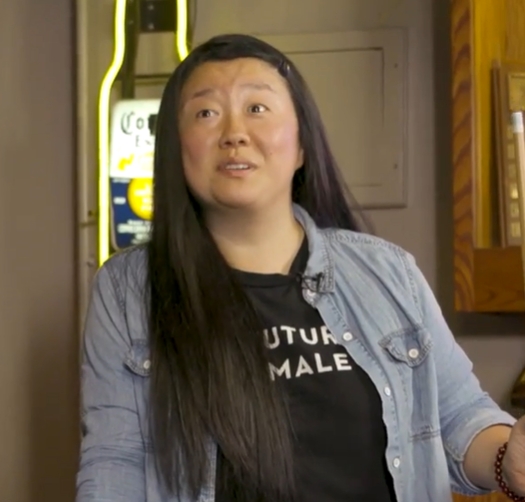
When someone discusses weight loss without mentioning drugs, surgery, or sponsorship deals, a certain kind of honesty emerges. In “The Half Size Me Show” episode 655, Sherry is seated across from host Heather Robertson and discusses years of trying, stalling, and trying again. The story isn’t as dramatic as a red carpet makeover. It may be more beneficial because it is slower than that.
Heather based her show on a fairly straightforward idea: she lost 170 pounds over the course of roughly five years, and rather than viewing that as a finish line, she transformed it into a continuous dialogue about what comes next. It’s difficult to ignore how different Sherry’s framing sounds from the celebrity weight loss narrative that has dominated headlines for the past few years. Sherry is the fourth and final guest in a brief series intended to surface a candidate for free coaching.
| Detail | Information |
|---|---|
| Name | Sherry |
| Featured On | The Half Size Me™ Show, Episode 655 |
| Host | Heather Robertson |
| Topic Discussed | Long-term weight management and the search for a sustainable approach |
| Series Context | One of four candidates profiled for a free coaching opportunity with Heather |
| Selection Process | Premium subscribers vote after all four episodes have aired |
| Host’s Background | Lost 170 pounds over roughly five years through diet, exercise, and mindset work |
| Show’s Focus | Weight loss, weight maintenance, and the emotional side of both |
Think about the difference Charles Barkley describes how Mounjaro reduced his weight from 355 to 285 pounds. Ozempic is credited by Kathy Bates with helping her shed the final fifteen pounds of a hundred-pound weight loss. Even Kelly Clarkson, who claimed for years that walking around New York City was the cause of her changing body, eventually acknowledged taking medication related to a pre-diabetes diagnosis. These are gripping tales, but they are also, in a way, tales of shortcuts succeeding or failing. Instead of discussing injection schedules, Sherry and Heather’s conversation focuses on the unglamorous mechanics of habit change.
That doesn’t facilitate her journey. It’s possible that the opposite is true. A number of celebrities, including Kandi Burruss, have talked about the psychological toll of trying medication and seeing it fail to work, of thinking that something must be wrong with them when a shot that worked for everyone else didn’t make them feel hungry. Without that kind of intervention, Sherry’s journey has likely required a different kind of resilience the kind that doesn’t receive a dramatic before-and-after caption.
The way the episode is presented makes the series’ overall structure stand out. After four episodes and four candidates, premium subscribers will vote to determine who gets to keep working with Heather. It has an almost vintage feel to it, similar to a call-in radio contest, but instead of a trip or gift card, the prize is months of accountability. Heather’s entire brand is based on the notion that maintaining weight is more difficult than losing it, so while the format does reward a compelling story, it also seems to reward consistency.
Heather makes it clear time and time again that she is neither a doctor nor a dietitian, and this disclaimer is more important than it may seem. A show centered on peer-to-peer coaching and behavioral change occupies a quieter, almost contrarian lane in a media landscape currently overflowing with testimonials about semaglutide, from Boy George calling the drugs “wonder drugs” to James Corden claiming Ozempic simply made him stop noticing hunger without addressing why he was eating in the first place. There’s a feeling that viewers weary of the dichotomy of “drugs worked” or “drugs didn’t work” might be drawn to something completely independent of a prescription.
Naturally, it’s still unclear if Sherry will be selected when the results are in. Because podcast listeners are unpredictable, it creates real competition when four people share four distinct accounts of a similar struggle. The fact that her episode is airing at all during a cultural moment full of celebrity weight loss headlines the majority of which are entangled in pharmaceutical brand names and red carpet rumors is worth pondering.
From the outside, it’s easy to interpret Sherry’s appearance as a minor reminder that stories about weight management don’t always require a syringe or a publicist. Regardless of whether she is hired as a coach, her episode contributes to a discourse that has recently become louder and, in some ways, more cynical. Seldom does sustainable change become a viral headline. Simply put, it usually lasts longer than the others.
i) https://parade.com/health/celebrities-on-ozempic
ii) https://www.forbes.com/sites/laurasirikul/2026/06/19/sherry-cola-superbly-takes-up-space-on-appletvs-shrinking/
iii) https://pmc.ncbi.nlm.nih.gov/articles/PMC5368011/
iv) https://www.halfsizeme.com/hsm655/
v) https://en.wikipedia.org/wiki/Sherry_Cola