

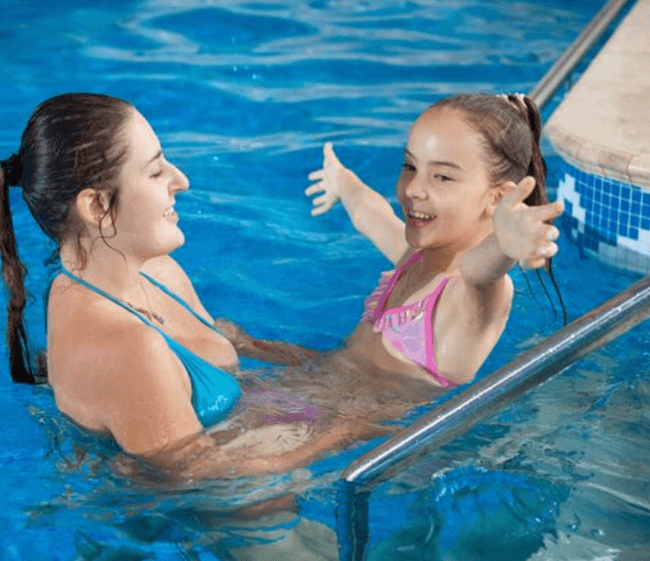
Almost every children’s swimming class has a moment around week three or four when a child who had been holding onto the pool wall with white knuckles abruptly lets go. For a moment only. Then longer. Their expression changes from one of caution to one of wonder. It’s difficult to ignore because it doesn’t appear to be an athletic accomplishment. It appears to have been a successful dialogue with their own body.
That’s the aspect of swimming that seldom comes up in the typical discussion about children and exercise. We discuss lung capacity, muscle growth, cardiovascular health, and coordination all of which are accurate and truly beneficial. Beneath those physical advantages, however, is something more subtle and possibly more significant: swimming helps kids develop self-confidence. Their capabilities, their bodies, and their instincts. Additionally, it accomplishes this in a manner that is challenging to produce in any other setting.
| Activity type | Low-impact, full-body aerobic sport |
| Recommended age to start | As early as infancy (with supervision) |
| Primary benefits for kids | Confidence, body awareness, strength, emotional regulation |
| Key developmental areas | Physical, cognitive, emotional, social |
| Session frequency (recommended) | 2–3 times per week for optimal results |
| Safety consideration | Always supervised; includes water safety instruction |
| Research reference | Griffith University 4-year study (7,000+ children) |
Water is truthful, it doesn’t give a damn about how loud a child is on the playground or how self-assured they appear. It only reacts to actual bodily movements, such as how the arms move, how the lungs control breathing, and whether the core is active. This creates a feedback loop that is almost therapeutic for children who are still learning what their bodies are capable of. Every kick that propels them forward, every breath they are able to time correctly, is instantly recorded. There is no room for doubt. In real time, the water tells them the truth about their efforts.
This helps explain why, when compared to their peers who do not swim in early childhood, children who regularly swim tend to be ahead in their cognitive and social-emotional development. Young swimmers were about fifteen months ahead in social and emotional development, according to a four-year Griffith University study that tracked over seven thousand kids. It’s a big gap. The pattern is sufficiently striking to imply that a particular aspect of water-based movement is doing significant developmental work, even though it’s possible that other factors contribute to that difference.
That work involves some physical labor. Unlike most childhood activities, swimming uses the entire body. The legs are used when running. The arms are used when climbing. However, swimming necessitates simultaneous coordination of the arms, legs, core, and even the neck while breathing. This type of whole-system engagement helps a developing body develop a sort of proprioceptive awareness, or an awareness of the body’s location and capabilities, which permeates everything the child does. improved alignment, more balanced movement, and better posture. Like good habits always do, it seems to accumulate over time.
And there’s the issue of fear. For young children, water is truly unfamiliar, and learning to navigate it requires facing discomfort in a controlled, encouraged manner. Swim school instructors frequently discuss the process of developing what they refer to as “water confidence,” and it’s important to take that term seriously. Confidence is a learned expectation about what you can accomplish under pressure, not just a mood. After weeks of anxious attempts, a six-year-old learns more than just swimming when they become proficient at floating on their back. Their internal model of what they can manage is being updated. The update is not retained in the pool.
When we discuss swimming and kids, there’s a feeling that what we’re really discussing is the growth of a positive internal relationship with the body’s potential. Childhood is heavily influenced by external factors, such as expectations from others, comparisons, and grades. One of the few locations where feedback is solely physical and intimate is the pool. When a child completes their first full lap, they are not competing against the stroke of another child. They are discovering the capabilities of their own arms and lungs.
It’s also worthwhile to focus on the emotional control section. Indeed, swimming enhances sleep patterns and encourages the release of endorphins. Beyond the chemistry, however, swimming’s rhythmic elements repeated strokes, deliberate breathing, and steady motion through the water seem to instill in children a sense of inner peace. Regular young swimmers’ parents frequently report that their kids feel more at ease after a swimming session. Whether this is solely biological or if the concentrated physical challenge creates a mental clarity that lasts throughout the day is still unknown. Most likely both.
This is not to argue that swimming is the only activity that helps kids develop body trust. However, it has a certain quality that seems to produce something unique: the immediate, physical honesty of water combined with the real challenge of mastering movement in an unfamiliar medium. It becomes evident that this isn’t really about swimming at all when you see a child go from being afraid to confident in the water over the course of several months. It’s about teaching a child that their body is capable, responsive, and deserving of attention. When a lesson is taught early on, it usually sticks.
i) https://www.swimnow.co.uk/health-and-wellbeing/9-benefits-of-swimming-for-kids/
ii) https://www.bearpaddle.com/swimming-blog/the-mental-benefits-of-swimming-7-ways-swim-lessons-support-your-childs-emotional-wellbeing/
iii) https://www.wildwildwet.com/visitor-information/blogs/blog/2024/09/25/4-reasons-why-preteens-should-swim
iv) https://www.everyoneactive.com/content-hub/swimminglessons/how-learning-to-swim-improves-your-childs-confidence/