

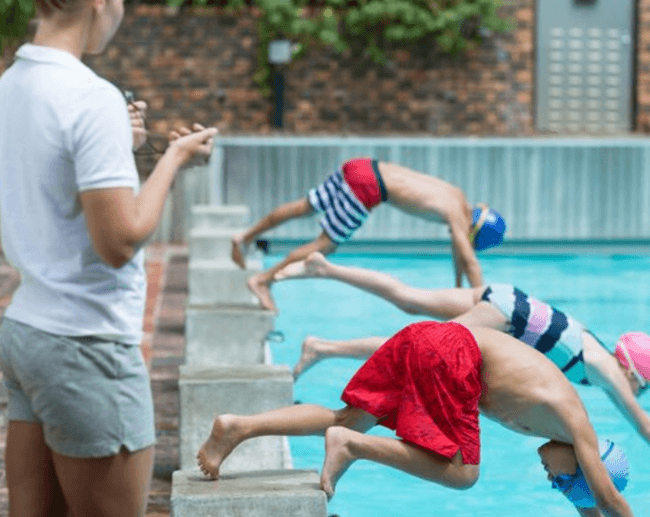
On mornings, a line of parents and young children forms at a recreation center in Surrey, just off the A3, long before the doors open. The kids are hardly old enough to walk steadily. Some are still in diapers. However, the families return week after week with rubber ducks in hand and towels tucked under their arms. As it happens, those parents might be onto something much bigger than anyone first thought.
September 2025 saw the publication of new research from Swim England’s #LoveSwimming campaign, which confirmed what some educators had long suspected: kids who swim early, before school, before reading, and sometimes even before they can tie their own shoes, seem to be more prepared to learn in the classroom.
The results are not particularly nuanced. Following regular swimming lessons, nearly eight out of ten parents reported quantifiable improvements in their child’s focus and attention span. After a time in the water, 84% of parents reported that their child’s mood had improved. These margins are substantial.
| Topic | Early childhood swimming and academic performance in Surrey, UK |
| Key organisation | Swim England — national governing body for swimming in England |
| Research campaign | Swim England #LoveSwimming — published September 2025 |
| Key finding | 84% of parents report improved mood; nearly 8 in 10 report better concentration and attention span in children after swimming lessons |
| Academic link | Griffith University research shows children who swim regularly score above average in cognitive skills, mathematics, and languages |
| National curriculum standard | All children in England must be able to swim 25 metres unaided by age 11 |
| Current gap | Only 70% of Year 7 pupils can swim 25m unaided; 3.4 million children aged 7–11 fail to meet minimum swimming standards |
| Reference | Swim England |
There’s a chance that some of this is physiological. The parasympathetic nervous system, which researchers refer to as the “rest and digest” state, is triggered when a child is submerged in water. This naturally lowers blood pressure and heart rate. Additionally, swimming increases blood flow and stimulates the release of endorphins, which helps the brain receive more glucose and oxygen. According to research from Griffith University, young children who regularly swim exhibit improvements in memory function and perform above average in cognitive skills and language and math problem-solving. It appears that the water is protecting more than just kids. Their brains are growing as a result.
The Olympic silver medallist diver Leon Taylor discusses this with the easy assurance of someone who has experienced both sides of the pool deck. Taylor, who has seen his five-year-old son Ziggy grow via consistent swimming, has talked about the self-assurance and composure his son brings to everything he does. “It is about much more than learning to swim,” he has stated. “It is about learning to thrive.” It’s remarkable that a former Olympian would say that the person being shaped beneath the performance is what matters.
Families in Surrey who have kept their kids in early childhood education are dealing with a sort of national crisis in the opposite direction. Over 3.4 million children in England between the ages of seven and eleven do not meet the minimum swimming standards. According to Sport England’s Active Lives survey, only 70% of Year 7 students can swim 25 metres without assistance, a decrease of 6% from 2017–18. Every child must reach that 25-meter mark by the time they are eleven years old, according to the national curriculum. Not even close to a concerning number. Additionally, the chance of a child meeting that standard falls to about one in three in some underprivileged areas.
The causes are complex. The continuity that swimming depends on breath control, buoyancy, and kicking rhythm was disrupted by the pandemic. These are repetitive skills that don’t hold up particularly well over a two-year break. Provision has been further squeezed by school budget constraints, pool closures, and growing energy costs. According to a STA survey, 63% of families whose kids aren’t learning to swim said that there aren’t enough lessons available, and 61% of respondents to a different survey said that the biggest obstacle is cost. Children from higher-income families are about three times more likely to meet the national standard for swimming than children from lower-income families, giving the impression that access to swimming is subtly becoming a class divide.
This makes it worthwhile to pay closer attention to what’s going on in some areas of Surrey. Small-group lessons for kids as young as two are provided by organizations like Sports Generation, frequently at private health clubs and recreational centers in Chiswick, Richmond, Esher, Cobham, and Dorking. In order to maximize progress, the model purposefully keeps groups small, sometimes with just two kids per class. Lessons are offered both during the academic year and on the weekends. Holiday intensive courses are also offered. Consistent early exposure is what the research increasingly indicates is most important.
And the key word is really consistent. Making a child competitive is not the goal. Before they enter a school for the first time, it’s important to get them into the water on a regular enough basis and at an early enough age so that the cognitive and physical benefits start to accrue. Researchers are still figuring out whether swimming causes the cognitive improvements or whether parents who prioritize early lessons also tend to invest in other forms of enrichment, so the Griffith University findings are still not fully understood. It’s still unclear if the advantages stem from any organized early physical activity or if the water itself is particularly valuable. However, it is hard to overlook the consistency of parent-reported results across several studies.
The most obvious thing is that children in Surrey who start swimming before the age of five are learning more than just how to float. They’re developing skills like concentration, emotional control, and physical self-assurance that carry over into the classroom. In a system where 96 per cent of children aged seven to eleven are stopping lessons before they reach a competent standard, the families still showing up on Tuesday mornings, rubber ducks in hand, may be making a quieter, more durable investment than they realise.
i) https://www.surreyswimschool.co.uk/blog/blog-post-title-one-l83yl-g2xfe
ii) https://www.wiltshire.gov.uk/article/14822/New-research-highlights-the-powerful-benefits-of-swimming-for-children-s-wellbeing
iii) https://www.swimdesignspace.com/blog/uk-children-swimming-skills-decline
iv) https://surrey.muddystilettos.co.uk/life/parenting/five-reasons-kids-should-know-how-to-swim/