

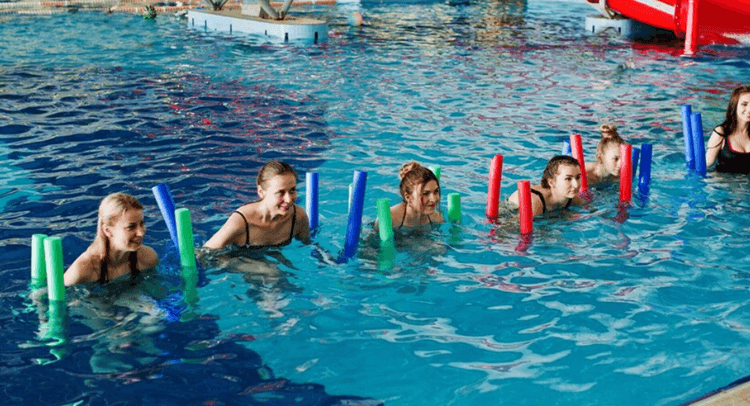
A group of six-year-olds gripping the wall, a patient teacher counting down from five, and a parent filming from the bleachers are all familiar sights when you stand at the edge of any community pool on a Tuesday morning. For decades, group swimming lessons have largely remained the same. It’s reasonable to wonder if the format is still effective or if we’ve just continued using it because it’s affordable and practical.
The truth is more nuanced than either side is willing to acknowledge. One of the most accessible and genuinely helpful methods for educating kids about water safety is still group instruction. According to research linked to initiatives like SafeSplash, formal swim instruction can lower the risk of drowning by up to 88%. Just that figure warrants serious consideration. Drowning doesn’t make an announcement. A child is significantly safer if they know how to float, reach the wall, and call for assistance. Group lessons are the practical way to achieve that goal for the majority of families.
| Program type | Structured aquatic instruction in shared class settings |
| Typical class size | 4–8 swimmers per instructor |
| Session length | 30–45 minutes (standard); 60 min for advanced |
| Average cost (group) | Lower per session than private ($50–$200/session private) |
| Drowning risk reduction | Up to 88% with formal swim instruction |
| Key providers | YMCA, Red Cross aquatics, SafeSplash, municipal rec centers |
| Age groups served | Infants through adults; skill-level tiered classes |
| Certifying bodies | American Red Cross, USA Swimming, national aquatic councils |
| Reference | American Red Cross — Swim Lessons |
A 30-minute session with four children is not the same as a 30-minute group class with eight children and one teacher. Whether enrolling at the YMCA, a municipal recreation center, or one of the specialized aquatic programs that have grown in popularity recently, the class size is a crucial consideration and one of the first things to ask. The price tag doesn’t always reflect what you’re actually purchasing.
It’s easy to underestimate the social component of group instruction. Only in a room full of peers can one find a certain kind of motivation. It makes a difference to see another child succeed in a freestyle stroke or even to observe that everyone else is just as afraid to submerge their face in the water.
It makes the procedure more normal. In contrast to one-on-one interactions with an adult, children often push themselves differently in groups and not always in a bad way. Teachers who have experience with both formats frequently observe this as well. In ways that are difficult to create in a private session, the group’s low-level productive tension the feeling that there’s something to keep up with can accelerate progress.
Group instruction does, however, have a structural ceiling. It is just not possible for a teacher who switches between six students to provide the same level of feedback as one who focuses on a single swimmer. Group instruction may quickly stagnate for a child who has developed a bad kick habit or who has a particular fear of water that requires careful handling. The math works against depth, not because the teachers aren’t good many of them are. Because the format isn’t designed for outliers, a child who freezes up or is noticeably ahead of the class tends to fall through the cracks rather than because someone failed them.
For the majority of families, cost remains the defining factor. Nationwide, private lessons typically cost between $50 and $200 per session, depending on the location, experience of the instructor, and length of the session. A class at a community center in a mid-size city can cost a fraction of what a specialized aquatic facility in a major metro charges for what appears to be the same product.
The actual number varies significantly depending on provider and region. Semi-private lessons, which divide two or three swimmers among one instructor and fall in between the formats in terms of cost and individualized attention, are another more recent middle option that is gaining popularity. It’s frequently the best option for close friends or siblings with comparable skill levels.
The instructor variable is something that the format question frequently overlooks. In a private session, a talented teacher leading a group of five driven students will often perform better than a mediocre teacher. Finding the right time to push someone past hesitation without undermining their confidence, reading anxiety, and modifying pace mid-lesson are all necessary for effective swimming instruction. These attributes are not unique to private education. The person, not the format, travels with them.
Over the coming years, it’s still unclear if the industry will witness a significant change in the way group lessons are organized. Smaller cohorts and more deliberate skill grouping are being tested by some programs. Some are using technology, such as underwater cameras and video review, to provide group members with the kind of feedback that previously required one-on-one time. Families’ willingness to pay for those experiments and the facilities’ capacity to conduct them will determine how long they last.
For the time being, group swimming lessons in 2026 will continue to be what they have always been: genuinely beneficial for developing fundamental safety skills, inspiring for social learners, and affordable for families on a tight budget. They are not the best option for every child, nor are they the quickest path to technical mastery. However, the pool is still the greatest water safety classroom available, and participating in it with others and a trained instructor is still more valuable than most other options. The splash might not be flawless. The point remains the same.
i) https://www.swimlessonswithmary.com/the-real-cost-of-group-swim-lessons-are-you-getting-what-you-pay-for
ii) https://www.pikespeakathletics.com/benefits-of-group-swimming-lessons-for-young-swimmers
iii) https://teachme.to/blog/how-much-do-swimming-lessons-cost
iv) https://www.sunsationalswimschool.com/blog/should-my-child-take-private-or-group-swim-lessons