

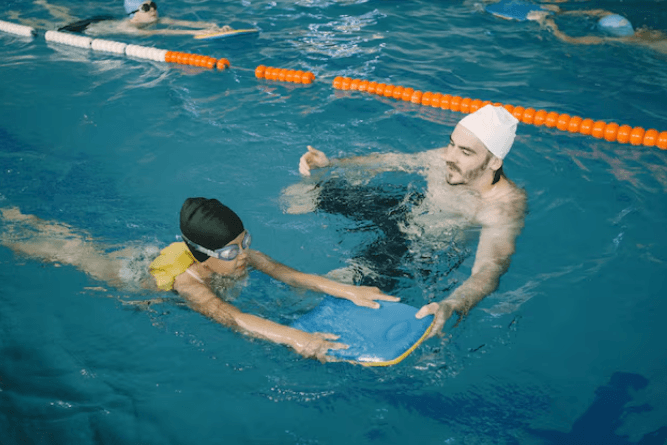
Nowadays, if you walk by any municipal pool on a weekday night, you’ll probably notice something that wasn’t there ten years ago. Standing at the shallow end, a line of adults, mostly in their thirties and forties, gripped kickboards as if they had just been given something delicate. Uncertain, some of them scan their surroundings in the hopes that no one will notice them.
A name is called out by the teacher. A woman advances The way you might ease into a conversation you’ve been avoiding, she lowers herself in gradually. In pools in London, Sydney, Toronto, and more cities where swimming was never fully ingrained in the culture in the first place, this scene keeps happening. Once a specialized service tucked away in the schedule between toddler splash time and the masters’ squad.
| Information | Detail |
|---|---|
| Topic | Adult Beginner Swimming Classes |
| Reported Non-Swimmers (England) | ~31% of adults, around 14.2 million people |
| Reported Non-Swimmers (Australia) | Nearly 1 in 4 adults |
| Common Age Group Enrolling | Late 20s to mid-50s |
| Typical Lesson Format | One-to-one or small group, 30–45 minutes |
| Average Time to Basic Confidence | 6–12 weeks of weekly lessons |
| Top Reasons Cited | Childhood fear, parenthood, holiday safety, fitness |
Adult beginner swimming classes have quietly grown to be one of the busier offerings in community aquatic centers. For a few years now, waiting lists for adult-only classes have been reported by pool managers in the UK. The idea that mature adults will pay more for private, one-on-one instruction is the foundation upon which private coaching companies like SwimExpert have built entire businesses.
The statistics supporting this are more startling than most people realize. According to Swim England, approximately 14.2 million adults in England, or 31% of the population, are unable to swim a single 25-meter distance without assistance. Nearly 25% of adults in Australia report having poor or no swimming ability, despite the public’s perception that every child grows up with sand between their toes.
It’s the type of statistic that strikes an odd chord because no one discusses it. People will acknowledge that they are incapable of using a spreadsheet, cooking, or driving. Swimming, on the other hand, falls into a different category because it is a skill that is so culturally accepted that acknowledging its lack is more akin to acknowledging illiteracy.
Maybe that’s why the boom seems so out of the ordinary. It isn’t motivated by a celebrity endorsement or some flashy fitness fad. It’s being fueled by parents who watch their toddlers wade into the bath and realize they can’t pull them out of anything deeper than a puddle. As well as by quiet. Slightly embarrassed admissions made in conversations with friends.
According to what instructors describe, becoming a new parent appears to be the single biggest tipping point. The discomfort of standing on a tiled deck in unfamiliar swimwear and requesting a lesson typically given to seven-year-olds is eventually outweighed by the intrusive what-ifs of early childhood. What if we slip near a river. What if he falls into a pool at a party.
Additionally, there is a noteworthy generational component. Many of today’s adult beginners grew up in homes where swimming was either someone else’s pastime or where a single negative childhood event silently closed the door. Migration trends also have an impact. Adults who grew up in nations where swimming was simply not a part of the school day and who came to Britain to find a culture that presumes otherwise are now prevalent in the country’s pools.
The most typical sentence in a first lesson, according to instructors, is a brief, almost apologetic statement explaining why they never learned, rather than a question about technique. The intriguing thing is how fast the shame fades. Anybody who has taken a beginner course will tell you that the same arc keeps coming up. The first lesson is terrible. The second is not as bad. Something changes by the fourth or fifth.
The scent of chlorine begins to register as something more akin to anticipation rather than anxiety. Blowing bubbles. An idea that many adult learners claim they had never heard of before. Turns into a tiny. Consistent act of trust. People explain it in the same way that runners explain when they stopped detesting running.
The word “addictive” isn’t very strong. A number of novices I’ve encountered have discussed it in the same way that converts discuss new religions. Which is endearing and somewhat illuminating about how desperate adults are for abilities that feel earned rather than performed. It’s noteworthy that the health argument usually comes last. Although swimming is a well-known cardiovascular health benefit and a low-impact. Full-body workout that is easy on joints. Adults hardly ever mention this when they sign up. A child is cited. a vacation. The beach wedding of a friend.
The fitness advantages come as a bonus, almost unexpectedly. The rise of these classes seems to have less to do with wellness culture and more to do with something more subdued: adults filling a tiny, personal void that has been present for decades. It’s difficult to ignore the fact that the instructors of these courses have also begun to discuss them in a different way. More restorative than remedial. According to this interpretation, the kickboard does not represent failure. It represents the appearance of someone.
It’s still unclear if the trend will continue to grow at this rate because the pool’s capacity is limited and there are still few instructors who are specifically trained to work with anxious adults. The lanes are currently filling. And somewhere, a person in their late thirties is submerging their face for the first time in a heated indoor children’s pool that smells like chlorine and second chances.
i) https://www.theguardian.com/lifeandstyle/2025/jan/05/learning-to-swim-as-an-adult-is-terrifying-embarrassing-and-wonderful
ii) https://www.swimexpert.co.uk/about-us/news/why-learning-to-swim-as-an-adult-matters-more-than-you-think
iii) https://www.swimschoolacademy.com/dive-in-why-adult-swimming-lessons-are-a-fantastic-investment/
iv) https://www.everyoneactive.com/content-hub/swimminglessons/adult-learning-to-swim/