

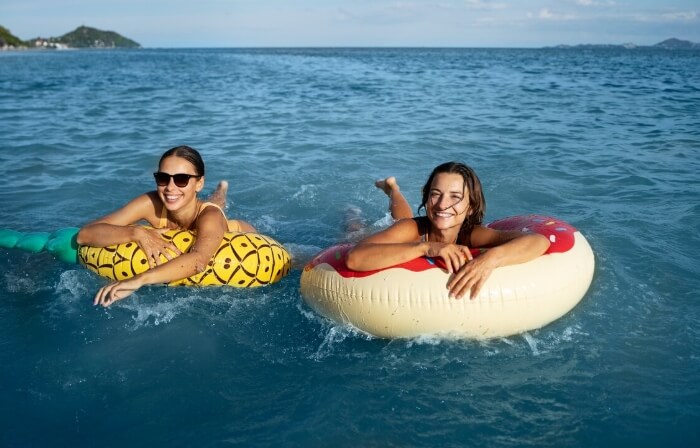
During a swimming vacation, there is a point between the third and fourth day when you begin to view the water as a road instead of a destination. It’s an odd change. The majority of us are raised viewing the sea as a backdrop, something to take pictures from a sun lounger, dip a toe into, or retreat from when it gets too cold. However, it ceases to be scenery after you’ve actually traveled for hours past fishing boats, around rocky outcrops, and into caverns where the sun hardly reaches the sea. It turns into a means of transportation.
That’s the subdued justification for considering swimming a travel skill as opposed to a recreational one. It’s also more difficult to ignore than it once was. In its first year, SwimTrek, a Brighton-based company that is credited with creating the swimming holiday in 2003, took about 100 people on four trips. It transported over 3,000 people to forty different locations last year. Other companies that have followed include Strel Swimming, The Big Blue Swim, and a few smaller Mediterranean groups. The idea seems to have caught up with the market rather than the other way around.
Depending on your point of view, the pandemic merits some praise or criticism. People strolled down to rivers and lakes and began entering them when gyms and pools were closed. Even though “wild swimming” had been making its way into the mainstream since the 2012 Olympics introduced the open-water event, the British, in particular, embraced it with a kind of half-mad enthusiasm. A corporate lawyer from Anchorage might spend two weeks in Montenegro engaging in what was once a specialized activity for Victorian eccentrics and Romantic poets.
| Topic Information | Details |
|---|---|
| Subject | Swimming as an Essential Travel & Holiday Skill |
| Industry | Travel, Outdoor Sports, Wellness Tourism |
| Key Trend | Rise of swimming holidays and slow travel post-2020 |
| Notable Companies | SwimTrek (founded 2003, Brighton, UK), Strel Swimming (founded 2010), The Big Blue Swim |
| Global Reach | 25+ countries, 50+ locations across 5 continents (SwimTrek) |
| Growth Indicator | SwimTrek grew from 100 swimmers (2003) to 3,000+ travellers across 40 destinations (2024) |
| Founder Inspiration | Lord Byron’s 1820 Hellespont swim |
Whether or not the contemporary swim tourist is aware of it, Lord Byron is the patron saint of all of this. He swam the Hellespont, a four-mile stretch of turbulent water between Europe and Asia, in 1820, in part out of conceit and in part because Leander had done so in mythology to win his lover. After reading Byron’s story two centuries later, a young Australian named Simon Murie made the decision to repeat the swim for his thirtieth birthday. He later claimed that swimming wasn’t the most difficult part. It was the permits, the boats, and the paperwork. He reasoned that other people most likely wanted to do this as well and didn’t want to deal with any of that. That observation led to the creation of SwimTrek. The fact that the origin story is so commonplace lends it an air of plausibility.
The fact that a swimming vacation is only feasible if you can swim is something that is not mentioned in the brochures. Not in a heroic manner. Not in a competitive manner. However, it’s sufficient to travel a few kilometers in open water without becoming alarmed if a fish brushes your leg or the current suddenly picks up. The majority of us overestimate this capacity. It’s not the same as swimming a few lengths in a hotel pool when you’re traversing the Bay of Kotor with mountains on all sides and the bottom disappearing beneath you. At this point, the argument for swimming as a travel skill becomes more compelling.
Even outside of planned swimming vacations, the ability alters the typical travel experience. Depending on whether everyone in the group is able to swim, families traveling with small children near lakes, water pools, or the coast face a genuinely different level of risk. Strangely, most of us actually use the skill during vacations, but we often neglect it for the rest of the year. In August, kids who learned to swim in March find themselves back in deep water, rusty and overconfident. Although practically no one treats it that way, the off-season may be the most crucial period to maintain the skill’s sharpness.
The issue of what swimming allows you to see is another. I keep returning to a point made by Ella Foote, editor of Outdoor Swimmer Magazine: water was once the primary means of transportation, so most large towns and cities grew up around it. The bones of a place are typically wet, including rivers, harbors, and coves. You get the same view that the location was intended to be seen from when you approach it from the sea, even if you are only there for an afternoon. In simpler terms, Nancy Meade, an Alaskan lawyer traveling to Montenegro, explained that being at eye level with the shore gives you a sense of belonging that no boat tour can.
When swimmers discuss why they keep returning, they seem to be referring to the sensation of being inside a landscape rather than passing it. It’s also the reason why guides who have worked on SwimTrek trips for ten years, like Marlys Cappaert, tend to describe their work more emotionally than logistically. On these holidays, people cry. When they complete a swim they didn’t think they could, they cry. On the final day, when the group disbands and heads home, they cry. In a way that a typical vacation seldom does, there’s something about the combination of physical exertion, unfamiliar water, and reliance on small groups that releases people.
All of this does not imply that regular travel is somehow inferior or that a swimming vacation is for everyone. However, it’s difficult to ignore how frequently those who are proficient swimmers end up with tales that the rest of us don’t. The Luňica peninsula has a submarine tunnel. The Blue Cave, which is close to Kotor, has turquoise water from below due to the seabed. Rock by rock, fishermen who were thankful for their lives constructed a church on a man-made islet in the Adriatic. Most of these locations are visible from a boat. But unless you can swim, you can’t truly be in them.
Perhaps that’s the minor, subdued point worth bringing up here. The ability to swim is not dramatic. It doesn’t appear on a passport. No one’s vacation highlight reel will mention it. However, it broadens the map in a manner that practically nothing else does, and considering how slow and inexpensive the rest of travel has become, that’s not insignificant.
i) https://www.bbc.com/travel/article/20250203-the-rise-of-the-slow-swimming-holiday-travel-trend
ii) https://loudavymkrokem.cz/en/swimming-vacation-travel-trend/
iii) https://www.activitywalesevents.com/training/the-importance-of-swimming-in-the-off-season/
iv) https://www.katieskickers.co/essential-water-safety-tips-for-holiday-travel-with-kids