

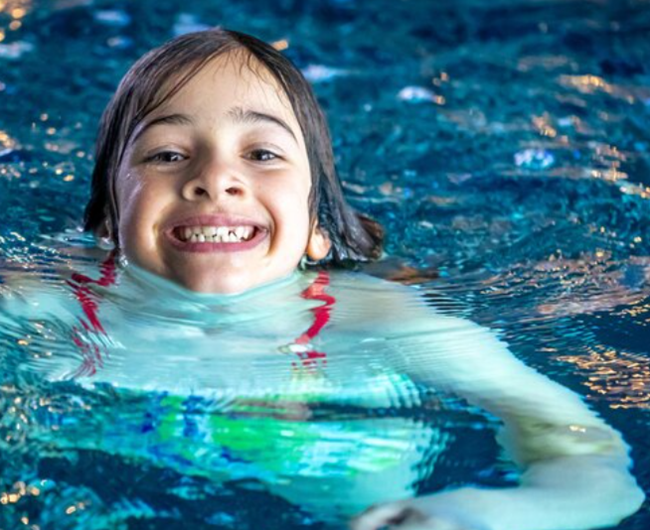
The most striking aspect of a typical Saturday morning at a municipal pool is not the sharp smell of chlorine or the reverberating laughter, but rather the way very young swimmers move with a calm assurance that feels earned rather than taught. They intervene, make adjustments, and try again, viewing the water more as a workplace than as a novelty.
Curiosity frequently manifests as movement in Gen Alpha children. They can climb, test, swipe, scroll, and switch tasks more quickly than adults would like. Swimming provides a very flexible and dependable outlet for that restless energy by meeting its demands on the body and mind with structure.
| Key Context | Details |
|---|---|
| Generation Focus | Gen Alpha, generally born between 2010 and the mid 2020s |
| Core Skill | Swimming as a practical life and movement skill |
| Primary Value | Safety, confidence, coordination, and adaptability |
| Developmental Impact | Physical strength, emotional regulation, cognitive focus |
| Long-Term Relevance | A lifelong, low impact skill that scales with age and ability |
Swimming starts with orientation, in contrast to many youth sports that jump straight to competition. When things feel momentarily out of control, kids learn how to float, breathe, and bounce back. The fact that those lessons are immediately applicable and strengthen confidence in one’s own responses rather than reliance on continual instruction makes them especially advantageous.
Teachers and coaches have observed a significant improvement in children who regularly swim in recent years: sustained focus. It’s mandatory to pay attention in the pool. Young swimmers learn to focus through repetition by coordinating their arms, legs, and breath, which simplifies their movements and creates mental space for awareness rather than distraction.
It’s a very effective setting for adventurous children. Every minor modification provides immediate feedback, resulting in a transparent and equitable learning loop. Progress slows down if you tilt your head too much. Your momentum will return if you relax your shoulders. Without passing judgment, the water explains itself.
Swimming functions socially differently than a lot of team sports. Children form quiet bonds that are surprisingly long-lasting by lining up, waiting, watching, and encouraging. Success is shared but personal, fostering an environment where advancement is apparent without being showy.
Children from various backgrounds practice the same drills in group classes, learning that skill varies daily. Early exposure to this variability helps normalize effort over result. The lesson is subtle but memorable.
Additionally, the pool develops a physical intelligence that is transferable to other places. By creating an internal body map, swimming improves balance and spatial awareness in ways that more static activities greatly diminish. Without relating it to time spent in the water, parents frequently observe better coordination on land.
Water has a regulating emotional quality that seems almost designed for contemporary childhood. The rhythm, temperature, and pressure all work together to create a calming atmosphere that doesn’t stifle curiosity. The change is frequently instantaneous and clearly grounding for kids who come overstimulated.
I recall stopping in the middle of a lesson one winter afternoon to observe a child repeatedly fail a breath drill but persevere with quiet resolve. I reflected on how infrequently perseverance now occurs without praise.
Although it is rarely dramatic, fear plays a significant role in this situation. Because swimming poses a manageable risk, kids can gradually face discomfort. They develop courage that feels transferable and not limited to the pool by making small but steady progress.
Swimming is incredibly resilient when it comes to long-term development. At six, sixteen, or sixty, the same basic abilities still hold true, naturally adjusting to strength and endurance. Without reinvention, few activities provide that continuity.
Naturally, safety is still a major advantage, and its effects are only greatly lessened when kids aren’t exposed. When conditions suddenly change, confident swimmers are more alert, more cautious, and better able to react.
Swimming is a very effective form of exercise and skill development because it works almost every muscle group while being easy on joints and promoting cardiovascular health. That balance is more important for developing bodies than just intensity.
Swimming’s cognitive demands promote problem-solving. Children convert abstract instruction into tangible understanding by learning to modify technique, control breath, and decipher sensory feedback. These abilities eventually facilitate learning outside of athletic contexts.
Swimming provides something especially novel for Gen Alpha, who grew up in a time of rapid change: a steady challenge. Progress stays honest, the medium doesn’t compromise, and the rules don’t change. Instead of emphasizing novelty, this consistency fosters trust in effort.
The water has a subtle equity as well. Once everyone is buoyant, height, background, and personality become less significant. Improvement is demonstrated by action rather than status, and movement becomes the common language.
Comfort near water is becoming more and more useful as travel habits, outdoor recreation, and climate patterns continue to change. Children who swim are better prepared for lakes, rivers, and coastlines they may come across in their lifetime.
Swimming appeals to children who are daring because it doesn’t push them. Instead of forcing confidence through competition, it encourages perseverance, curiosity, and repetition.
Parents frequently talk about a change that is simple to identify but difficult to measure. Youngsters who regularly swim appear more at ease, confident, and noticeably more open to trying new things.
That self-assurance doesn’t make a big statement. It manifests as the capacity to think things through before acting, to breathe steadily, and to make small decisions. These behaviors eventually become ingrained in a child’s strategy for overcoming obstacles outside of the pool.
Shortcuts or spectacle are not promised by swimming. Rather, it provides a stable route to competence, inspiring kids to respect boundaries, trust their bodies, and safely explore. That might be just the right set of skills for a generation characterized by motion and curiosity.