

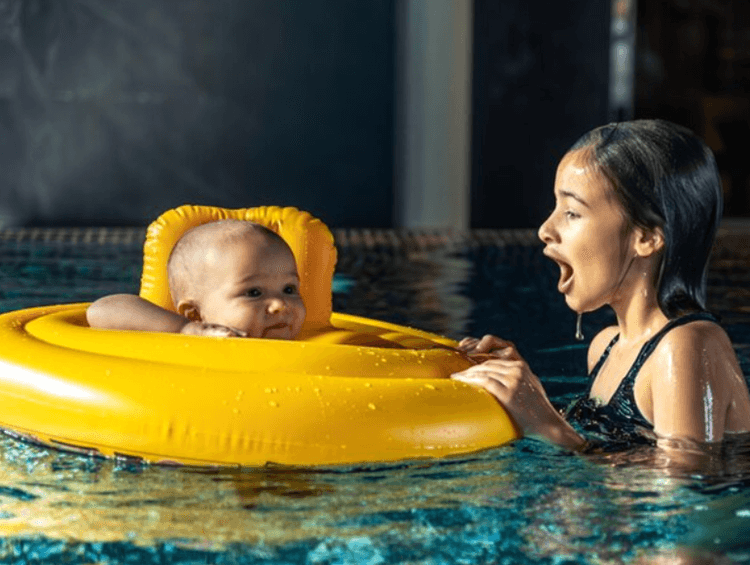
Parents now arrive early, settle in thoughtfully, and watch the water with a level of attention that feels remarkably similar across neighborhoods and income levels. In recent years, pools that once echoed mostly with casual chatter have taken on a quieter intensity.
Baby swim lessons are selling out months in advance, and the rate of enrollment feels significantly better than it did even five years ago. This is due more to a deliberate desire to prepare kids for scenarios that parents hope never happen than to ambition.
| Topic Area | Key Factual Context |
|---|---|
| Recommended starting age | Many pediatric groups support water safety instruction around age one, depending on readiness |
| Primary concern | Drowning remains a leading cause of accidental death for children ages one to four |
| Lesson emphasis | Early classes focus on comfort, floating, orientation, and parent participation |
| Key limitation | Swim lessons reduce risk but do not eliminate the need for supervision |
The adults around the babies treat every splash as significant, as though these little moments are early investments in something much bigger, even though the babies themselves are frequently barely sitting upright and move in an uncoordinated and exploratory manner.
Since drowning is quiet, rapid, and often invisible until it is too late, rather than abstract, theatrical, or noisy, the motivation becomes very evident for many families once it is said out loud.
Families have started to reframe swim lessons as a practical safety measure rather than as enrichment by paying more attention to accident data that is widely shared in parenting circles. This is especially helpful in early childhood, when curiosity grows more quickly than judgment.
The pool, which was formerly mainly used for leisure, is now used as a training area where skills are gradually introduced. Before any indication of propulsion is anticipated, instructors place a strong emphasis on orientation and breath awareness.
In order to normalize an unfamiliar environment and significantly lower stress levels for both parents and children, modern baby swim classes are remarkably effective at slowing down the pace through the use of warm water, repetitive songs, and gentle handling.
In these sessions, parents are rarely passive observers; instead, they stay within arm’s reach and learn incredibly versatile techniques, such as how to hold a child without transmitting anxiety or how to recognize the subtle signs of discomfort.
The majority of the training is aimed at adults, which is noteworthy because it teaches them to remain composed, alert, and attentive, especially in situations where their natural tendency would be to act too hastily.
During one session, I noticed that the room exhaled in unison after witnessing a baby briefly sputter and recover, as though everyone had silently practiced the same fear.
The terminology surrounding these lessons has changed significantly, with educators and pediatric specialists now using phrases like “water competency” rather than “swimming“, which emphasize readiness over performance.
That difference is significant to parents because competency translates into time saved in an emergency, which can save lives when seconds are the only money available.
Lessons that focus on floating, turning toward the air, and holding onto edges are helping programs address situations that parents worry about in private but rarely discuss in public.
This surge also has an emotional component that is linked to guilt and responsibility. For some parents, choosing not to take swim lessons can feel like ignoring a known risk, even though they are aware that no one action is adequate.
This effect has been amplified by social media, where videos of infants floating peacefully on their backs have gone viral. These videos are remarkably persuasive, even when viewers realize they depict controlled environments and trained instruction.
Swim lessons are one layer among many, experts always stress, along with supervision, barriers, and vigilance, but the act of signing up gives parents a sense of agency that is surprisingly inexpensive when compared to the peace of mind it offers.
While this is going on, instructors spend a lot of time managing adult expectations, reminding families that comfort cannot be rushed without consequences, that progress is uneven, and that crying can be a normal part of adjustment.
Since not all babies take to the water right away, experienced teachers freely discuss letting resistance fade over time rather than pressuring compliance, which is a very effective strategy for fostering confidence over the long run.
These programs seek to promote familiarity that transcends the pool and into everyday moments like bath time and summer outings by treating water exposure as a relationship rather than a test.
Wrapped towels and flushed cheeks indicate physical effort at the end of each class, but as tension subsides and dialogues return, the parents’ relaxed postures show the true effect.
But for these families, the pool is more than just a place to play; it serves as a reminder that careful planning and early preparation can have a huge impact later. As a result, the vigilance never completely goes away.