

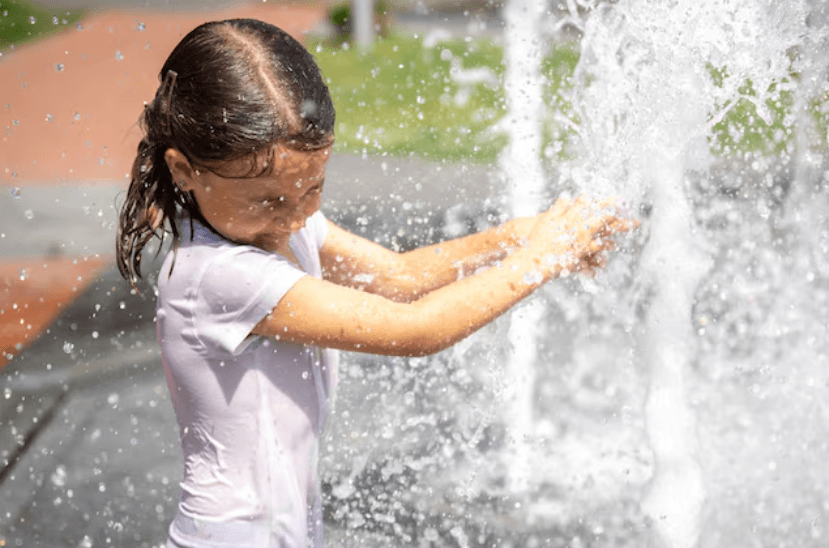
Nearly every parent has experienced the moment when a toddler finds a puddle. Not the kind of occasion you anticipate. The youngster pauses, looks down, raises one foot, and then, fully committed, slaps it down. There’s more than just joy on their faces. It’s more akin to relief. As though the water provided an answer to a query the child was unaware they were posing.
It’s not a random instinct. This observation has been the focus of pediatric therapists and developmental researchers for decades, and the emerging picture is compelling. Water has a specific and quantifiable effect on a young child’s nervous system due to its temperature, resistance, and constant pressure against the skin. It aids in its organization. That organization is important for kids who have trouble with sensory processing. It has the power to alter a child’s entire day.
| Category | Details |
|---|---|
| Topic | Water Movement and Sensory Processing in Young Children |
| Field | Pediatric Occupational Therapy / Aquatic Therapy / Early Childhood Development |
| Key Organizations | American Occupational Therapy Association (AOTA), Aquatic Therapy & Rehab Institute (ATRI) |
| Therapeutic Application | Sensory Integration Therapy, Hydrotherapy, Aquatic Therapy |
| Age Group Covered | Infants (6 months) through early school age (8 years) |
| Relevant Conditions | Sensory Processing Disorder (SPD), Autism Spectrum Disorder (ASD), ADHD, Developmental Delays |
To put it simply, sensory processing is the process by which the brain takes in, organizes, and reacts to information from the body and surroundings. The majority of kids act in this way without thinking. However, that sorting process is unreliable for a sizable portion of children roughly one in six are thought to have sensory issues to some extent.
Some inputs are too much to handle. Others hardly notice. The outcome may manifest as poor motor coordination, anxiety, behavioral issues, or just a child who seems to be constantly out of step with their surroundings.
Nearly all of the senses are activated simultaneously by water, and most children find this to be naturally manageable. The tactile input is constant; unlike loud noises, water doesn’t suddenly change. Proprioceptive feedback a consistent signal to the brain about the body’s location in space is produced by the pressure it applies to the body, which therapists refer to as hydrostatic pressure.
That feedback is grounding in a truly physical sense for kids who have trouble with body awareness. This could be the reason why so many kids with sensory differences have an innate affinity for water, even before anyone has attempted to use it therapeutically. Movement through water also elicits a strong response from the vestibular system, the inner ear network that controls balance and spatial orientation.
The vestibular system is active when a child floats, wades, or just shifts their weight in a shallow pool. It’s adjusting. Additionally, water provides something slower and more predictable than the startling vestibular input that might come from a playground with sudden movements and loud noise.
The medium itself seems to function as a sort of buffer, lowering the intensity of sensory input while maintaining a high level of it. Although the research base has recently become much more rigorous, occupational therapists who specialize in sensory integration have long used water-based activities in their treatments. In early intervention classrooms, water tables are a common sight.
Programs for aquatic therapy, which were formerly thought of as a specialty, have grown significantly. During sessions, therapists lead kids through structured activities that appear straightforward on the outside, such as pouring, scooping, floating objects, and moving against resistance. The underlying system is cautious.
Every exercise is designed to practice the nervous system’s ability to receive and process a specific type of input. It is difficult to distinguish clearly between the motor and sensory benefits. Because of the water’s inherent resistance, kids must use their muscles more deliberately than they would on land.
This allows them to gradually gain strength without the harsh impact that some kids find unpleasant or painful. Additionally, buoyancy lessens the force of gravity on the body, allowing kids who struggle with motor planning to try actions they might otherwise shy away from. Moving through water to reach a floating toy may be much easier for a child who finds it difficult to catch a ball on a gym floor.
When this success is repeated enough times, confidence and coordination begin to grow. This also has an emotional component that is sometimes overlooked. Children tend to slow down when they play in the water.
It is required by the nature of the medium. And during that slowing, parents frequently become aware of the anxiety and stress response before they are able to express it. Children who are dysregulated wound up, agitated, and having trouble settling often come out of water play in a noticeably different state. calmer. more structured. There are more connections available.
The role of endorphin release, the soothing impact of rhythmic sensory input, and the fact that water only requires a child’s presence are all cited by researchers. Performance is not necessary. Water can be one of the most consistently accessible therapeutic environments for children with autism in particular because of its predictable sensory input, decreased social demand, and physical regulation.
Proprioceptive feedback is provided by the resistance of moving through water, which some kids actively seek out in other, less socially acceptable ways. Water transforms that need into something constructive and even joyful. Some families describe their children’s most talkative and calm moments in a pool with a mixture of appreciation and mild perplexity, as though they’re not quite sure what the water knows that they don’t.
It’s still unclear how much of the therapeutic benefit of water is specifically sensory and how much is just the outcome of providing a kid with a fun. Stress-free activity that they can excel at. There may be some academic significance to that distinction.
It is undeniable that water movement provides young children with something the nervous system can actually use. Whether it is in the form of a full aquatic therapy session or a kitchen sink with a cup and funnel. When the child puts their foot in that puddle, something is happening, but it’s not nothing. It’s most likely a significant amount.
i) https://behavioral-innovations.com/blog/water-play-benefits-sensory-therapeutic-benefits/
ii) https://wekidz.com.au/how-water-play-supports-sensory-development-in-young-children/
iii) https://davinasswimhouse.com/how-swimming-supports-children-with-anxiety-and-sensory-processing-challenges/
iv) https://faithandfunction.info/blog/making-waves–how-aquatic-therapy-supports-sensory-challenges-in-children