

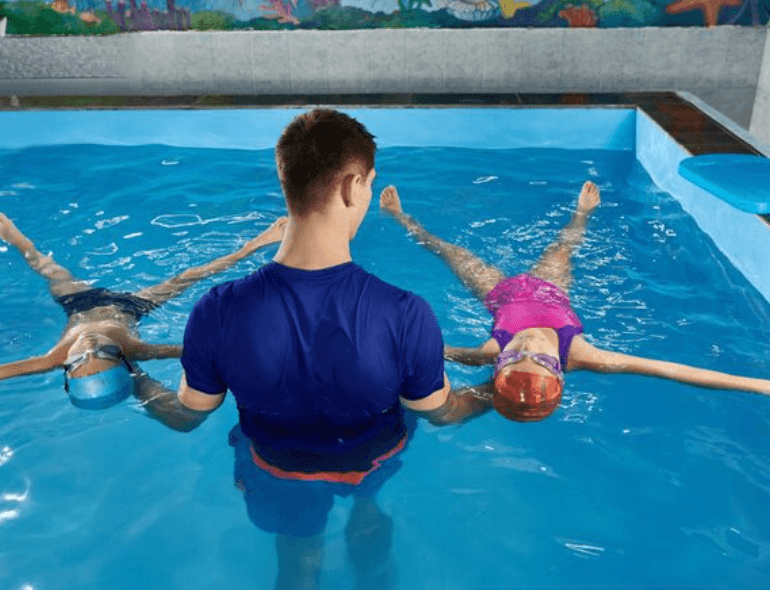
Dozens of times every day, a silent moment occurs in pools all over the world. For the first time, a toddler, perhaps two or three years old, lets go of the pool wall and kicks. Just kicks. And their face changes in some way. It’s not quite a victory. It resembles surprise more. The relationship has completely changed since they didn’t think the water would hold them.
Parents on the sidelines are familiar with that expression. And more and more of those parents made the conscious decision to submerge their kids in the water before signing them up for soccer tryouts, Saturday dance classes, or even before the tennis racket came into contact with a small hand. They agreed that swimming would be the first activity. It’s a decision that’s becoming more widespread, and the reasons behind it are more nuanced than most people realize.
| Founded | 2009 |
| Headquarters | United States |
| Mission | Reduce drowning deaths through education, advocacy, and the promotion of swim lessons as a first life skill |
| Key Initiative | #FirstSport Campaign — promotes swimming as the first sport every child should learn |
| Safety Framework | 5 Layers of Protection: barriers & alarms, supervision, water competency, life jackets, emergency preparedness |
| Endorsed Age to Start | As early as 1 year old (per American Academy of Pediatrics guidelines) |
| Key Statistic | Drowning is the leading cause of accidental death among children ages 1–4 (CDC) |
| Research Highlight | 84% of parents report improved mood in their child after swimming lessons (Swim England, 2025) |
| Official Website | ndpa.org |
It would be dishonest to downplay the importance of safety. Drowning continues to be the most common unintentional cause of death for children between the ages of one and four, according to the Centers for Disease Control and Prevention. After parents read that number for the first time, they usually remember it. The National Drowning Prevention Alliance has focused its entire campaign on this fact, making the urgent case that swimming should be a child’s first sport. Their logic is straightforward: a child’s soccer skills won’t help if they fall into the water. It doesn’t help with dance technique.
It’s interesting to note that parents aren’t persuaded to make the pool their child’s first major commitment based solely on water safety. The body of research on early swimming is more extensive and, in some respects, more unexpected. According to a 2025 study conducted on behalf of Swim England, 84% of parents reported that their kids’ moods had improved following swimming lessons. Almost eight out of ten said their focus and attention span had improved. These observations are not insignificant. Parents are witnessing their children’s progress in real time, poolside, every week. These invisible foundations of learning include concentration, mood, and emotional regulation.
Swimming has always had a strong physical justification. Swimming is a full-body activity that is genuinely difficult to duplicate elsewhere, in contrast to the majority of childhood sports. Every movement increases strength without the joint stress associated with running or jumping on hard surfaces because of the resistance of water.
For years, researchers have been delving into a cognitive aspect. Regular swimmers use bilateral coordination, which is the simultaneous firing of both hemispheres of the brain to control arm and leg movements. Researchers have linked enhanced spatial awareness and early reading skills to this type of cross-body movement. When a toddler splashes in a pool, they are doing more than just exercising. It seems like their brain is working very hard.
Parents who decide to start swimming at a young age feel that they are providing their kids with something that other early activities can’t quite match a realm where development is observable, quantifiable, and intensely personal. There is no opponent to compete against or a teammate to work with in the pool. Only the child and the water are involved. Every tiny skill that is mastered, such as kicking, floating, or turning to breathe, is a compromise between ability and fear.
And that weekly negotiation seems to create something long-lasting. Youngsters who swim frequently possess a certain level of confidence that their parents characterize in nearly identical terms: they are less likely to give up at the first sign of difficulty, more willing to try new things, and more capable of overcoming frustration. It’s still not entirely clear if swimming creates that quality or just draws kids who already possess it. However, the pattern is intriguing because it is consistent enough.
It’s difficult to ignore how swimming serves as a developmental environment in a different way than team sports. During their first football practice, a shy child may blend in with the group and stand on the wing, hoping the ball doesn’t hit them. At their first swimming lesson, a shy child has nowhere to hide and no reason to worry about being judged by their teammates.
That has a peculiar freedom to it. Pitches and courts aren’t always equalizing, but the pool is. One of the most dependable moments in their work, according to educators who have worked with kids for years, is when the scared child finally floats on their back for the first time. Because the water provides the same conditions for all children, it occurs repeatedly.
In this case, parental involvement seems to be very important. Parents are in the water with their children during the early lessons, especially for infants and young children. This creates a different dynamic than dropping a child off at football practice and watching from the sidelines. The songs and games that structured programs incorporate into early sessions, as well as the shared physical experience and eye contact, are not incidental. According to research on early childhood development, attachment and emotional control are strengthened by attentive, involved parenting in unfamiliar settings. It turns out that the pool is a great location for all of that.
All of this does not imply that swimming is without challenges. Money is spent on lessons. There aren’t always pools close by. No amount of zeal can overcome the actual barriers to access that some families face. Due to historically unequal access to lessons and pools, children from lower-income families and members of specific racial groups are disproportionately at risk of drowning, which is why organizations such as the NDPA are motivated. In some ways, the push to make swimming a child’s first talent path is also a covert advocacy for equity, arguing that being able to swim shouldn’t be a privilege.
It’s evident that the parents who prioritize swimming aren’t doing so based solely on calculations. Safety is a concern for some. Some are considering their physical growth. Some parents who have witnessed their child’s anxiety struggles feel that the pool provides a grounding effect that is hard to describe but difficult to ignore.
Some just recall how much they enjoyed the water as kids and want to instill that love in their own children before the fear of submerging their faces takes hold. Regardless of the starting point, they usually come to the same conclusion: that this particular ability, this particular connection with water, is worth putting ahead of the other things vying for a Saturday morning. Some parents used to think that the pool could wait. They’ve been changing their minds more and more.
i) https://ndpa.org/why-swimming-should-be-the-first-sport/
ii) https://www.wiltshire.gov.uk/article/14822/New-research-highlights-the-powerful-benefits-of-swimming-for-children-s-wellbeing
iii) https://www.virginactive.co.uk/blogs/articles/2025/11/05/9-reasons-swimming-is-an-important-life-skill-for-your-child
iv) https://fitnesschamps.com.sg/how-swimming-supports-kids-growth-and-development/