

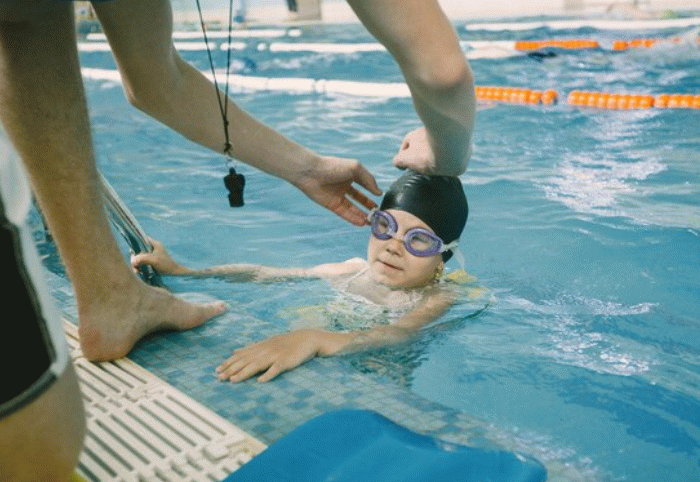
A woman in her late forties stands at the shallow end of a public pool on a soggy Tuesday morning in north London, gripping the rail with both hands. Waist-deep in the water, her instructor is already speaking softly to her. No clipboard, no whistle, and no line of kids passing by on kickboards. The slow process of learning to trust water, a pool, and just two adults.
It’s important to keep an eye out for this kind of scene, which is growing more prevalent throughout the UK. For many years, adult swimming lessons in Britain consisted primarily of a hurried lane at the neighborhood recreation center, an instructor yelling from the side, and a hazy feeling of shame about not being able to do something that most people seem to be able to do by the time they are ten. Something has changed Quietly taking over is a new type of swim program that is kinder, more psychological, and frequently based on methods taken from movement disciplines like the Alexander Technique.
This concept is the foundation of Art of Swimming, a limited liability partnership-run academy in London. They don’t really begin with strokes in the Confidence in the Water course. Breathing, walking in shallow water, and the tiny act of letting your face touch the surface without becoming alarmed are the first steps. You’re in the pool with the coach. No floats have been distributed. You will be met where you are, according to the promise, which is based on more than 25 years of experience teaching adults who never quite learned.
| Field | Details |
|---|---|
| Sector | Adult swimming instruction, confidence and water-safety coaching |
| Primary Region | United Kingdom (London, Brighton, Bristol, Dorset, and beyond) |
| Notable Providers | Art of Swimming Academy, Swim for Tri, Out To Swim, Sport for Confidence, S4 Swim School, Individuality Swimming |
| Approach | Hands-on, mindful, slow-paced instruction — often without floats or kickboards |
| Influential Methods | Shaw Method, Alexander Technique, therapeutic and inclusive coaching models |
| Demographics Served | Adults with aquaphobia, returners, LGBTQ+ swimmers, over-55s, parents, triathletes |
| Industry Recognition | Sport for Confidence won a Swim England National Award for its swimming programme |
It’s difficult to ignore how different this feels from the swimming culture that many adults in Britain were raised in. Anyone over forty probably recalls being thrown into the deep end at school or being told to just relax, which is the exact opposite advice if you’ve ever had a fear of the water. It appears that the new programs are aware of this. In a recreation center in 1995, terms like mindful, sensory, and supportive would have sounded a little absurd.
Dan and Keeley Bullock, siblings, founded Swim for Tri in 2003. Although it is at a slightly different end of the spectrum, it shares a similar overall narrative. Dan is a coach who has worked with thousands of swimmers, including triathletes training for Ironman competitions, and a former British age-group record holder. With thirty years of experience as a teacher, Keeley has developed a specialty in assisting individuals with true water phobia the kind of fear that makes taking a shower seem doable but swimming in a pool seem unachievable. Despite their team’s fifty years of combined experience, a lot of their beginner work still involves simply sitting on the steps and breathing.
Speaking with people in this area of British sport gives me the impression that the nation has finally come to terms with what psychologists and physiotherapists have been saying for a long time: adult learners are not just slow children. They have histories with them. A parent who couldn’t swim and unintentionally transmitted the fear, a teacher who was cruel, and a parent who almost drowned by the sea. These are viewed as the beginning rather than as challenges to be overcome in confidence-based programs.
The growth is more than anecdotal. Sport for Confidence was created with the express purpose of bridging the gap between clinical therapy and regular swimming lessons. It was awarded a Swim England National Award for its efforts. Originally founded by a small group of enterprising swimmers, Out To Swim is an LGBTQ+ aquatics club that has spread from London to Brighton and Bristol. In Dorset and the Midlands, local councils, leisure trusts, and small academies are launching Over 55s Swim 4 Confidence sessions, private one-on-one lessons, and parent-and-baby classes that subtly serve to boost the parent’s confidence.
It’s more difficult to pinpoint the exact cause of all of this. A portion of it is likely the result of the wellness economy doing what it does best repackaging an ancient practice in terms of mindfulness. Water is one of the few places where most adults feel both vulnerable and somewhat free, and part of it is real the pandemic caused many people to reevaluate their relationship with their bodies. The popularity of triathlon has also been beneficial, drawing anxious swimmers in through the back door. You enroll in order to participate in an open-water event at Lake Windermere, but you wind up rediscovering something simpler.
It’s still unclear if this will be a long-term change in swimming instruction in Britain or if it’s just a London-centric phenomenon. Pool closures are still a major issue nationwide. For years, public funding for community swimming has been constrained. The methods which are slower, kinder, and more attentive feel like they should have been in place all along, and the demand appears to be genuine. Seeing a reluctant adult eventually float in the middle of a pool without assistance gives one the impression that perhaps the previous method of instruction was just ineffective for the majority of people, and that someone has finally realized this.
i) https://www.artofswimming.com/confidence-in-the-water/
ii) https://www.swimnow.co.uk/overcoming-water-phobia/build-water-confidence-with-private-swimming-lessons/
iii) https://www.better.org.uk/what-we-offer/lessons-and-courses/swimming
iv) https://www.everydayactivekent.org.uk/activities/over-55s-wellbeing-beginner-swimming-lessons/