

Somewhere around the first warm weekend of the year, when families naturally gravitate toward the water and parks fill up wwimming pools, Lidos and the shore. You realize how complex our relationship with water is when you watch kids splash, scream, and wade deeper than their parents intended. It’s happy. It’s risky Furthermore, far too many kids in the UK have never received adequate instruction on how to handle it.
The blunt statistic that keeps coming up in this discussion is that one in four English children still cannot swim when they graduate from primary school. That figure seems like a failure in a nation with rivers, coasts, and a national curriculum that mandates swimming instruction since 1994. The chaotic aftermath of the pandemic, funding constraints, and years of uneven school provision could all have played a role. Regardless of the reasons, the result is always the same: children entering adolescence lacking a skill that could mean the difference between life and death in some circumstances.
| Key Information: Swimming Education in the UK | |
| Governing Body | Swim England |
| National Curriculum Stage | Key Stage 1 or Key Stage 2 (Primary School) |
| Minimum Swimming Standard | 25 metres unaided by end of Year 6 |
| Required Water Safety Skill | Safe self-rescue techniques |
| Current Gap (England) | 1 in 4 children leave primary school unable to swim |
| Drowning Risk Reduction | Formal lessons reduce drowning risk by up to 88% |
| Recommended Start Age | From 6 weeks (baby classes); structured lessons from age 2 |
| Curriculum Funding | Covered from core school budgets (no ring-fenced PE Premium) |
| Programme Reference | Swim England Learn to Swim Programme (8 Award Stages) |
| Official Reference | www.swimengland.org |
In the UK, drowning is still one of the main causes of unintentional death for children, and the statistics are even more concerning worldwide. Every year, drowning claims the lives of over 235,000 people worldwide. The fact that about 40% of those fatalities involve people who had no intention of entering the water at all someone who slipped close to a riverbank or was caught by an unexpected wave is something that is frequently overlooked. Our perspective on swimming is altered by that context. It becomes more akin to survival literacy and ceases to be a recreational activity.
Formal swimming instruction can lower the risk of drowning by up to 88%, according to research. That statistic is so startling that it is worth restating in simple terms: early, structured instruction significantly lowers a child’s risk of drowning. The Department for Education’s tacit admission that swimming is the only sport included in the national curriculum due to its life-saving aspect and Swim England’s own data support this. Football and gymnastics are not given the same level of seriousness.
However, the system intended to provide this isn’t functioning reliably enough. Before students graduate from Year 6, primary schools in England are legally required to make sure they can swim at least 25 meters and use basic self-rescue techniques.
There is no longer any ring-fenced funding specifically for swimming; instead, headteachers bear the responsibility and the expense comes from core school budgets. Some schools do a good job of handling it. Others are having difficulty, especially in places where the closest pool is a long way away. Whether the existing framework has the teeth to close that one-in-four gap is still up for debate.
The claim that swimming lessons accomplish more than just physical training has gained more attention lately. The #LoveSwimming campaign by Swim England has been collecting parent data over several waves, and an intriguing picture has emerged.
After a swimming lesson, about 84% of parents said their child’s mood had improved. Lessons have helped people feel less stressed or anxious, according to nearly 80% of respondents. Nearly 75% of parents thought swimming had improved their kids’ engagement and preparedness for school. These are significant figures, especially in light of the fact that child mental health is currently one of the most urgent issues in public discourse.
It’s difficult to ignore the similarities between this and what educators and child psychologists have been saying for years: children who engage in structured physical activity, particularly that which calls for listening, following directions, and controlling their fear, develop qualities that go far beyond physical fitness.
Perhaps more than most sports, swimming presents a child with real uncertainty. It’s not familiar with water. It doesn’t act like land. It takes a certain kind of bravery, followed by a certain kind of discipline, to become at ease in it. It seems like more than just a stroke is being learned when you watch kids go through that process, from clinging to the pool’s edge to gliding across it on their own.
The Olympic silver medallist in diving, Leon Taylor, has talked about seeing this in his own son. Ziggy regularly takes swimming lessons, and Taylor has talked about how his son’s confidence in the pool seems to translate into other aspects of his life, making him calmer, more stable, and better equipped to handle the typical pressures of being five years old.
It’s a minor, subjective observation, the larger data appears to support it. Children learn more than just how to swim in the pool. Some of them discover that they are capable of doing challenging tasks there.
Parents and swim instructors frequently revisit the issue of when to begin. Around Year 3 or 4, swimming is officially added to the national curriculum in England for students between the ages of seven and nine. However, the majority of experts in the field advise against waiting until then because doing so would miss a crucial window.
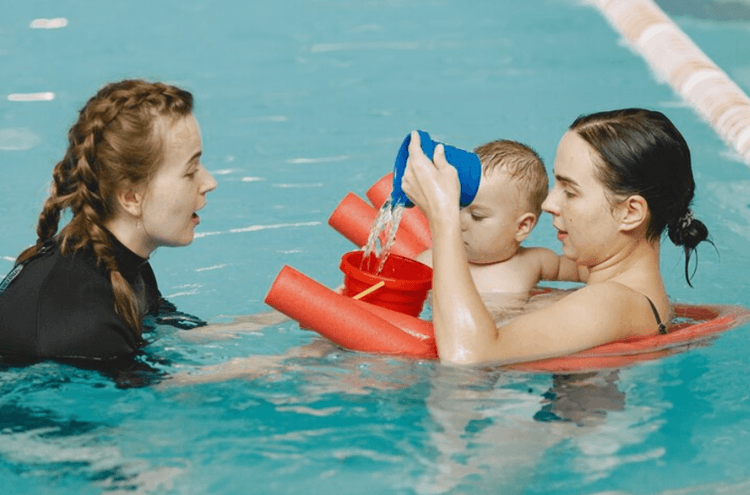
As early as six weeks of age, babies can be introduced to water in sessions that prioritize comfort and bonding over technique. Toddlers between the ages of one and four typically respond to playful, low-pressure situations and naturally absorb water confidence. Many educators contend that the groundwork should be established by the time a child is four years old.
There is a belief that the discrepancy between the curriculum’s recommendations and what child development actually indicates is one of the reasons why so many kids still fall short of the necessary standard when they reach Year 6.
With limited funding and schedules, schools are trying their hardest. However, years of lack of exposure to water cannot be entirely made up for by a few hours spent in the pool during Key Stage 2. Many families are still unable to afford private instruction. It’s both a provision and an access issue, and the two contribute to one another in ways that are genuinely challenging to separate.
The current focus of Swim England is to encourage kids to begin lessons as early as possible and to continue long enough to finish all eight stages of their Learn to Swim Programme the point at which, according to instructors, kids are competent and self-assured enough to handle a variety of water emergencies. Schools, home educators, and local authorities can all sign the Charter that serves as its foundation. The information is released. In theory, the accountability is apparent. The question of whether visibility results in real improvement is quite different.
It’s possible that changing how families view swimming in the early years is more important than curriculum reform. According to the data, the sooner a child develops a relationship with water one that is confident and respectful rather than fearful or overly cautious the better the results are on all fronts. school preparedness, mental health, physical fitness, and safety. Making every child a competitive swimmer isn’t the main argument in favor of swimming lessons. Giving them a chance to survive in a world that is essentially mostly made of water is the goal.
i) https://www.swimming.org/schools/parents-and-pupils
ii) https://thepehub.co.uk/blog/national-curriculum-swimming
iii) https://www.swimnow.co.uk/guide/what-to-expect-from-your-childs-first-swimming-lesson/
iv) https://www.swim.co.uk/blogs/what-is-the-cost-of-not-knowing-how-to-swim/
v) https://www.swimming.org/justswim/swimming-lessons-benefit-children-beyond-pool/