

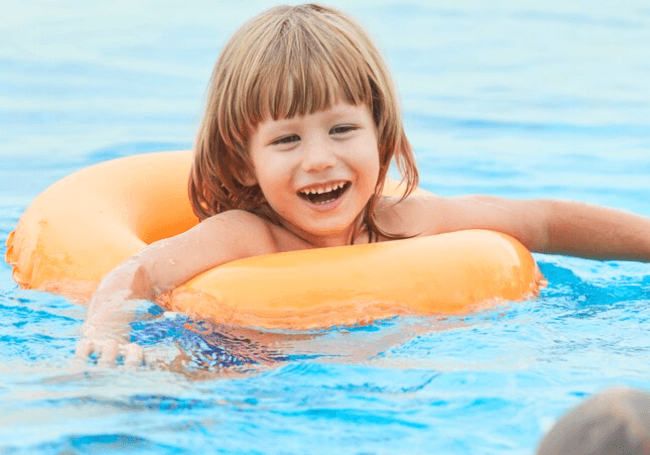
A Saturday morning at a public pool has a certain sound. Before a tiny body kicks off the wall, there are whistles, splashes, and the muffled echo of an instructor counting to three. With their phones half-raised and half-forgotten, parents lean against the viewing gallery railing. A four-year-old who was clinging to the pool’s edge six weeks prior lets go for a full two seconds before grabbing on again. Two seconds. It sounds insignificant. However, parents talk about that child’s expression for the remainder of the week.
New research from Swim England’s #LoveSwimming campaign has been attempting to quantify that moment, which is silently repeated across thousands of pools. Additionally, the numbers are louder than you might anticipate. After a lesson, 84% of parents report that their child’s mood improves. Nearly 80% of working parents say swimming has helped their kids feel less stressed or anxious. About the same percentage report that their child’s focus at school has improved. The numbers may sound a little too convenient, as campaign data occasionally does. Even without a chart, the trend is evident to anyone who has witnessed a reluctant child transform into a child who rushes to the changing rooms.
The speed at which the shift occurs is intriguing. More than most childhood activities, swimming provides a child with tiny, quantifiable victories nearly every week. The face submerges first. Next, a float. Then an unassisted kick across the shallow end. Even though each step is tiny, it represents a tiny renegotiation of the child’s self-perception. That kind of progression is not readily apparent on a football field. Math homework doesn’t either. Coaches believe that the pool is one of the few locations where a child can witness, in real time, the outcome of trying again.
| Topic | Details |
|---|---|
| Subject | Swimming lessons and child confidence development |
| Key Research | Swim England #LoveSwimming Campaign, Wave 16 |
| Notable Voice | Leon Taylor, Olympic silver medallist (Athens, diving) |
| Key Finding | 84% of parents report improved mood after lessons |
| Classroom Impact | Nearly 8 in 10 parents note better concentration |
| Recommended Age | As early as possible |
In recent interviews, former Olympic diver Leon Taylor—who won silver in Athens—has discussed this, sounding more like a father than an athlete. He has talked about how being in the water gives his five-year-old son Ziggy a sense of calm that permeates everything. bringing it to class. transferring it to novel social contexts. When it appears at the breakfast table on a Monday morning, parents seem to recognize this soft, difficult-to-measure quality right away.
Swimming appears to accomplish this task more quickly than other activities, which is most likely due to discomfort. A child’s natural habitat is not water. They must learn to trust a body that behaves differently than it does on land, breathe differently, and balance differently. No matter how minor the initial fear was, conquering it leaves a lasting impression. For many years, researchers studying young children’s aquatic readiness have observed that emotional development and water proficiency coexist in ways that gym classes just cannot match. Along the way, you discover something about yourself while learning the pool.
It’s also difficult to ignore how much of the advantage stems from the way the lesson is structured. In essence, a thirty-minute swimming class is an exercise in listening, obeying directions, waiting your turn at the wall, and trying something that didn’t work the week before. Teachers witness children adopt routines that they find difficult in other areas of their lives. According to Alex Barrett, Senior Technical Aquatics Manager at Swim England, swimming instructors witness this every day: kids emerge from the pool slightly happier, sharper, and more eager to try the next challenging activity.
None of this is automatic, of course. If a child is forced to attend classes against their will or is pushed too quickly, they may leave feeling the opposite of confident. Good teachers are aware of this. Since the objective isn’t to create a swimmer, they develop progress gradually—sometimes tediously slowly from a parent’s perspective. It’s to create a child who thinks they can manage water. Almost like a side effect, the swimmer arrives later.
If you’re concentrating on technique, it’s easy to overlook the social aspect. Children observe one another during group lessons. When someone eventually completes a length, they applaud. When someone belly-flops, they laugh. They learn to wait, share lane space, and take turns. These are modest, everyday social skills, but they build up in ways that manifest in playgrounds and classrooms. Teachers have long noted that children who regularly swim have a tendency to settle into group projects more easily. It’s still unclear if the pool is the cause of that or if it just correlates with families that value activity and routine. Most likely, both are accurate.
The openness with which parents are making the connections in this most recent wave of research feels novel. They’re not merely claiming that their children can swim. They claim that their children are more focused, calmer, and prepared for school. The safety-first message that swimming has historically relied on is not the same as that type of testimonial. Preventing drowning will always be important and ought to be. However, it’s obvious that families are now seeing something different in the water—something more akin to therapy than athletics.
Even if no one in the building has read the research, you can tell that the lessons are doing exactly what it says when you watch children leave a swim school on a winter evening, their cheeks pink, their hair wet, and their large kit bags in tow. The campaign’s core message is straightforward: start earlier than you think you should. Parents can find lessons at poolfinder. The confidence appears more quickly than anyone anticipates, and once it does, it usually lasts.
i) https://www.everyoneactive.com/content-hub/swimminglessons/how-learning-to-swim-improves-your-childs-confidence/
ii) https://www.waterbabies.co.uk/swimming-in-early-childhood
iii) https://www.wiltshire.gov.uk/article/14822/New-research-highlights-the-powerful-benefits-of-swimming-for-children-s-wellbeing
iv) https://individualityswimmingandfitness.co.uk/benefits-of-kids-swimming-lessons-boost-your-childs-confidence/
v) https://thegreenparent.co.uk/5-ways-to-boost-water-confidence-for-kids/