

You usually ignore it the first time you truly notice it. Suddenly quiet, knee-deep in a yellow plastic tub, pouring water from one cup into another with the concentration of a chemist, is a toddler who spent the morning in full meltdown mode. She was not taught how to do this.
Nobody offered her a prize. Nothing you’ve said for the past hour has been able to change her mood; she’s just there, hands wet, totally engrossed. Parents seldom discuss this despite seeing it frequently. Water seems to have an effect on young children that other materials don’t, and this feeling is frequently unsaid. It soothes them. They are drawn to it.
| Field | Detail |
|---|---|
| Subject | Water Play and Childhood Emotional Development |
| Field of Study | Early Childhood Education, Developmental Psychology |
| Notable Practitioners | Vortex International (Splashpad® designer, 25+ years) |
| Recognized Frameworks | EYFS (UK), Montessori Early Years, Reggio Emilia |
| Core Skills Built | Emotional regulation, empathy, turn-taking, sensory processing, motor coordination |
| Recommended Age Range | 18 months to 8 years (with adaptations beyond) |
| Notable Research | Frontiers in Psychology systematic review (2025) on play and emotional intelligence in children aged 3–7 |
It alters an afternoon’s mood. This was classified as folk wisdom for many years, similar to what grandmothers would say. Researchers are now beginning to take it more seriously. Additionally, their findings point to water play as one of our more effective ways to deliver emotional intelligence. At the rear of the garden, hiding in plain sight.
The term “emotional intelligence” is ambiguous. It is used by psychologists to characterize a group of skills, roughly speaking: recognizing your emotions, labeling them, controlling them, and perceiving the same in others. Pretend play and outdoor play were found to have particularly strong effects on emotional symptoms and resilience in a 2025 systematic review of play in children aged three to seven that was published in Frontiers in Psychology.
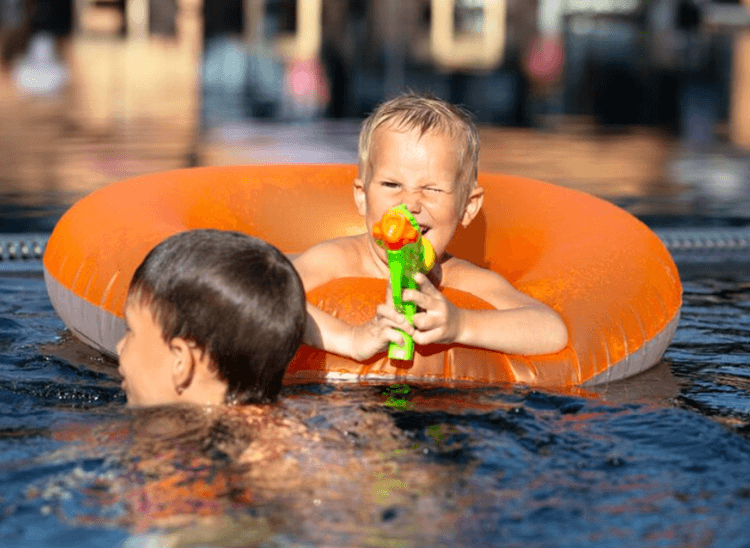
At the nexus of those two categories is water play. A kid with a hose isn’t just splattering. She is negotiating, telling stories, arguing, and occasionally comforting a younger sibling who was squirted in the eye. Water doesn’t fight back or impose a script, which makes it exceptionally well-suited for this work. There is only one way to solve a puzzle. There are rules in a board game.
There is none of that in water. It holds any shape you give it, moves where you push it, and rewards experimentation right away. That mix of control and unpredictability is nearly perfect for a child whose nervous system is still developing self-regulation.
It is soothing to repeat. The small surprises maintain interest. It’s similar to what adults aim to accomplish with mindfulness applications, but a five-year-old doesn’t need to be reminded to breathe.
Teachers have long observed that water tables are more often used as quiet workshops than as play areas, especially in Montessori and EYFS classrooms. See what happens when two kids share one. In the first five minutes, there is almost always a conflict because someone splashes too forcefully. The funnel is desired by someone. Most of the time. Without the involvement of an adult, a feasible peace is negotiated.
The emotional learning occurs during that negotiation. Youngsters are learning how to read frustration in other people’s faces and how to control it in their own bodies in real time. The stakes are low. The water is unconcerned. The practice is made possible by that low pressure. All of this has a physical component as well, which should not be disregarded.
Applying cold water to the wrists causes a vagal response that actually lowers heart rate. Muscle tension is released in a bath with warm water. Long before they have the vocabulary to do so, children figure these things out.
A 7 years old will tell you that the pool is enjoyable if you ask her why. She may be referring to the fact that her body feels different there looser, slower, and less like the wound spring it occasionally is on land. Those associations develop into a tool she can use over the course of months and years. Are you feeling overburdened? Run through the sprinkler system. It sounds oversimplified. It appears to be effective as well. Any absorbing activity would do the same, according to skeptics. Sand, clay, and finger paint are all visually appealing.
That’s reasonable, and there is no evidence in the research that water is particularly magical. Fluidity, sound, temperature, and reflectivity all work together in a way that activates multiple channels simultaneously. When a child watches ripples spread, they are simultaneously processing tactile, auditory, and visual information.
The nervous system appears to be calmed by that type of multisensory immersion in ways that single-channel activities don’t quite match. Research is still ongoing to determine whether that results in quantifiably higher emotional intelligence over time. The early indicators are positive. Vortex International, with its Splashpads, is one of the businesses and educators that have centered their work around this. Early childhood Montessori programs. In the UK, the EYFS framework frequently refers to water play as a type of social architecture.
If the area is well-designed, kids will almost automatically form cooperative groups. Toddlers continue to play in parallel, happy with each other. Older children create rules, assign roles, debate them, and make revisions. This isn’t engineered at all. It simply keeps coming up near water. Observing all of this, it’s difficult to get rid of the feeling that we’ve been overcomplicating child development. A curriculum is not necessary for every emotional skill. Some of them require time, a hot afternoon, and a hose. Most of the time, the children will figure out the rest on their own.
i) https://www.vortex-intl.com/blog/benefits-of-water-play-for-child-development
ii) https://kiddiegarden.com.au/benefits-of-water-play/
iii) https://www.busybees.edu.au/the-benefits-of-water-play-for-childhood-development-2/
iv) https://www.radkidsusa.com/blogs/radkids/developmentalbenefitsofwaterplay