

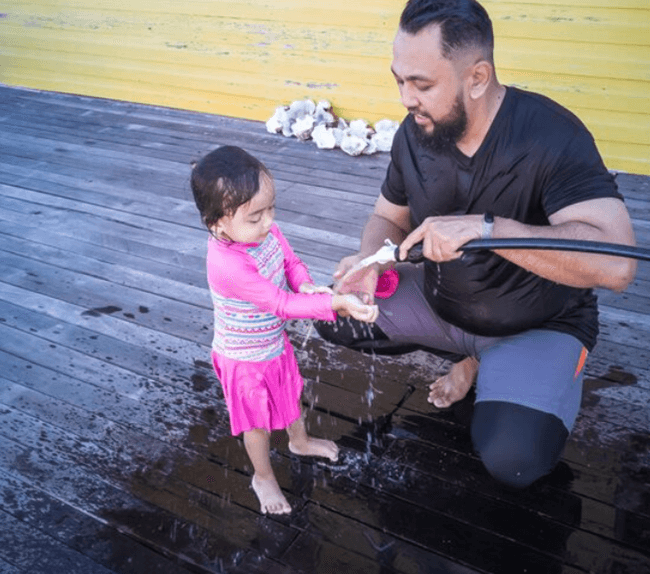
Few other materials can capture children’s attention like water does. Something simpler and older, rather than screens with prompts or toys with instructions. After rain, a puddle. An afternoon in the heat in a plastic tub. A sink was left running for a bit longer than normal.
For decades, researchers have been attempting to explain why young children seem to unlock something through water play. Although the language sensory integration, divergent thinking, and cognitive flexibility is formal, the scenes are everyday. A youngster moving water between mismatched containers. another observing the collisions and shape changes of ripples. Another person telling the story of a whole made-up world in which floating leaves are transformed into boats.
| Key Context | Details |
|---|---|
| Core activity | Open-ended water play (pouring, splashing, channeling, experimenting) |
| Age range most studied | Early childhood (approximately ages 1–7) |
| Primary developmental links | Creativity, imagination, problem-solving, motor skills, emotional regulation |
| Typical settings | Homes, early learning centers, playgrounds, outdoor spaces |
| Safety baseline | Continuous adult supervision; shallow water only |
What’s striking is how little guidance water needs. It comes with no agenda, unlike craft kits or puzzles. The purpose is decided by the children. It’s a river one minute, soup the next, and then all of a sudden it’s a slightly botched science experiment.
Children who find it difficult to interact with others tend to spend the most time at water tables, according to early childhood educators. They don’t hurry. They do things again. By changing the speed of a pour or the angle of a jug, they experiment with minor changes. Instead of being mindless, this repetition is where original ideas start to emerge.
Children’s creativity doesn’t immediately manifest as originality. Persistence is how it manifests. as an interest. as being open to asking “what if” questions without expecting a prompt response. Water can handle this type of thinking. Incorrect use does not cause it to break.
Additionally, it has a physical component. Hands are occupied. The arms move. shifts in balance. The body engages in thought processes. Due in part to the fact that children aren’t distinguishing between thought and action, studies have linked this type of embodied play to greater imaginative capacity. Concepts are put to the test right away.
Children create their own rules if you pay close attention. It only fills this cup halfway. It must not leak that dam. The blue thing cannot float, but the red one can. These private systems change rapidly, frequently being abandoned and then rebuilt a few minutes later. That adaptability is what makes creative thinking what it is.
Water play also encourages storytelling. Youngsters converse with themselves as they play, explaining cause and effect, giving objects roles, and practicing words they have heard in other contexts. Seldom are the stories linear. They bounce. They contradict one another. They don’t have to make sense to the audience.
Group environments foster social creativity. Kids negotiate ideas, tools, and space. The river of one child turns into the barrier of another. Without adult assistance, conflicts develop and end. Disagreements appear to be lessened by the common interest in water, providing everyone with a neutral point of reference.
Once, I saw a normally cautious child stay ten minutes longer than everyone else, totally engrossed in using a bent piece of cardboard to redirect a trickle of water.
Creativity thrives in settings where failure carries no consequences, according to experts. Water offers that security. Nothing gets destroyed by spills. Errors disappear as fast as they happen. It is more important than it may seem to be able to fail silently, repeatedly, and without being corrected.
It’s easy to ignore the emotional component as well. Sometimes in the same session, water can energize or soothe. Tensed children tend to settle into rhythmic motions. Others laugh and splash to release pent-up energy. Creativity tends to develop alongside emotional control.
Importantly, water play does not adapt to adult optimization. It is not possible to “level up.” The finished product is not available for display. Some adults, particularly those who have been trained to seek out quantifiable progress, are frustrated by this lack of results. However, it’s precisely this lack of structure that makes room for creativity.
Increased neural connectivity has been associated with open-ended sensory play by neuroscientists who study early development. In other words, when kids explore freely, their brains create more connections. Because of its shifting characteristics, water provides infinite variation without requiring replacement.
The most inventive water play arrangements are frequently made on the spot at home. On the kitchen floor, a bowl. ancient measuring cups. A sponge that has experienced better times. Kids hardly ever ask for more. They beg for time.
Safety is a concern, of course. It is impossible to compromise on shallow water, ongoing supervision, and distinct boundaries. However, restraint is helpful within those parameters. The urge to demonstrate or correct can interrupt the very thinking adults hope to encourage.
Instead of treating water as a special occasion, educators are increasingly treating it as a fundamental component of outdoor learning spaces. Hand pumps, basins, and integrated channels all encourage daily interaction. What comes out isn’t more flamboyant or louder. It’s more stable.
Permission appears to be the most valuable thing that water play offers. Allow me to stay. To reiterate. to alter one’s opinion. to pursue a notion without knowing where it will lead. It is a rare and valuable permission for children.
In an increasingly regimented and monitored childhood, water stubbornly doesn’t care about productivity. What kids learn from it doesn’t matter to it. And it could be precisely because of that apathy that creativity consistently appears there.