

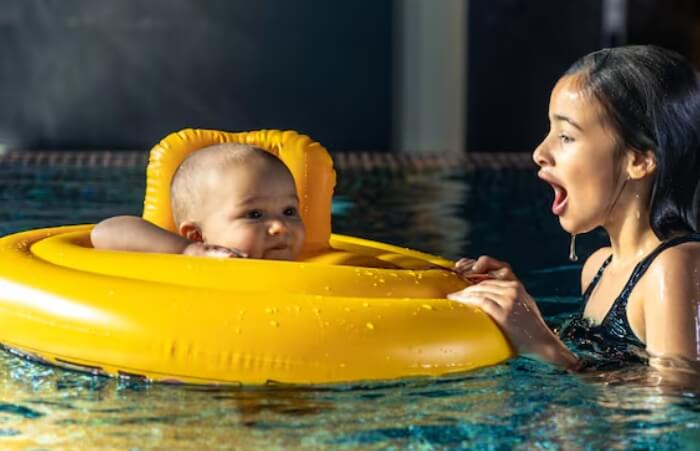
The kids aren’t the first thing you notice when you walk into a small indoor swim school in Hampshire on a Tuesday afternoon. The temperature is the cause. Pushchairs line the wall like cars at a school gate, and the air is slightly thick, almost tropical, and slightly chlorinated. A young child clings to her father’s neck while wearing a yellow swim diaper. A teacup is raised in a slow salute by an elderly resident somewhere behind the glass. This is Rusalka, also known as Happy Splash, one of dozens of tiny businesses that are subtly changing the way kids in Britain learn to swim.
The local recreation center was the standard in this nation for many years. loud, reverberating, and frequently a little too chilly. Parents went because that’s what they did. Something has changed, and it is no longer subtle. It was hinted at quite clearly in the STA’s recent survey on family swimming habits, which noted that only a small percentage of lessons now take place through purely public provision. The remainder increasingly attend private indoor schools. The migration is real, but it’s happening slowly.
| Quick Reference | Details |
|---|---|
| Topic | Indoor Swim Schools in the UK |
| Typical Starting Age | 3 months and upwards |
| Common Class Ratio | 6:1 (juniors), 8:1 (babies) |
| Average Lesson Length | 30 minutes |
| Average Price Range | £9.50 – £18 per session (group vs. 1:1) |
| Governing Programme | Swim England framework |
| Industry Insight | STA survey notes a clear shift toward private swim schools |
As soon as you stand by the pool, you can see part of its appeal. Indoor swim schools typically have a maximum of five or six students per teacher and operate in a boutique-style manner. Compare that to a council class, where one teacher makes a valiant effort to control eight or nine tiny bodies that bob around. The smaller pool is simply favored by the math. Parents take notice. They converse. Waiting lists start to grow into months as word gets out in WhatsApp groups and at the school gates.
And there is the actual water. The temperature of a hydrotherapy pool, such as the one Happy Splash operates in a care facility in Nottinghamshire, is approximately 32 degrees. For a three-month-old whose body temperature drops more quickly than an adult’s, that is a far cry from the typical 28-degree municipal pool. It’s the reason a baby won’t cry for twenty minutes instead of remaining composed enough to learn something.
It’s difficult to ignore how frequently these schools’ founders come from unusual backgrounds. Happy Splash’s creator is a former member of the special forces and a national swimmer. Rusalka, which has been operated by the same family for twenty years, opened a second specially constructed pool in 2014 after demand exceeded the capacity of one location. These chains have identities. They feel more like little bakeries than commercial establishments, which adds to their allure and most likely influences their pricing.
For what it’s worth, the price is in an odd middle ground. A 30-minute group lesson is reasonably priced at about £9.50. A £18 one-to-one is neither inexpensive nor ostentatious. It almost seems like a good deal when compared to private piano lessons or even soft play visits in central London. It’s unclear if this will continue as energy costs put pressure on small businesses, and some owners believe the next two years will be financially challenging.
You begin to comprehend the emotional pull when you watch a Dippers class taught by Better, the biggest provider of newborn lessons in the UK. Parents and their infants in the water. A teacher is leading the verses while singing a little off-key. In the corner, a grandmother is mouthing the words because she managed to complete the lesson this week. This is a bonding experience that has more to do with the shared strangeness of being submerged in warm water with someone you love before lunch than it does with technique.
The unglamorous foundation of it all is water safety. Every respectable indoor school incorporates it from the beginning, in part because Swim England’s framework mandates it and in part because, to be honest, drowning is still one of the main causes of unintentional death for young children. After reading brochures full of corporate softness, parents appreciate the straightforward language used by schools like Rusalka when they discuss making kids “drownproof” as early as possible.
Of course, there are uncertainties. Contrary to popular belief, indoor swim schools are not subject to strict regulations. There are differences in quality. Parents don’t always know what to look for, and some operators rely on warm pools and inadequate instruction. The good ones those with instructors who have been DBS-checked, Level 2 qualifications, and a clear sense of pride in their work tend to stand out fast. The bad ones usually don’t last.
It is evident that children’s swimming is no longer restricted to public pools. The industry has not yet provided an honest response to the question of whether that is beneficial for the nation or if it subtly deprives lower-income families of a necessary life skill. But for now, the waiting lists are lengthy, the warm pools are full, and somewhere in Sutton-in-Ashfield, a room full of elderly people sipping tea are applauding a small girl. It’s a very British scene. It might also be the future.
i) https://www.better.org.uk/what-we-offer/lessons-and-courses/swimming/baby-parent
ii) https://www.seriouslyfun.net/swimming-lessons-slough-teikyo-japanese-school/
iii) https://www.sta.co.uk/news/2025/05/16/sta-survey-reveals-parents-priorities-and-concerns-around-learning-to-swim/
iv) http://brightwaterswimschool.co.uk/2025/09/11/how-parents-can-support-swimming-lessons/